Dr Freddie Hong
- Tutor (Research)
- Design Products MA/MDes
Freddie is an artist and researcher working at the intersection of art and technology, and at either end, expert in building and exhibiting interactive installations.
Dr Freddie Hong is an artist and researcher working across human-AI interaction, robotics and spatial computing. Since completing his PhD at Imperial College London, he has worked collaboratively across academia and industry, including as a robotics researcher at Microsoft Research Cambridge, publishing in flagship venues such as Nature, CHI and ICRA.
His art is a more personal inquiry into what it means to be human in an increasingly automated world. His installations have been shown at Ars Electronica, ISEA and the London Festival of Architecture.
Key details
School, Centre or Area
Expertise
More information
Research interests
Freddie's research explores how encounters with computers and intelligent machines influence human perception and relationships.
In robotics, he designs custom hardware, prototype control systems and end-effectors for specialist applications.
In spatial computing, he uses motion tracking and real-time sensing, both vision-based and non-vision-based, for participatory performance and navigation.
His fabrication research makes hardware more accessible, developing open-source multi-axis 3D printing and conformal 3D-printed electronics.
Practice
Freddie's artistic practice spans interactive installation, kinetic sculpture and performance. Using emotion recognition and generative AI, his works invite audiences to notice how machines read and respond to them.
His key work, Algorithms in Reflection, has been shown in London, Seoul and Portugal. Working independently and collaboratively, he has created public installations for the London Festival of Architecture, Gwangju Design Biennale, Venice Glass Week and Ars Electronica Future Lab.
He previously worked as an architectural designer at Asif Khan Studio, contributing computational design to the Hyundai Pavilion at the 2018 Winter Olympics, Dubai Expo 2020 and the Museum of London redevelopment.
Research funding
Co-Investigator, Sounding Bodies, XR Network+ Future Live Fan Experiences R&D Challenge, EPSRC (2026–27)
Collaborator, Drawing Lines, RCA RKE Vis Lab Fund (2026)
Air Teaching: Vision-Based Gesture Programming for Collaborative Robots, Kingston University Cross-KERI Collaboration Fund (2025–26)
Robotic End-Effectors for Deformable Objects, Kingston University Design, Arts and Creative Practice (DACP) Fund (2025–26)
Current and recent research projects
Sounding Bodies (2026–27)
An immersive, responsive environment for participatory classical music performance, using real-time motion tracking to link movement, sound and image. Freddie is Co-Investigator with Dr Ali Mohammed (RCA), in partnership with Kingston School of Art and ARCO–Music for All. Funded by XR Network+ (EPSRC).
Drawing Lines (2026)
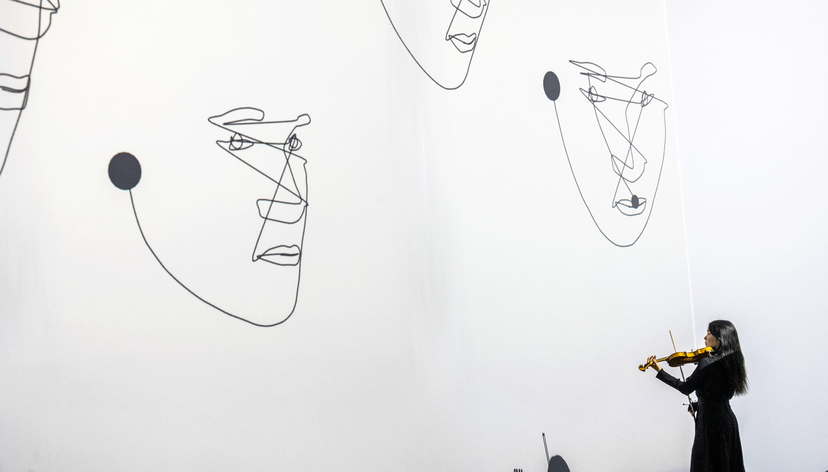
A live performance in which a dancer and a violinist improvise with technology. Motion tracking turns movement into drawn lines while AI improvisation software responds with sound and image, asking where to draw the line between human expression and machine representation. Created with Giacomo Pini, Sue In Kang and Ali Mohammed, it premiered at the RCA's Immersive Arts Symposium.
Algorithms in Reflection (2023–25)
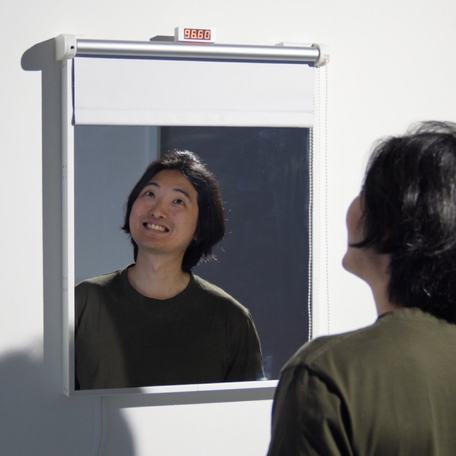
Two interactive mirrors that reveal the viewer's reflection only while they hold an emotion: happiness in one, sadness in the other. An offline neural network reads facial expression and drives a motorised blind. The work explores being unseen by automated systems, and how emotion performed for AI differs from emotion in social life.
Datacentre Robotics and Project Silica (2022–25)
At Microsoft Research Cambridge, Freddie designed robotic systems for Project Silica, which stores archival cloud data in glass, and for wider datacentre automation. Outputs include the RASCAL storage robot and four patent filings.
Open5x (2021–23)
An open-source system that converts a desktop 3D printer into a 5-axis machine, with a conformal slicer for printing curved electrical traces. Developed during his PhD at Imperial College London with David Boyle, Connor Myant and Steve Hodges.
Publications, exhibitions, other outcomes
Publications
Microsoft Research Project Silica Team (incl. Hong, F.) (2026). Laser Writing in Glass for Dense, Fast and Efficient Archival Data Storage. Nature, 650, pp. 606-612.
Hong, F. et al. (2024). Self-maintaining [Networked] Systems: The Rise of Datacenter Robotics. In: Proceedings of the 23rd ACM Workshop on Hot Topics in Networks (HotNets '24).
Black, R., Caballero, M., Chatzieleftheriou, A., Deegan, T., Heard, P., Hong, F., Joyce, R., Legtchenko, S., Rowstron, A., Smith, A., Sweeney, D. and Williams, H. (2024). RASCAL: A Scalable, High-redundancy Robot for Automated Storage and Retrieval Systems. In: 2024 IEEE International Conference on Robotics and Automation (ICRA).
Microsoft Research Project Silica Team (incl. Hong, F.) (2023). Project Silica: Towards Sustainable Cloud Archival Storage in Glass. In: Proceedings of the 29th ACM Symposium on Operating Systems Principles (SOSP).
Hong, F., Lampret, B., Myant, C., Hodges, S. and Boyle, D.E. (2023). 5-Axis Multi-Material 3D Printing of Curved Electrical Traces. Additive Manufacturing, 70, 103546.
Hong, F. (2023). Multi-Axis and Multi-Material Additive Manufacturing of Electrical Traces. PhD thesis. Imperial College London.
Hong, F., Tendera, L., Myant, C. and Boyle, D.E. (2022). Vacuum-Formed 3D Printed Electronics: Fabrication of Thin, Rigid and Free-Form Interactive Surfaces. SN Computer Science, 3(4), 275.
Hong, F., Hodges, S., Myant, C. and Boyle, D.E. (2022). Open5x: Accessible 5-Axis 3D Printing and Conformal Slicing. In: Extended Abstracts of the 2022 CHI Conference on Human Factors in Computing Systems (CHI EA '22).
Hong, F., Myant, C. and Boyle, D.E. (2021). Thermoformed Circuit Boards: Fabrication of Highly Conductive Freeform 3D Printed Circuit Boards with Heat Bending. In: Proceedings of the 2021 CHI Conference on Human Factors in Computing Systems (CHI '21).
Hong, F. (2019). SURFACE: Xbox Controlled Hot-wire Foam Cutter. In: ACM/EG Expressive Symposium: Posters, Demos and Artworks.
Exhibitions
(2026) Hello World! Ars Electronica Future Lab. Linz, Austria.
(2026) Arts in Robotics. IEEE International Conference on Robotics and Automation (ICRA). Vienna.
(2025) Algorithms in Reflection. Periphera, Trafaria Digital Art Festival. Trafaria, Portugal.
(2025) Algorithms in Reflection. 30th International Symposium on Electronic Art (ISEA). Seoul.
(2024) Algorithms in Reflection. Peckham Digital Festival, The Hub. London.
(2023) Logitech MX Mind Gallery. Salon am Moritzplatz. Berlin.
(2023) Simple Steps Towards a Happier Space and PLAY! London Festival of Architecture, Studio Egret West. London.
(2022) Entangled. Trinity Laban Conservatoire of Music and Dance. London.
(2022) InterPlaces. Wabash Valley Art Spaces. Terre Haute, USA.
(2022) Open5x. Formnext. Frankfurt, Germany.
(2022) Sonic Scenery. The House of Macan, Porsche Korea. Seoul.
(2021) Sonic Scenery. Gwangju Design Biennale. Gwangju, South Korea.
(2021) Diffusion. Sinchon Theatre. Seoul.
(2020) Bonner Road. Sinchon Theatre. Seoul.
(2019) Surface. Bath Open Art Prize, Fringe Arts Bath, 44AD Artspace. Bath, UK.
(2019) Generative Chronicles. Expressive 2019, Casa Paganini. Genoa, Italy.
(2019) (Anti) Voice Loop. St James Hatcham. London.
(2018) Butterfly Effect: Voices of Korean Artists. OXO Bargehouse. London.
External collaborations
- (2026) Resident Artist, Cerfav, France (with Richard Meitner)
- (2022–24) Skills Tutor, MArch Design for Performance and Interaction, UCL
- (2022) Associate Chair, Works-in-Progress Programme Committee, ACM TEI
- (2021) Speaker and Panellist, HCI Korea
- (Ongoing) Peer Reviewer, ACM CHI, IEEE ICRA and Additive Manufacturing