superFUTURES: Understory
Jump to
Borrowed from forest ecology, Understory asks what grows beneath dominant systems: how socio-spatial acts of (dis)obedience enable new ways of living to emerge.
Working alongside Royal Botanic Gardens Kew, Territory Studio and Dark Matter Labs, 2026/27 sees superFUTURES explore acts of dissent and resistance in everyday systems and forms of knowledge. Working with trans-disciplinary experts we consider how alternative forms of organisation and spatial co-existence might be possible between people and more-than-human ecologies. Students study contemporary acts of refusal and survival to develop future imaginaries through film and 1:1 artefacts.
In ecological terms the forest understory is the layer of life that exists beneath the main forest canopy but above the forest floor. Understory describes a spatial condition in which marginal, interdependent and often invisible forms of life and organisation become sites of knowledge, resistance and collective survival.
The project will draw on Holloway’s understanding of resistance through everyday acts (4), Harney and Moten’s conception of the undercommons as a space of collective study and refusal (5), as well as abolitionist queer approaches to survival, care and transformation (6). Creating the conditions for students to question dominant assumptions, we will ask how space can be felt, experienced, rehearsed. Students will explore how spatial design might reveal hidden infrastructures to cultivate a multi-species commons.
Looking to the Whole Earth Catalog’s proposition of accessible tools for self-education and alternative forms of living (1), Tsing’s account of collaboration and survival within precarious ecologies (2), and Kimmerer’s understanding of reciprocity between humans and the more-than-human world (3), students explore the understory as a space of interdependence, knowledge and collective survival.
Through mapping, drawing, making, film and spatial experimentation, students will construct an ‘understory’ of their own; a speculative environment where new and hopeful ways of living, learning, caring and organising can take root.
- Brand, S. (ed.) (1968). Whole Earth Catalog: Access to Tools. Menlo Park, CA: Portola Institute. The first issue was published in 1968, with the Whole Earth Catalog subsequently appearing in multiple editions.
- Tsing, A.L. (2015). The Mushroom at the End of the World: On the Possibility of Life in Capitalist Ruins. Princeton, NJ: Princeton University Press.
- Kimmerer, R.W. (2013). Braiding Sweetgrass: Indigenous Wisdom, Scientific Knowledge and the Teachings of Plants. Minneapolis, MN: Milkweed Editions.
- Holloway, J. (2010). Crack Capitalism. London: Pluto Press.
- Harney, S. and Moten, F. (2013). The Undercommons: Fugitive Planning & Black Study. Wivenhoe: Minor Compositions.
- Branson, S., Hudson, R. and Reed, B. (eds.) (2023). Surviving the Future: Abolitionist Queer Strategies. Oakland, CA: PM Press.
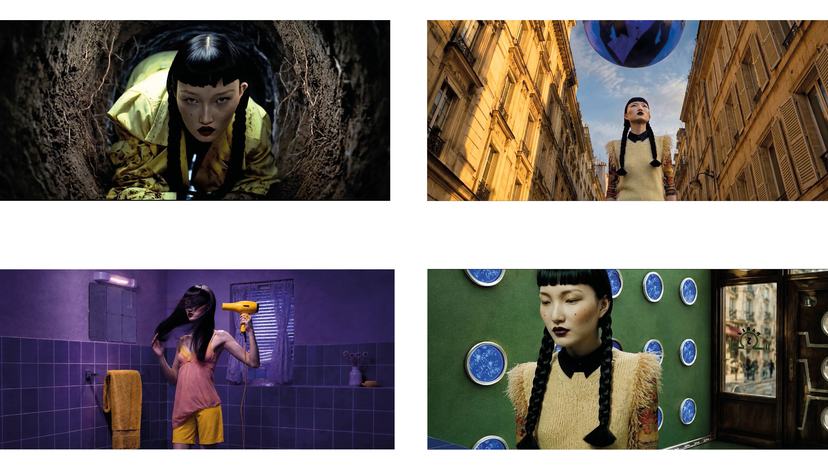
404 unfound by Seyoung Lee
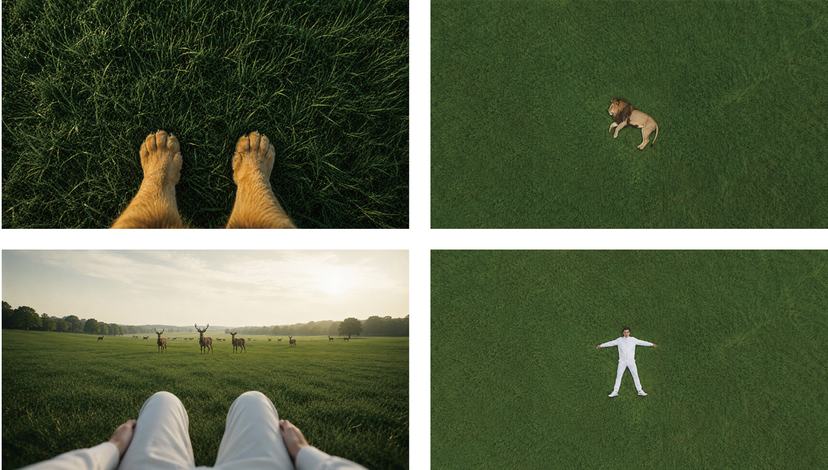
Depoil by Jiale Zhang
About superFUTURES
We do not design interiors. We design worlds and we design stories; where spaces and species collide in unique and innovative ways. For us, ‘the interior’ is many things - research, language, process, ingredient, catalyst but it is not our outcome, or product, or object.
We bring futures close enough to be felt, not just imagined. Because facts alone do not change behaviours. Only emotions can do that.
Film is our method for doing this: exploring alternatives, imagining other ways of being, questioning the role of the built environment in futures yet to come. This is a critical positioning of the discipline: don’t ask how to do it, ask why to do it. In doing so, we stretch a well-worn field, asking it the questions it has never had to face.


