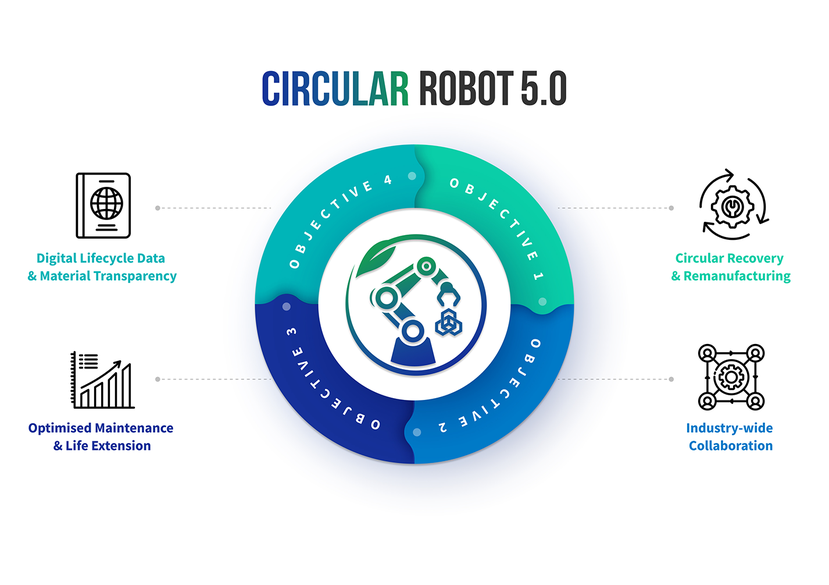
Circular Robot 5.0 advances a new paradigm for industrial robotics by combining AI-driven predictive maintenance, blockchain-enabled traceability, and life-cycle intelligence to maximise robot longevity and recover critical materials through remanufacturing and recycling, laying the foundations for a truly circular robotics economy.
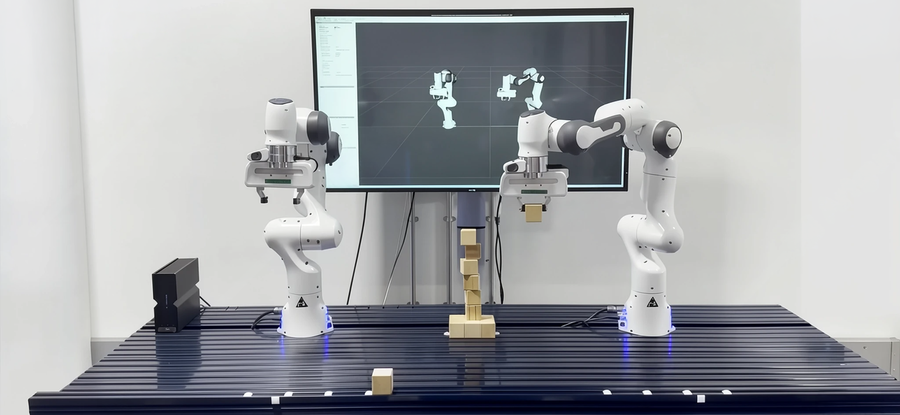
At a glance
- A 3-year EPSRC-funded research project (EP/Z534262/1) integrating AI-driven predictive maintenance, blockchain-backed Digital Product Passports, Digital Twin simulation, and Life Cycle Assessment / Costing models within a single architecture.
- Led by the Royal College of Art, the consortium brings together leading researchers from Loughborough University, King’s College London, University College London, and Manufacturing Technology Centre, alongside industrial partners including NVIDIA, Omron Electronics, ASTM International, Amentum, Katlas Technology Ltd., and Wootzano Ltd.
- Aims to prolong operational life, enable remanufacturing and recovery of Critical Raw Materials, and develop a proactive, data-driven lifecycle approach to industrial robotics.
Key details
Gallery
More information
The challenge
As the UK accelerates the robotisation of its manufacturing sector, valued at over £224 billion and ranked among the world’s largest manufacturing economies, a critical sustainability challenge is emerging. Industrial robotics is set to expand rapidly over the coming decade, driven by national ambitions to enhance productivity and competitiveness. Yet this technological transformation also risks creating a significant wave of decommissioned robots, controllers, sensors, and associated digital systems, many of which contain valuable and scarce critical raw materials. Underlying these issues are a lack of interoperable data standards between robot OEMs, inadequate lifecycle traceability, fragmented data ownership, and the absence of lifecycle-based decision models for reuse and recycling.
Without intelligent strategies for life-cycle management, maintenance, reuse, and recovery, the rapid growth of industrial robotics could intensify material waste, increase environmental pressures, and undermine broader net-zero and circular economy ambitions. Circular Robot 5.0 addresses this challenge by rethinking industrial robots not as disposable assets, but as long-life, traceable, and recoverable systems within a data-driven circular economy.
Our approach
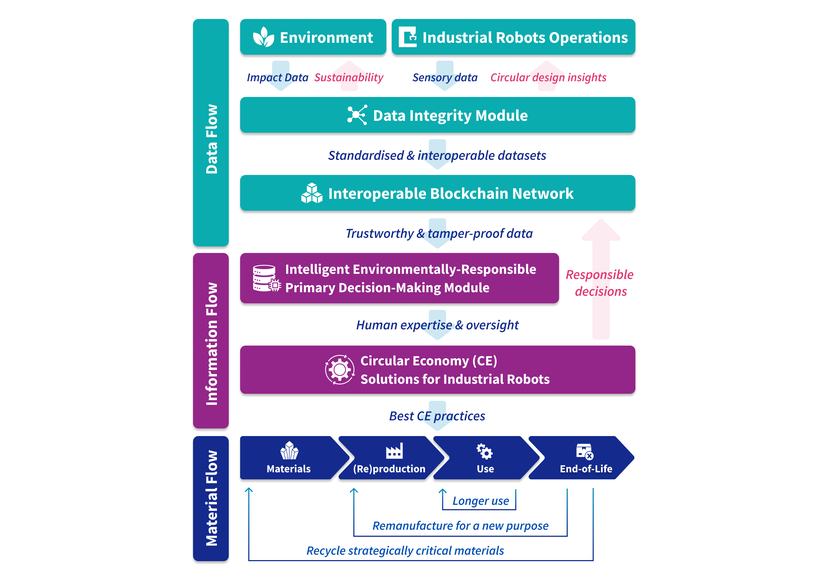
CR5.0 advances a digitally enabled circular economy ecosystem for industrial robots, combining AI, blockchain, and life-cycle intelligence to transform how robots are monitored, maintained, reused, and recovered across their entire operational lifespan.
The project is structured around five interconnected work packages: defining industrial requirements and system architecture; developing digital enablers such as blockchain-backed Digital Passports and generative AI failure-scenario simulation; creating intelligent end-of-life decision-support tools through Life Cycle Assessment (LCA) and Life Cycle Costing (LCC); integrating and demonstrating the system within industrial environments; and coordinating project management, dissemination, and stakeholder engagement.
At the core of the CR5.0 approach is a continuous, AI- and blockchain-enabled monitoring framework that supports robots throughout their “first life.” Selected real-time operational data is securely recorded through an interoperable blockchain network, ensuring tamper-proof traceability, transparency, and trusted performance histories. This immutable digital infrastructure forms the foundation for trustworthy generative AI systems capable of predictive analysis and life extension strategies.
Outputs
Richardson, R., Field, S., Walker, J., Scott-Robinson, B., Sareh, S., and Nefti-Meziani, S. (2025). Why doesn’t the UK make more Robots?
Partners
Academic partners
- Royal College of Art (RCA Robotics Laboratory) – lead
- Loughborough University – Centre for SMART (Sustainable Manufacturing and
- Recycling Technologies)
- King’s College London
- University College London
- Manufacturing Technology Centre (MTC)
Industrial partners
- NVIDIA
- Amentum
- Omron Electronics
- ASTM International
- Katlas Technology
- Wootzano
- Inovo Robotics