....or is it just a ‘nice to have’ addition?
We explore how creativity can help patients process their experience, and reimagine the future of healthcare, in the latest episode of the RCA Podcast.
Listen now:
🎧 Listen on Spotify
🎧 Listen on Apple Podcasts
🎧 Listen on YouTube Podcasts
In this episode of the RCA Podcast, RCA President and Vice-Chancellor Christoph Lindner is joined by two practitioners who have dedicated their practice to the impact of creative expression on wellbeing:
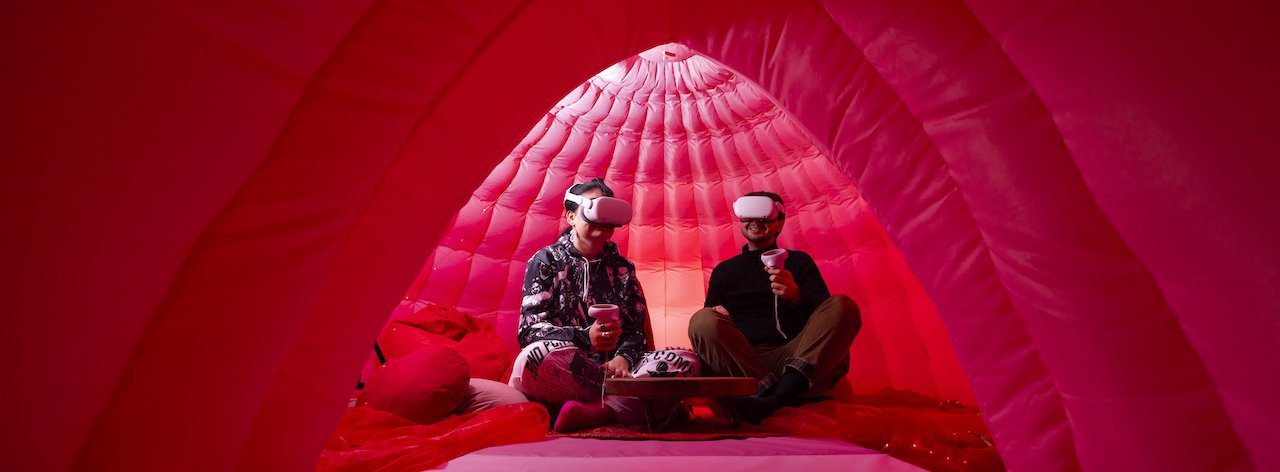
- Camille Baker, Professor of Interactive and Immersive Art in the School of Communication, whose immersive VR projects like Mammary Mountain and Into/Her explore the hidden, internal experiences of disease, trauma, and body image.
- Lottie Barnes, Creative Health Professional, and the artist behind Finding the Beauty in Illness, a photography project documenting her personal journey through cancer treatment. In 2020, Lottie was awarded a Churchill Fellowship to research the role of culture, arts and nature in health care spaces.
They discuss the evolution of creative health - from traditional bedside activities to immersive technologies that foster empathy and offer "positive distraction" in clinical settings. The conversation addresses systemic challenges like "compassion fatigue" and the need for a healthcare model that treats the whole person, rather than just the symptoms of an illness.
Together, they explore areas including:
- Reclaiming the narrative, and how creative practice allows individuals to own and process their personal experiences of illness.
- Immersive technology as a bridge between a patient’s internal experience and a clinician's understanding.
- Creative health in the community, and its power to reconnect and support isolated and lonely individuals.
- Funding challenges, and barriers to embedding creative health permanently into the infrastructure of modern healthcare.
- The hospital of the future, reimagined as a vibrant community hub rather than a clinical silo.
Transcript
00:00:00:00 - 00:00:24:19
Lottie Barnes
Why are we building hospitals? Why are we not getting rid of hospitals? Because if we were really good at the prevention side, and we were really good at staying, and if community played a big role in that, we should be closing hospitals.
00:00:24:21 - 00:00:55:03
Camille Baker
Especially cancer, people feel like they are really well cared for during the treatment experience. But afterward, when it's over, a lot of them felt kind of dropped off. That's the place where something like art and health can really play a role.
00:00:55:05 - 00:01:23:14
Christoph Lindner
Should creativity be an essential part of patient care, or is it just a nice to have addition? My name is Christoph Lindner, and I'm the president and vice chancellor of the Royal College of Art. And I'm thrilled to be joined by two guests today who have committed their research and practice to exploring how creative expression, design and immersive technology can profoundly impact health and well-being.
00:01:23:16 - 00:02:08:12
Christoph Lindner
Camille Baker is Professor of Interactive and Immersive Art at the RCA, where she teaches on the Digital Direction Master's programme, Camille's VR projects Mammary Mountain and Into/Her uses immersive design experiences to explore sensitive topics like the hidden experiences of disease, trauma, and body image. We're also joined by Lottie Barnes, Head of Creative Health for the States of Guernsey. Lottie champions the integration of creative health into public services and is the artist behind Finding the Beauty in Illness, a photography project documenting her personal journey through cancer treatment.
00:02:08:14 - 00:02:26:08
Christoph Lindner
So very warm welcome, Camille and Lottie. And my understanding is that you actually met while working on projects around your own experience with health and creative expression, and so I'd love to start the conversation just by hearing, how did you meet? What were those projects? What brought you together?
00:02:26:10 - 00:03:10:04
Camille Baker
So we have a mutual contact who brought us together, actually, Sarah Ticho, who's been long working on a project around mental health and also trying to build a network around health and immersive around the UK. And she's a big champion for the role of immersive tech, especially mental health. But more broadly, health and wellbeing. And, Sarah has been really great at pulling me into things because I'm so busy with all the different things that I'm doing, and she's really focused on this one approach and, and this particular agenda that she's always sort of when she finds people that might be of interest, she's she connects us.
00:03:10:04 - 00:03:14:11
Camille Baker
So Lottie and I met through Sarah Ticho.
00:03:14:13 - 00:03:16:02
Lottie Barnes
We did indeed.
00:03:16:04 - 00:03:44:15
Christoph Lindner
So let me ask a question about health and creativity, because I think there's probably an old fashioned, or maybe outmoded view of how creativity can promote health. And to me, it looks something like you're sitting in a hospital bed, you've just had a big operation or something, and someone puts a kind of sad picture of a sunset on the wall opposite your bed, and somehow by looking at that, it's going to cheer you up and you're going to have a wonderful recovery and get back to your former health.
00:03:44:17 - 00:04:11:06
Christoph Lindner
Now, of course, things have moved along a lot since those days. And actually, already what I'm hearing in your work is that immersive technologies now have a place in the way that we bring creativity into health care, into health spaces. So can you help me understand at the moment, in your own work and in the field, how do we approach bringing creativity, art and design into health care environments?
00:04:11:08 - 00:04:38:03
Lottie Barnes
So particularly for the program that I oversee, we have kind of two key elements. So we look at creating therapeutic environments. So how can we improve the experience for people being cared for in those spaces but also for staff. And then also we look at the role of participatory arts. So that might be something like, a bedside activity or group activity.
00:04:38:03 - 00:05:03:22
Lottie Barnes
But ultimately it's about how do we improve the experience for people in a hospital setting is a key part of the work I do. And I think the thing that's really exciting and as you say, you know, this idea of a very sad looking painting on the wall to look at, there's just been so much research about therapeutic environments, everything from understanding colors to different kinds of art, and it's really fascinating to look at different approaches.
00:05:03:22 - 00:05:26:21
Lottie Barnes
I actually was awarded a Churchill Fellowship to research the role of culture, arts and nature in health care spaces, and I visited 18 hospitals around the US, and it was fascinating to see how different hospitals tackle this. So some believe things like don't include faces in the in the pictures, the like. We just use abstract art. So actually there's a lot of different approaches.
00:05:26:21 - 00:05:53:20
Lottie Barnes
And actually all of them have kind of valid reasons. So I think it's very much about developing something that works for your community. So that's very much what we do for the environment, for participatory arts. Lots of stuff is happening. This can be anything from things like dance for Parkinson's, which is a well-established way of working, using dance, to support people, to stay well, to keep active.
00:05:53:22 - 00:06:14:01
Lottie Barnes
What I oversee is, by the bedside, our activities. So it's about positive distraction. So giving them something else to think about. Or sometimes you may have people that have been in hospital for long periods of time and may find themselves feeling isolated. So art is playing a key role in and giving them some, connection, positive distraction.
00:06:14:01 - 00:06:21:13
Lottie Barnes
So yeah, there's there's a lot to it. And, and it takes place in different places from hospitals to community.
00:06:21:15 - 00:06:31:00
Christoph Lindner
And Camille, your background is also in performance. How does that shape the way that you approach creativity in health spaces?
00:06:31:02 - 00:06:56:11
Camille Baker
Well, actually, I didn't realize, but I noticed it when I was creating Intro/Her. And so I created Intro/Her because I had had an ovarian tumor myself and I it was in 2016, and over time, I was going through the health system and talking to other women and trying to understand what, what can I do to open up the conversation, because it seemed kind of taboo and kind of, you know, insular and hidden.
00:06:56:11 - 00:07:34:08
Camille Baker
And so the only thing I can do is make something and have conversations with people. And then I started to see similar things. When I started working on Mammary Mountain - Mammary Mountain was inspired because several friends and colleagues and family members were going through breast cancer around the time I was, working on Into/Her. And so I'm coming from this place of what can I do as someone who's been on the the patient side, but also seeing having that researcher mind and thinking, well, there's something there's conversations that are not happening and how can we open up the conversation.
00:07:34:12 - 00:07:59:24
Camille Baker
So I don't know if that's from a performer point of view, but from making the work, I wanted to make the work like a mini theater or a sort of a a space that in both cases they came from different places from for Into/Her it was much more about making a safe, warm, comfortable space for people to physically enter and then virtually enter, and then to be able to have conversations afterward in a safe, enclosed way.
00:07:59:24 - 00:08:32:10
Camille Baker
So I made this womb shaped tent, and brought people into the womb. And then for Mammary Mountain, in contrast, and working with collaborators, was one of my closest friends, had breast cancer, and I pulled her in as one of the artists on Mammary Mountain because she's an amazing fashion designer, sound maker and singer and environmentalist. Her name is Tara Beth Mooney, and we had these conversations about how to bring people into the experience of going for a treatment.
00:08:32:12 - 00:08:53:09
Camille Baker
So was very performative. We put ourselves up in, doctors sort of coats. No, maybe doctors don't dress like that anymore. But we tried to create the sort of clinical kind of the opposite of Into/Her kind of a stark, scary experience that before they came into the treatment, they would put themselves in the shoes of being a patient.
00:08:53:09 - 00:09:18:11
Camille Baker
So that's kind of the performative dimension that I bring to this place. And, and so many people reported that it really, especially if it hadn't happened to them before. But even if it had, it created that mental space, that place of, okay, now I'm going into this and I kind of have a sense of what I'm getting into on some level, more so with Mammary Mountain than Into/Her.
00:09:18:11 - 00:09:26:08
Camille Baker
I think they just came from different places, but the performative dimension and the staging became a primary element of it.
00:09:26:10 - 00:10:01:08
Christoph Lindner
Yeah, I'm really struck, Camille and Lottie, by how in the projects that you're describing, a big part of what you're doing seems to be bringing to patients, to individuals in health care environments, bringing joy, community activity. But also there seems to be an element of empowerment and advocacy. And I'm just wondering if you could reflect a little bit on that side of your work, you know, why is it that in so many different health care spaces, there's a need for patients to have the kind of support that gives them voice, that gives them confidence?
00:10:01:08 - 00:10:07:01
Christoph Lindner
Why isn't that already designed in to the experience? Why do we need to work to bring it on top of it?
00:10:07:03 - 00:10:43:17
Lottie Barnes
That's a really interesting question, and I think it does come down to resources for me personally. I turn to the arts. When I was going through my second breast cancer diagnosis. I knew that for this journey, it was going to be kind of more intense treatment. So, I started to research chemotherapy. And what shocked me was that I couldn't find any imagery around the experience of going through cancer or an illness, let's say, in any way other than suffering.
00:10:43:19 - 00:11:08:03
Lottie Barnes
And so, I guess, just to come back to the point of sort of the work that we do within hospitals as well, it's trying to move away from that element of suffering. And so that was kind of my motivation to do a project that really challenged, I guess, how we look at illness and the experience of illness. And I use the word illness because I think we're getting better at, visibility around disability.
00:11:08:07 - 00:11:31:17
Lottie Barnes
And we talk about that and it's brilliant and it's really important. But I don't hear a lot of narrative around illness. So through my project, I approached a fantastic photographer called Elliot, and he brought together a team of creatives and leading up to this, I'd been creating a journal, and I felt of my experiences, and I felt the need that I wanted to challenge what I was seeing.
00:11:31:17 - 00:11:52:00
Lottie Barnes
And also being creative health professional, I felt like I couldn't tell other people to do this. I needed to do this myself. Like, you know, it's important that I was prepared to put myself in that position. And so basically, I broke down what were my biggest kind of experiences or things that I felt strongly about, which also challenge language around cancer.
00:11:52:00 - 00:12:13:08
Lottie Barnes
And actually one of them was joy, and that there are moments of joy to be found even in the most difficult of experiences. And I think that's an important thing to talk about, because all I was seeing, I know we talk about a lot around illness is suffering. And yes, it is hard. And I guess also what is lacking and we know it's lacking is the emotional support, the spiritual support.
00:12:13:10 - 00:12:30:17
Lottie Barnes
And I think that's commonly why we turn to arts and so I went on this journey and I had amazing support from my, my nurse, actually, because I had to PICC line in my arm and we wanted it to be part of the photograph. We wanted the illness to be visible, but at the same time we wanted you to almost see the illness secondary.
00:12:30:19 - 00:12:45:10
Lottie Barnes
So my nurse even came to the photography studio and wrapped my PICC line, and then came back at the end and wrapped it again. And that's a beautiful, dynamic and relationship with health care professionals. When would you ever think that that would happen? And that's what creative health has the power to do.
00:12:45:10 - 00:13:06:13
Christoph Lindner
And that leads to my next question, which is I'm really interested to hear more about how, medical staff, nurses, doctors, hospital workers, how do the people who work in health care tend to respond to your projects, your interventions, the experiences, and maybe even the disruptions that you bring?
00:13:06:15 - 00:13:25:11
Camille Baker
One of the things that I discovered, two different kinds of circumstances, I guess in the context of of reproductive health, the response was kind of like, get rid of everything, then we don't have to deal with this again. And for me, that was not helpful. One of the women who who is the voice in Into/Her put it the best.
00:13:25:11 - 00:13:50:04
Camille Baker
She's like, that's like saying, why don't you cut off your arm in case one day you get an infection, so that that kind of perception about reproductive health, I feel like that has to change. But when a lot of people in that space, came to see it, like there was a gynecologist, there was somebody who is teaching, in Sheffield in the, in, the medical school there, there were a few other people who came in.
00:13:50:04 - 00:14:19:05
Camille Baker
They were all extremely positive and, and were saying things like, we need to bring this into our teaching. We need to bring this kind of, advocacy and this kind of opening or making visible experiences that women are having. In contrast, Mammary Mountain wasn't showing so much joy like Lottie was trying to make visible, but it was definitely trying to make again visible the invisible experience of going through cancer treatment.
00:14:19:07 - 00:14:47:09
Camille Baker
A lot of the people we spoke to and interviewed had talked about how they didn't have enough energy because of the treatments to talk about what they were going through, because it would cost them more energy to explain or even to to take care of the people around them who felt bad about what was going on. So when they saw Mammary Mountain Experience Mammary Mountain, they felt like someone else saw them or validated their experience.
00:14:47:09 - 00:15:15:02
Camille Baker
But also they felt a sense of connection to the stories and the other people whose stories were being conveyed. Again, we had it particularly at the beginning of the project. We had someone who was desperate to get the project into an oncology, again, teaching context to show, to help create empathy amongst young doctors and health care professionals.
00:15:15:02 - 00:15:37:04
Camille Baker
Because her thoughts were that they see so many patients, they start to lose that sense of empathy. And so it's not that it's not there, but they they kind of have to protect themselves with all the different people they encounter. A third thought, which kind of addressing what you mentioned earlier, Lottie, was the sense of - especially cancer.
00:15:37:04 - 00:16:03:08
Camille Baker
People feel like they are really well cared for during the treatment experience. But afterward, when it's over, a lot of them felt kind of dropped off. And that that's the place where something like art and health or something else needs to take care. Not so much their physical health anymore, but their mental health because they're changed. Something has completely changed, and they're not the same person they were before.
00:16:03:08 - 00:16:28:05
Camille Baker
And so at that point, often they have no one because they're there. They're done, at least for that time period. Some people have recurrences, but at that moment they're done. And so that to me, while there's amazing health care and as Lottie says, there's a lack of resources and lots of levels, maybe they don't have time or energy or money or whatever resources to support that second part of the journey.
00:16:28:05 - 00:16:32:12
Camille Baker
But that's piece where I think art can really play a role.
00:16:32:14 - 00:16:55:20
Christoph Lindner
Yeah. And let's come back to that question of the second part of the journey. What happens when we go home? But first, Lottie just wanted to hear some of your thoughts on, how hospitals tend to respond to the work that you do, how welcoming, how accommodating, what are some of the obstacles, but also what are some of the ways in which hopefully, those spaces are with you and behind you?
00:16:55:22 - 00:17:32:23
Lottie Barnes
Yeah, I think what we tried to do well, for two reasons. A lot of hospital arts managers or people like myself in my role, we do look at how we can support staff as well. And so actually, sometimes the best way for staff to really understand this is to partake in it. So we deliver staff wellbeing workshops, in fact, New York City Health and Hospital, they focus their arts program actually on staff because they believe that you need to care for the carers first, so they actually prioritise the patients, they prioritise the staff.
00:17:33:00 - 00:17:59:17
Lottie Barnes
So we will engage staff in creative workshops. It helps them to understand - we've had a lovely thing happening recently where we've brought music into the hospital. We - one of the wards we visit is a rehabilitation ward. And actually the OTs identified the music that we bring in - they partake in the music making, and they observed that the music making could be part of their recovery.
00:17:59:17 - 00:18:27:09
Lottie Barnes
So, we now have built into our music program music, where it encourages movement. So working with the physios and the OTs. So that is a brilliant example of how of being there and showing what can happen if you can give space for staff to interpret how they feel, it can then be utilised and, you know, the example of the music is, is is a brilliant example of that where the staff could see the potential.
00:18:27:11 - 00:18:48:21
Lottie Barnes
I guess, coming back to the compassion fatigue, it is a big challenge. It's not because staff are not compassionate. It's because they're under a lot of pressure. And I think and I'm sure we'll talk about this more in depth. But one of the challenges is almost we work to the ethos of ‘do no harm’, which is fantastic, but that can be restricting.
00:18:49:02 - 00:19:12:23
Lottie Barnes
So if somebody doesn't understand something, they're more likely to reject it. So it's it's important that we take health care professionals on the journey with us. And so and actually, I've just been to this conference, National Organization for Arts and Health in New York. And one of the special moments for me was that I actually got to spend some time with some clinicians, some doctors, and to see their passion.
00:19:12:23 - 00:19:30:14
Lottie Barnes
And it's not often that you have the opportunity day to day to kind of sit down and be passionate about it. And actually we want to achieve the same things. We want to make a difference. We want to change how our health system is, and they are interested in knowing more. So sometimes it's just purely a lack of understanding.
00:19:30:14 - 00:19:33:09
Lottie Barnes
And how do we best take them on the journey with us?
00:19:33:09 - 00:19:51:00
Christoph Lindner
Yeah, that makes a lot of sense and it's actually great to hear you both speak about health care professionals, about the people that you work with, that patients are working with, who obviously are a huge part of this whole journey. But maybe we could pivot for a moment away from people to systems, which is probably not the most exciting thing.
00:19:51:00 - 00:20:11:00
Christoph Lindner
However, I do think it's important, and you've mentioned lately some of your experiences of visiting American hospitals and some of the experiments they're doing there with Creative Health. If we bring this back to where we are here in the UK, and we had the National Health System, which, as we all know, has been really strained for many, many years.
00:20:11:00 - 00:20:39:19
Christoph Lindner
And the pandemic just added a whole new level of weight. On top of that, I'm wondering to what extent the system under the current strain does that enable more opportunity? Because there isn't resource dedicated to doing this, and so it creates space for you and other creative health professionals to come in. Or actually is the strain in the system making it harder to integrate this sort of approach more holistically, systematically?
00:20:39:20 - 00:21:07:15
Camille Baker
Well, I'll just speak from my experience, because I've been trying desperately to connect through both nearby hospital trusts where I am, but also through the Health Innovation Network. And those conversations are still ongoing. But the beginning of that is that, yes, they're really interested, but they they're risk averse, as Lottie and I've talked about before. And so they want to have reassurances.
00:21:07:15 - 00:21:44:10
Camille Baker
So I've been talking to a psychologist like can we, can we test this from your perspective and give some kind of, testimonial from your professional opinion about the value of this? I spoke to a psychiatrist another time about the same thing. And so there's that side of it. The other side is that, I've - and my collaborators, especially if Mammary Mountain, have been talking more to charities and because they often end up picking up all the extra work that the health care system doesn't have the capacity to do, but they're also underfunded.
00:21:44:12 - 00:22:07:01
Camille Baker
But their reason d'etre is more about that support side in in many ways, at least in my personal experience and speaking to others who've been engaged with charity. So there's that kind of complementary system that I'm looking at. Again, Lottie has a bigger picture sort of perspective. I'm coming from the ground up, I guess, and just trying to figure out the system.
00:22:07:03 - 00:22:43:24
Lottie Barnes
Yeah. I think, one of the biggest challenges is who funds this and the biggest tension I see is, is it health or is it the arts that fund this? So there's definitely tension there. And I don't think that there is a simple answer. Why would I to this is the from a point of view of systems when we think about it this way, is that in a way, an important part is to almost empower community and individuals to find solutions as well.
00:22:43:24 - 00:23:08:06
Lottie Barnes
So, sometimes systems can disempower. And if you think about something like I find it quite fascinating. So we talk about something called social prescribing, where you can now go to your GP and be prescribed an hour activity with a local community group, or go in on a walk. It feels a little bit like we've pulled that into the system.
00:23:08:06 - 00:23:29:06
Lottie Barnes
It already exists, so we already have all this amazing things happening community that happen naturally and organically. You know, a little knitter natter group might start in the library. These are all things that are really good for your wellbeing. And actually what we should be doing, I feel, is supporting community to be healthy, happy and well like so it's a little bit.
00:23:29:06 - 00:23:47:17
Lottie Barnes
It doesn't quite answer the question, but another thing that I always think about as well is why are we building hospitals? Why are we not getting rid of hospitals? Because if we were really good at the prevention side and we were really good at staying well and community played a big role in that, we should be closing hospitals.
00:23:47:19 - 00:24:07:17
Lottie Barnes
So it's really fascinating. Creative health in hospitals and in community. And I think they are integrated and they should be integrated. But I think community has a huge and really important role to play in this, in supporting the community to help solve this is is well, they know how to solve it. They do it.
00:24:07:17 - 00:24:33:14
Camille Baker
I just have one thing to add as well. Just because I'm coming from research and and and also arts, I have noticed changes in funders and what they're supporting. So there's mindset funding from the UKRI that came out last year. And it's more mental health, but it's still health based. I had a conversation with the Head of Arts Council last year because they help support Mammary Mountain to go to various festivals.
00:24:33:16 - 00:24:52:02
Camille Baker
And she said, we're trying to prioritise art and health. And it was just when, Starmer just came into government. So she was saying, we're trying to prioritise it with the government. So there is initiatives also, not just arts funding, but in in research funding. But again, it does go back to who's who's responsible for that.
00:24:52:05 - 00:25:17:16
Christoph Lindner
But this brings us to a broader conversation about, you know, what is health and where is health. So when we tend to think about it, mostly we sort of focus in on hospitals, you know, medical environments where we're doing health interventions and treat actively treating people with acute, you know, conditions. But I think lots to your point about actually, from a system point of view, there's this thing called community.
00:25:17:17 - 00:25:49:03
Christoph Lindner
We have lots of them. Many of them are quite strong, resilient, caring, empathetic, supportive. And we just need to not just support that, but also help connect people to those communities. But the fact that so many patients feel alone and maybe when they return from hospital, that sense of isolation is maybe even intensified because now you no longer have people around you, actively looking after you, interested in your care?
00:25:49:05 - 00:26:15:07
Christoph Lindner
That maybe there's something about the way contemporary society is working where we have both the tantalising proximity of communities, yet nonetheless, they feel distant and we feel disconnected from them. I'm reminded - it's a terrible segway - but I'm reminded of Edgar Allan Poe's short story The Man in the Crowd. You know, this this man wandering in a big urban crowd, surrounded by people, yet still feeling totally alone.
00:26:15:09 - 00:26:37:13
Christoph Lindner
And so I guess what I'm wondering then is how do we, bring together both the tantalising proximity of communities and all the potential for care and support that they offer, and people who either don't know how to make that step or don't feel able to make that step, you know, what are the blocks to us being more connected to our communities?
00:26:37:13 - 00:26:54:24
Christoph Lindner
And I'm asking that, you know, we're sitting here in central London, a very large city, a very diverse, global, international, cosmopolitan, multicultural city, so many neighborhoods, so many different communities here. But it's very easy living in London to feel alone, even when you're part of the crowd.
00:26:55:01 - 00:27:23:19
Lottie Barnes
Here's an interesting question. And also, there's a lot of research being done on loneliness and actually how bad that is for your health. It's, it has huge impacts on your health and well-being. I guess part of what social prescribing addresses is some of that. So you may be prescribed a visit to your museum. So it's kind of encouraging you to get out there and to get to all of the beautiful things that are in your community, all the groups that are in your community.
00:27:23:21 - 00:27:45:09
Lottie Barnes
What I do find really curious as well, and I just would like to read a quote that I had recently which says there's never been a culture without art. And what I find curious about this kind of era of like, social prescribing and stuff. And it's like we are being prescribed to an art session, but it's always been part of who we are.
00:27:45:09 - 00:28:13:18
Lottie Barnes
To be human has been using the arts, are viewing the arts, and so sometimes I just wonder if some of the essence of what's going on is like a reminder of what it means to be human. Like we need connection. Arts is fundamental to who we are as human beings, and all of it shapes and forms. So it's it's actually like a really big question because there's some fundamental things kind of going wrong in how we exist at the moment that we're becoming isolated bit technology, whatever.
00:28:13:18 - 00:28:35:02
Lottie Barnes
I mean, this could go into a two hour long conversation, but I guess creative health, arts and health is trying to address those things in some interesting ways. But it also kind of doesn't make sense, because a lot of the things where you may be prescribed to a kind of they're why are we not going there? Why are we not walking in the art gallery or that art class?
00:28:35:04 - 00:29:04:02
Camille Baker
Because I use technology. So I'm going to say something that might be counterintuitive to that, but I feel like especially after the pandemic, everybody being online, everybody using social media, I feel like there's a lot that happened that took people away from each other. So yeah, I feel like there is some work that we still need to be doing around, even though, like I say, I work with technology, the way I work with immersive is very one to one.
00:29:04:02 - 00:29:25:16
Camille Baker
It's intimate, it's dealing with difficult topics. But there's a huge part of it. Is that okay, you've you've seen or experienced this thing. Now let's talk about how it made you feel. And it's very much around connecting again back to that person on a one to one level and tapping into what has happened for you and how did it make you feel.
00:29:25:18 - 00:29:45:23
Camille Baker
And I think more of those kinds of bringing people together, opportunities are necessary now because the things are out there, the opportunities, the art, everything is out there. But we have to pull people out of their homes and find ways to do that. And there was one man who was in our we interviewed in, Mammary Mountain who had had breast cancer.
00:29:46:00 - 00:30:16:14
Camille Baker
He was a farmer, completely isolated in Ireland. And the only way he saw people was when he went in for his chemotherapy treatments. And this is how we found him, because, my collaborator met him during her chemotherapy treatments, and he was so on his own. No partner. His daughter was far away that he checked himself back into the hospital after his chemotherapy because he was worried he would collapse or something would happen to him on his own.
00:30:16:14 - 00:30:36:08
Camille Baker
So there are people like that who are also, by their nature of their their job or where they are in the world aren't automatically geographically isolated. But the everyday person in our world right now is isolating themselves on some level. So is figuring out techniques to bring people back to each other and to find each other.
00:30:36:10 - 00:30:55:11
Christoph Lindner
So let me let me paint a scenario which is obviously quite, extreme and absurd. But here's the scenario I want to paint, you know, are we headed towards a world where you have a large, you know, hospital room with 12 beds, each person sitting there with a pair of virtual reality goggles, and each person is on a completely different individual experience.
00:30:55:11 - 00:31:28:12
Christoph Lindner
One person is on vacation in Hawaii. Another person is having a birthday party with all their families back home, and the third person is at the zoo playing with penguins. Maybe you're offworld on the moon, but whatever it is, that you could sort of be trapped or alone in your own isolated escape, and that this is a way to kind of, you know, overcome the experience of being in a hospital or the experience of being home alone, a way of processing or dealing with fear, anxiety, but at the same time, something that keeps us separated from each other.
00:31:28:14 - 00:31:54:12
Camille Baker
I mean, my immediate response would be to do that responsibly. After everybody's session, someone would come in and have a conversation with those people, and they'd all share their experience in the work that I'm doing. The off boarding, the after the debriefing is just as important as the experience itself, really, and sometimes more so, because in some ways that experience is just a conversation starter.
00:31:54:12 - 00:32:13:22
Camille Baker
And afterward, that's where the work of the action might begin. And like my hopes again for Into/Her were that all these women know more about their bodies, and they go out and talk to their doctors, and they go similarly with the breast cancer issue, that more women and men go out and talk to their doctor, but also talk to each other.
00:32:14:01 - 00:32:18:19
Camille Baker
So my response to that is that it's only a beginning. It shouldn't be the end.
00:32:18:21 - 00:32:44:11
Lottie Barnes
Yeah. It's like viewing it as a part of lots of different things. I mean, there's definitely value in that. Like, the, the opportunity to escape, to have a positive distraction. Absolutely. But there's so much in peer to peer support. And I think as you identify when you finish your treatment, it's a very difficult time. And I've been honored to be part of communities, that have gone through cancer.
00:32:44:13 - 00:33:07:09
Lottie Barnes
And it's a very special community. And it it's this thing about being able to share your story, isn't it? And the work that you do, Camille, that's understanding people's stories and, and those people that have had an opportunity to tell the story. And that's what I needed to do in my work, was to tell my story. We need to keep being able to tell our story, and we need places where people can hear that.
00:33:07:11 - 00:33:26:11
Camille Baker
Well, when I had my tumor, the I went to a geneticist to see if it was genetic and so on, and and the geneticist said, no, you don't have any of these genetic markers. It looks like it was something rare, etc., etc.. But she said 1 in 2 of us will get cancer. And I didn't realise at that moment that it was so high.
00:33:26:13 - 00:33:47:05
Camille Baker
But also more people are living. So yeah, we need to address it as a society, like we need to address death in a more positive and a more life affirming way. And if that makes sense in a way that is bringing people together, bringing people to support each other.
00:33:47:05 - 00:34:10:11
Lottie Barnes
Actually, we were having a conversation prior to this, weren't we? And we started to look at where the other spaces are, where this should be happening. You know, not always in galleries, not always in museums. There's lots of great things happening around creative, healthy museums and galleries now, which is fantastic. But, you know, we've got, where are those of the spaces so even more people can access this.
00:34:10:11 - 00:34:13:08
Lottie Barnes
It's always about breaking down the barriers, I think.
00:34:13:13 - 00:34:36:16
Camille Baker
Yeah. With Into/Her and Mammary Mountain, I had some creative partners where we put the projects into shopping malls, into, parking garage, other places where people just be passing by. And that was so amazing because you got people who would never seek out, never tried VR. Some may have been interested by the topic, so they came because of that.
00:34:36:18 - 00:34:57:08
Camille Baker
But those experiences, those people, what they reported back, was so much more interesting to me than the people who came to see it at the festivals, who were more picking apart the technical or the creative dimensions. Those people were having authentic experiences, and we do need to take it to them, as opposed to expecting them to find us for sure.
00:34:57:09 - 00:35:29:10
Christoph Lindner
I mean, part of the issue about why has art been, you know, taken out of school, is taken out of our daily lives and put behind walls in museums in high cultural spaces and expensive spaces in spaces that not everyone feels comfortable, and able to access. I think, there's a lot of work to be done, and creative health might be one of the really powerful, impactful ways of doing it, of kind of democratising art at a time when that's super, super urgent in society.
00:35:29:15 - 00:36:02:01
Christoph Lindner
And there's also the question of your kind of position in relation to the work of creativity. So art being done to you versus you making art or being part of, of the creation? And we've heard examples of lots of different ways in which to bring art into health environments. And as you say, Lottie, being open to, you know, the full range that that can take and not and being open to what actually makes an impact on an individual, what speaks to them, what what helps them, what makes a difference for them.
00:36:02:01 - 00:36:19:05
Christoph Lindner
And we shouldn't assume that everyone responds to the same things. But within that, I get the feeling that having, patients and as well as staff being more on the participatory side of that might be where to place the emphasis. What do you think?
00:36:19:10 - 00:36:42:15
Lottie Barnes
Yeah. So we talk a lot about co-production, which is complicated. It's really important to do, but it's complicated to do. So for example, when we develop a therapeutic environment, cause also we're really keen to use that language, therapeutic environment. So it takes away that core focus on the art, because then you do get stuck in those arguments about what should be there.
00:36:42:15 - 00:37:03:24
Lottie Barnes
So we go, okay, what would the therapeutic environment need to be? But we are going through a phase of hospital modernisation. And what's really important is that, you know, you want to bring the lived experience with you. So, you know, the the ideal situation if you are developing a space and you want to bring art into that space, you want to create a therapeutic environment.
00:37:04:01 - 00:37:28:24
Lottie Barnes
You need a steering group. And within that steering group is lived. Experience is staff, is is artist is everybody. And together you create the creative brief and and then the artist that is commissioned has to deliver on that brief. And you know, that committee will keep the artist in check to make sure that they do that. So it it should never just be about a curator coming in and doing it.
00:37:28:24 - 00:37:44:16
Lottie Barnes
It has to be, co-created. And that's the same with really any impactful creative health intervention. You should build it together. It's a tricky thing to do to get it right. But it's a really, really important thing to do.
00:37:44:19 - 00:38:09:18
Christoph Lindner
And in a way, this makes me think of the hospitals of the future. And, you know, earlier we talked about maybe if we're getting health right, we would have fewer hospitals. But, as a place to kind of draw our conversation towards a close, could I invite you to just imagine a little bit, particularly if you had the ability to shape that future, what would hospitals look like in the future?
00:38:09:18 - 00:38:29:15
Christoph Lindner
And I asked that question, having recently walk past a kitchen store, and it struck me that the way that kitchen designs are going, kitchens now look like everything except kitchens, right? They look like libraries and art galleries and this. But there's no evidence of food and cooking and all the stuff that we traditionally think should happen in a kitchen.
00:38:29:19 - 00:38:42:02
Christoph Lindner
And I'm not saying that's a good or a bad thing, but I'm just wondering if we really want to kind of stretch our imagination. What what would an ideal hospital of the future look like? And maybe it's something beyond the category of a hospital.
00:38:42:06 - 00:39:05:10
Camille Baker
I'm not terribly great at speculative futures, but I mean, when you said that, the first thing that came to mind was something that might be more akin to a playground round, but also something that's lots of comfortable chairs and lots of small, cozy spaces and, and yeah, somewhere between the playground and the classroom. But for adults.
00:39:05:12 - 00:39:07:03
Christoph Lindner
I love that playground in the classroom.
00:39:07:03 - 00:39:24:23
Camille Baker
For the kids, there's a lot, lot re reconfigurable spaces and lots of materials and things that are not just about, like you said, not just about health and getting better, but communing and making and doing and relaxing and those kind of things. That's my immediate thought about that.
00:39:25:00 - 00:39:44:00
Lottie Barnes
Yeah, it's interesting because the NHS has released its ten year strategic plan and it's the, we go into more of a neighborhood model. So there's, community hubs that are being developed where a GP may sit within that space and then some things that may have taken place in a hospital can now take place in that community hub.
00:39:44:00 - 00:40:09:00
Lottie Barnes
And the idea is that it might have a cafe that's run by the community, and creative health is integrated into every element of the patient pathway. So I think, being available, creative health, VR technology, anything that helps us to tell our story, to make our experience better for me should be part of all of the pathways. I think the community has a massive part to play.
00:40:09:00 - 00:40:30:13
Lottie Barnes
And the other thing that I'm really passionate about is not only what it should be, but how we get there. And for me, and I learned this massively from when I did my Churchill Fellowship, sharing knowledge is so vital, and doing this together is so vital because there's so many of us that are trying to do this work in silo.
00:40:30:15 - 00:40:54:03
Lottie Barnes
So again, that's putting pressures on the resources and the funding. And if we work together, and we do this together and we share knowledge globally like we're all dealing with the same, well, some of the same health challenges. So why can we not work globally and try and solve it? And because this would speed it up and it would save resources.
00:40:54:03 - 00:41:22:23
Lottie Barnes
So I've become hugely like motivated by this idea of collaboration, share, you know, sharing knowledge. Let's let's solve this together. And I'd like to think that in return also helps some of the divisions that we're facing and theoretically build more connection and more access to this. So it might sound like a quite an idealistic vision, but certainly when I work on a, you know, on a small island and I'm fascinated by building an islands network because it's unique.
00:41:22:23 - 00:41:41:22
Lottie Barnes
Again, for islands, it's a different health system or rural communities or seaside communities or, communities that have indigenous communities and strong heritage. It's like it all has a place. But like, I just think sharing the knowledge like we're doing today, we're sharing our knowledge, our experience. To me, that's really important.
00:41:41:23 - 00:42:02:22
Christoph Lindner
Yeah, that's a really beautiful sentiment. And my hope is that we have listeners who, are thinking to themselves, I want to get involved in creative health. What advice would you have for anyone who, would would like to actually explore for a future as a creative health professional, how do you get into this field and what do we need to do to support the field?
00:42:03:00 - 00:42:24:21
Camille Baker
Well, again, I'm going to say something really quick and then pass it over to Lottie. But I would think that a lot of the people who get into it do it like myself because something has happened to them or someone they know. So that's coming from a place of passion and personal, but then it needs to spread out to being not just about yourself and about how you can connect with others.
00:42:24:21 - 00:42:35:21
Camille Baker
So I would say for artists who are who want to, they should do it. But then the next stage is finding people like Lottie to connect with. I think that's the more challenging part.
00:42:35:24 - 00:42:59:21
Lottie Barnes
I think you're right. I think it is about if you have a passion for it, seek opportunities to explore that as an artist individually. The pathways into creative health, I guess, are a little bit complicated, but obviously creative health exists in communities, so it's delivering projects with community, in community. So that could be something you develop yourself or with other grassroots organisations.
00:42:59:23 - 00:43:23:07
Lottie Barnes
A lot of hospitals do have arts managers. So reaching out to arts managers, and I think looking at things like, the center for Creative Health, their website, keeping an eye on what's kind of happening. I know this isn't necessarily that we wanted to go into, but it is also an area that is still a little bit complicated around, professionalisation.
00:43:23:07 - 00:43:48:01
Lottie Barnes
There isn't any sort of certification for this. So it's, it's is about kind of getting out there and trying to learn as much as possible. There are things like a creative health quality framework. That's really interesting because it helps to sort of dissect some of the key principles about working in this field. But a good place to start is always that passion and that personal motivation.
00:43:48:03 - 00:43:52:00
Lottie Barnes
Yeah. And then just kind of keeping an eye as to what is going on out there.
00:43:52:02 - 00:44:19:12
Christoph Lindner
And on that note, I really want to thank you for joining us today. So thank you, Camille and Lottie for sharing so many ideas and being so open and generous. With your work. And I also want to thank our listeners, and we hope you'll join us soon for more episodes of the RCA Podcast.
00:44:19:14 - 00:44:52:00
Outro
This podcast is from the Royal College of Arts, home to the next generation of artists, innovators and entrepreneurs, and the world's number one art and design university. You can learn more about our programs at rca.ac.uk, as well as finding news and events relating to the college, and our application portal if you're interested in studying at the RCA.