Key details
Date
- 8 December 2025
Read time
- 7 minutes
Former dancer turned multidisciplinary artist Maki Takato – an Information Experience Design MA alumna – explores light, perception and tradition through immersive works that merge the ephemeral with the enduring.
Could you tell us about your creative journey before entering the RCA? What led you to pursue further studies in London?
Before coming to London, I worked for several years as a professional ballroom dancer in Japan. During that time, I became increasingly drawn to performance art using the body, which led me to explore the relationship between body and space more deeply.
I researched art universities across Europe and attended open days, and was captivated by London's vibrant art scene. In 2014, I studied Performance at Central Saint Martins, where I explored spatial design and wearable costume design. Through this work, I investigated how my own body and skin sensations influenced space. In 2015, I progressed to a design course at Goldsmiths, where I learned anthropological approaches to research.
Then in 2016, I entered the RCA's Information Experience Design course, where I began combining these elements into practical creative work. It was a significant career change, but because the RCA brings together people with diverse backgrounds, I was able to leverage my previous experiences and refine my areas of expertise.
What initially drew you to the RCA? How has participating in that community influenced your expression and growth as an artist?
I chose the RCA's Information Experience Design course because I was attracted to the opportunity to express myself experimentally using various digital media, moving image, music, and other forms.
Within the course, there were students from diverse backgrounds – people who had studied physics, mathematics, and law, as well as musicians, graphic designers, and animation designers – and each person's research methods and modes of expression had a profound influence on me. I was able to pursue new expressions that combined my physicality from the performing arts with digital technology, such as interactive works that responded to my own body movements using motion sensors.
A particularly memorable experience was collaborating with students from Imperial College London. Working with engineers, material designers, and sound designers, we developed wearable devices. These devices sent signals to remotely control performers' movements and send instructions – a project pursuing the relationship between technology and humanity. I had the opportunity to perform at the Victoria and Albert Museum.
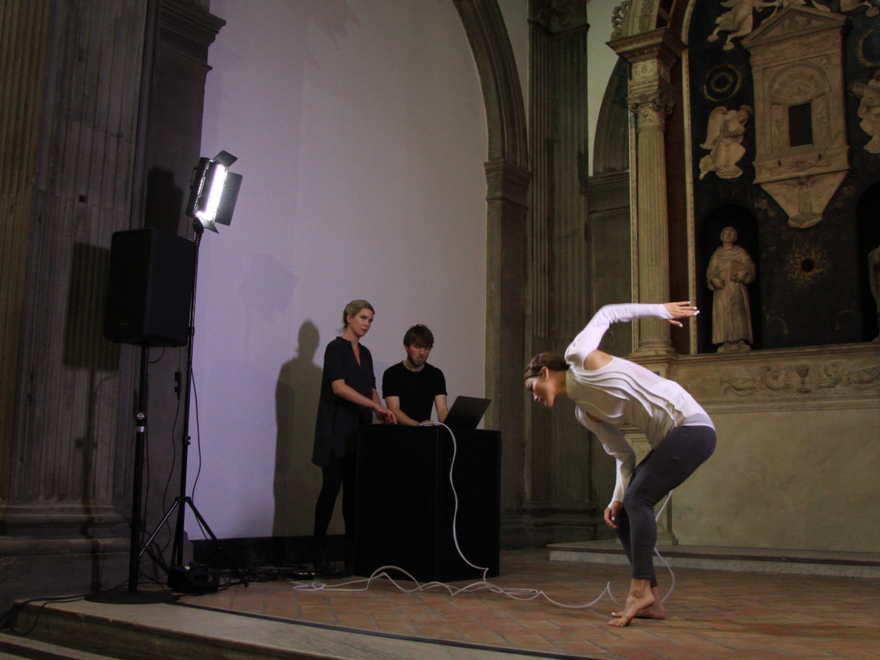
Performance at the Victoria and Albert museum by artist Maki Takato - who worked for several years as a professional ballroom dancer in Japan - made in collaboration with the Imperial College London.
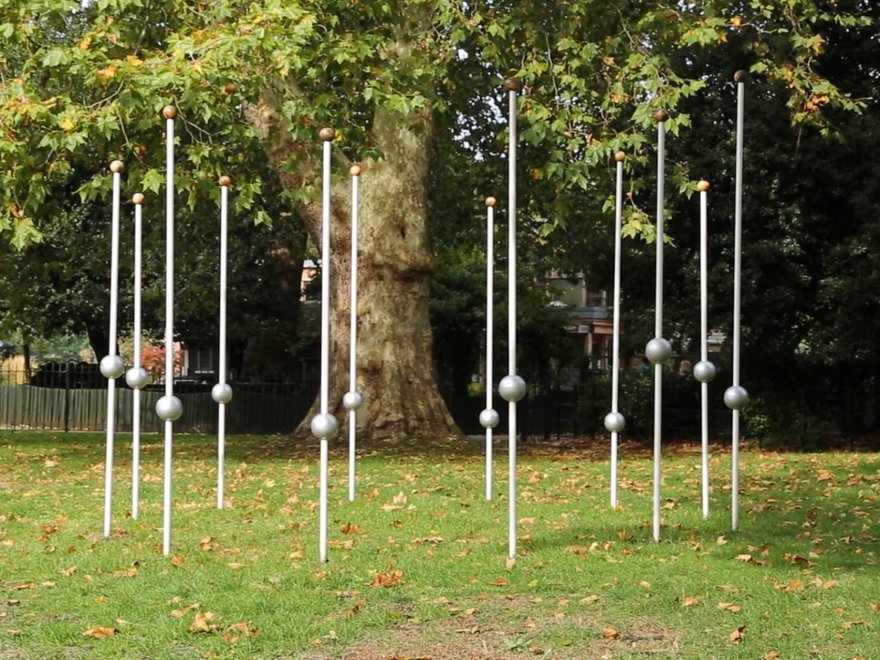
Public sculpture by Maki Takato in Battersea Park
During your time as a student, was there a particularly memorable faculty member, workshop, or experience that significantly influenced your approach to materials and scale?
The most memorable aspect was the abundance of opportunities to collaborate with other courses and universities.
I participated in classes about architectural space and art with architecture students, attended Royal College of Music classes, and formed teams with product designers, sculptors, and engineering students through the Across RCA programme. Additionally, I worked with students from Cambridge University's biology department and London Business School (LBS), which provided invaluable opportunities to engage with people from various fields.
The RCA also receives various competition opportunities. I won an art competition, which gave me the chance to install a public sculpture in Battersea Park in London for one year. The fact that students can actively present their work in public spaces like this is one of the RCA's great attractions.
Through these collaborations and public presentation experiences, I was exposed to different perspectives and approaches, which greatly expanded my understanding of materials and scale. In particular, dialogue with people outside my own field became a major catalyst for expanding the possibilities of my work.
You work with both ephemeral and permanent materials. How did this multidisciplinary direction emerge?
The genesis of this direction came from an experience of losing someone close to me during my time at Central Saint Martins and Goldsmiths. Through that experience, I began to think deeply about the contrast between momentary existence and eternal memory, between ephemerality and permanence.
During my time at the RCA, while helping with theatre production work, I became more acutely aware of this contrast. My experience as a ballroom dancer – how a momentary performance becomes etched as a lasting experience in memory – has greatly influenced this choice of materials.
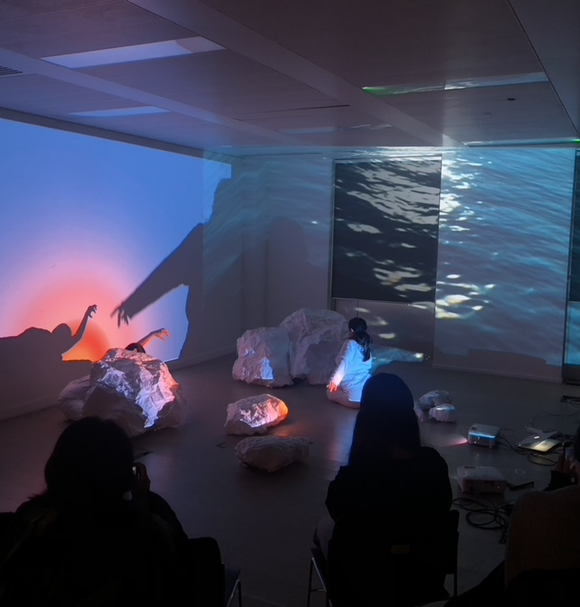
The ephemeral materials I work with include light, shadow, air, fabric, and sound. These change over time and disappear. On the other hand, as permanent materials I use metal and stone. However, what interests me most are materials that exist on the boundary between these two.
More recently, I've come to consider digital technology and AI as forms of "ephemerality" as well. Digital encompasses change and momentariness. Currently, I'm interested in collaboration with AI, exploring the relationship between technology and humanity, and how their mutual responsiveness can enhance one another through fluctuation.
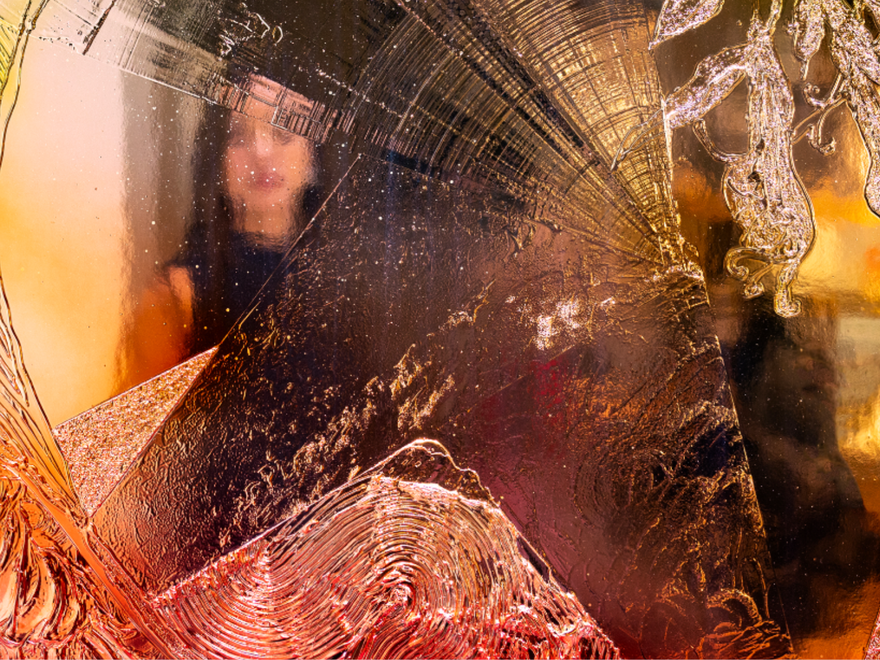
A piece of work from Maki Takato's 'Silver Screen' series
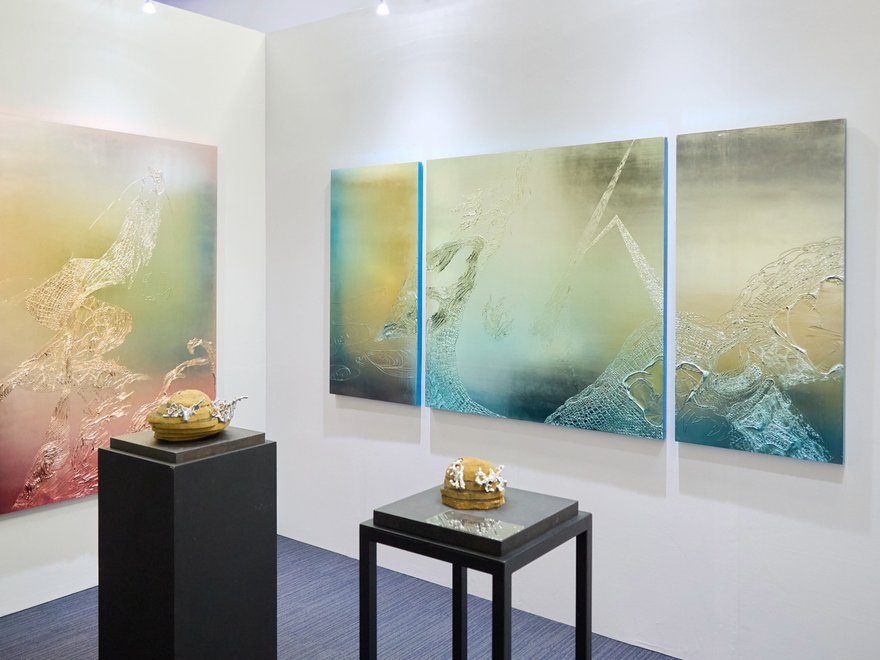
Light and perception are central elements in your installations. What role do these themes play in your work? How do you think about engaging with viewers when creating immersive works?
Light and perception are crucial elements for visualizing "change" and "relationality" in my work. The Silver Screen series marked a particularly significant turning point.
In this series, I used a special material called silver mirror coating. I wanted to express a relationality where one's own body movements, shifts in power, and presence influence others and create change, so I wanted to develop a material that changes through reflection. I sought out and contacted companies with coating technology on my own, researching the adhesion properties and visual qualities of this complex technique that requires special facilities.
When creating immersive works, I aim for viewers to become not mere observers, but co-creators of the work. From my experience as a dancer, I understand the dialogue between body and space, and the beauty of the unpredictable moments that arise there. I want to enable viewers to experience that sensation through technology.
Since 2023, you've been working under the name "Maki Takato." What motivated this change of name?
As opportunities to appear in media and exhibitions increased, I decided on an artist name to clarify my identity and presence as an artist more distinctly.
"Takato" is the name of a region in Nagano Prefecture, my birthplace in Japan, that has existed since ancient times. I chose this name to take pride in and be conscious of my identity and roots.
This change marked a turning point in renewing my awareness and responsibility as an artist. As my international activities expand, I want to carefully balance weaving my origins and cultural background into my work while exploring universal themes.
You've presented your work widely at festivals, galleries, and public spaces both in Japan and internationally. Among your recent projects, which have been particularly significant to you?
The most significant was my work "Hopeful Monster" at the Osaka-Kansai International Art Festival 2025, held during the Expo period.
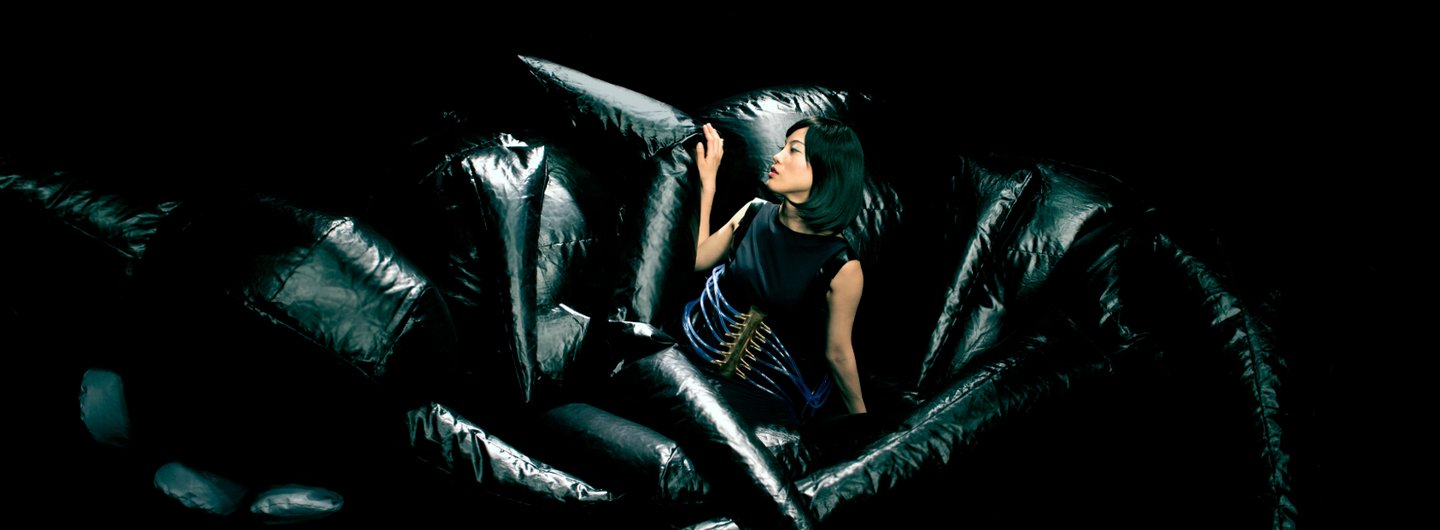
This work evolved from a theme I had created for my RCA graduation project ten years earlier. It's an interactive installation using giant balloons with air, themed around yōkai –supernatural beings and phenomena appearing in Japanese folklore. The structure is made of fabric characters that change size and move when people approach. Additionally, I 3D-scanned my own body from 360 degrees, scaled the output up more than 100 times, and created a giant face balloon over six metres tall.
Yōkai represent the wisdom of Japanese culture in visualising and narrativising things that are invisible or incomprehensible. I attempted to express a dialogue between tradition and innovation, ephemerality and materiality, by fusing this concept with contemporary technology.
Nankai Electric Railway and Takashimaya Osaka became my sponsors, giving me the opportunity to create work on a large scale. The fact that an idea that germinated during my time at the RCA could mature both technically and conceptually over ten years and be realised on an international stage was a deeply moving experience. Witnessing people from around the world actually touching and experiencing my work on the international stage of the Expo was a major turning point for me.
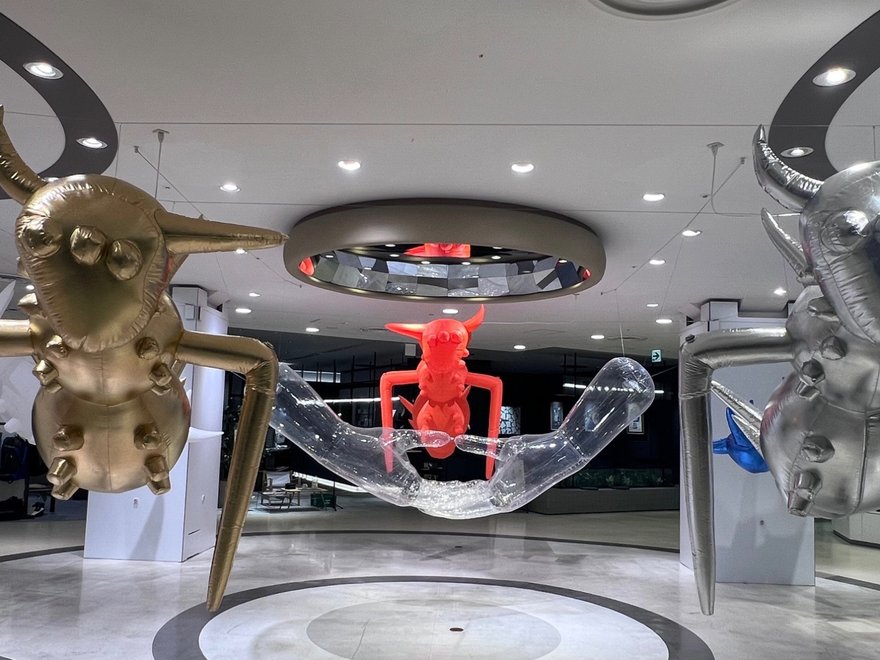
Art installation by Maki Takato
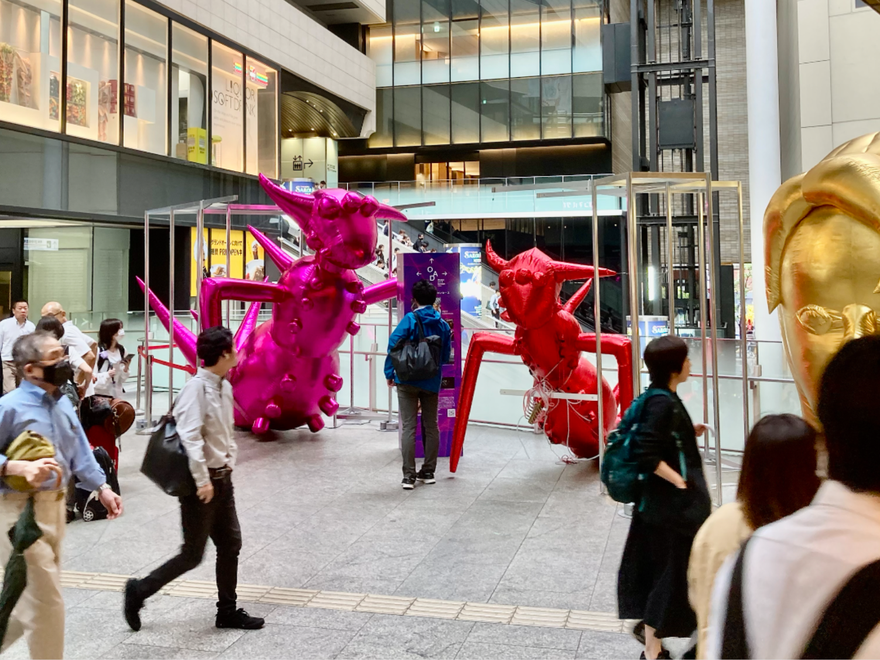
Art installation by Maki Takato in a train station
What advice would you give to current RCA students aspiring toward multidisciplinary practice and working across different materials?
First, I recommend collaborating with many people and trying various media. Through collaboration with other artists and companies, I've developed new materials and techniques for expression. You truly receive inspiration from unexpected places so often.
The RCA is a special place where excellent students and faculty from different fields gather. Don't be afraid of dialogue and collaboration with people outside your speciality – actively seek out opportunities. In my case, collaborations with students from Imperial College and the Royal College of Music greatly expanded my work's possibilities.
And don't fear failure. As it took two years to develop the Silver Screen series, by taking time for trial and error, you'll see what you truly want to express. In the process of remaking prototypes many times, there will be unexpected discoveries.
Finally, cherish your roots and background. In my case, my experience as a dancer and my Japanese cultural background are the wellspring of my work's uniqueness. Your individuality and experiences are what will generate work that no one else can imitate. Make the most of your time at the RCA to find your own unique expression.
Could you tell us about projects you're currently working on or exhibitions you're looking forward to?
Currently, I'm working on a collaboration with Katsuo-ji, a historic Buddhist temple in Osaka. This temple, visited by people from around the world, actively incorporates participatory experiential mechanisms as a place where people can discover new insights, not just as a religious facility.
I feel great potential in being able to explore contrasts between tradition and contemporaneity, individual and collective, momentary and eternal in the special place of a religious space.
I'm also currently establishing a studio with a base in Nagano. Nagano was a region where sericulture flourished, and I'm deeply interested in that history and culture. While renovating a kominka – a distinctive Japanese architectural form, a century-old traditional house – I want to create textile and fabric works using silk and raw silk. I want to challenge myself to revive the memory of the land and the stories that materials hold as contemporary expression.
Visit Maki Takato's website and her Instagram page.