Key details
Date
- 2 December 2025
Author
- RCA
Read time
- 4 minutes
The Royal College of Art (RCA), in collaboration with the Stockholm Environment Institute (SEI) at the University of York, and Wrexham University, announces the recipients of the third funding round in the Ecological Citizen(s) Network+ research project.
Key details
Date
- 2 December 2025
Author
- RCA
Read time
- 4 minutes
Ecological Citizens: Tools, Technologies and Means to Enable Sustainable Citizens unites experts in design, arts, science and technology to address the ecological and climate crisis. By leveraging the digital economy, the project aims to drive sustainable change beyond individual actions and to promote Ecological Citizenship for positive climate action through targeted interventions.
The project was awarded £3.4 million in 2023 by UKRI’S Engineering and Physical Sciences Research Council (EPSRC) to establish the Ecological Citizen(s) Network+, over 4 years.
The grant awarded by EPSRC has included three rounds of funding which will support innovative research projects, initiatives and pilots, devising new-found ways to encourage and explore Ecological Citizenship and its potential in moving us towards preferable futures. In this third round, under the theme Co-creating Everyday Ecosystems, the Ecological Citizen(s) Network+ is funding research projects that explore the co-creation of resilient, place-based Everyday Ecosystems to collectively transition to a Sustainable Digital Society, through Ecological Citizenship. Following an extensive review process the projects awarded funding are:

Flow.Walk.Drag.Everyday, Margate, EColi pool, by James McCauley
1) Flow.Walk.Drag.Everyday: Pooling with Microbes, Water and Communities for Multispecies Care and Resistance [Liverpool Hope University]
Flow.Walk.Drag.Everyday transforms climate anxiety into collective action through radical play and multispecies solidarity. The approach centres on ‘pooling’ – inspired by how water naturally pools in tidal zones and how microbes share survival resources through horizontal gene transfer. The project involves creating networks of mutual aid between Liverpool and Margate, two waterside communities facing unprecedented sewage discharge rates and environmental injustice.
2) Imagined Infrastructures: Creative and Collective Worldbuilding to Explore Ecological Citizenship Within Specialist School Provision [Queen Margaret University]
This project uses innovative, trans-disciplinary approaches to work closely with young neurodivergent people to explore their experiences of ecological infrastructures within a specialist school setting. Creative workshops and data gathering will provide new insights on how to create more inclusive environments that can aid in the development of ecological citizenship, and how educational systems must change in the face of the climate emergency.
3) Ecological Citizens’ Assembly: Rooted Deliberations with Everyday Ecosystems [University of Sheffield]
The initiative will stage two ecological citizens’ assemblies focused on food ecosystems – one at Regather Cooperative Farm, Sheffield, and the other within a digital twin on the computer game, Farming Simulator. The project will experiment with how emerging digital deliberation tools and digitally simulated environments, alongside place-based citizen climate assemblies, can strengthen and reimagine ecological democratic governance.
4) Nature-Centric Systemic Risk Tool for the Ecological Citizens of River Tone [University of the West of England]
The project will bring together the ‘people of River Tone’ to plan a new nature-centred systemic response to the risks the river faces (including flooding, pollution, habitat loss, and climate change) by creatively considering the viewpoints of the river’s animals, plants and fungi. Working alongside researchers and digital designers, this insight will be built into a 3D digital platform the community can use to help guide decisions on how to act in support of these nonhuman cohabitants.
5) Food Futuring: Co-creating a shared vision for Hertfordshire’s food system [Loughborough University]
Food Futuring is a place-based collective visioning project that brings together stakeholders from across Hertfordshire’s food system to co-create a shared vision for increasing resilience and regeneration in the region. From farmers to food banks, the diverse group will share their perspectives through a combination of in-person participatory workshops with large-scale digital deliberation tools.
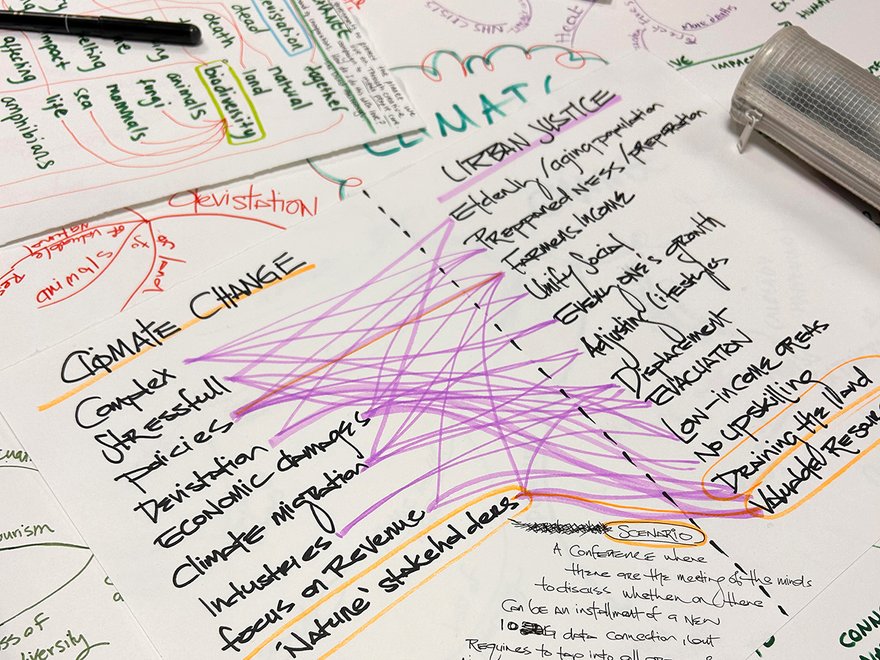
CARES, Resilient and Ecological Thinking, 2025, by Dr. Idrees Rasouli
6) CARES: Citizen Action for Resilient and Ecological Sustainability [Anglia Ruskin University]
CARES investigates how creative community-led design can strengthen everyday ecosystem resilience in climate-stressed urban environments across Cambridge and the wider Fenland. Central to the project is the CARE Platform (Community Atlas for Resilience and Ecology)—a co-created open-source digital atlas that visualises relationships between local assets and climate risks supporting communities to coordinate resilient food, water, and heritage practices.
7) Bristol Quiet Areas Plan 2025: A Citizen-Led Approach to Co-Create an Inclusive Map with Neurodivergent People to Define Quiet Spaces and Improve Mobility [University of Gloucestershire]
The project will identify the city’s most restorative urban spaces using soundwalks, co-creation workshops and accessibility audits to understand what makes a public space feel comfortable for people sensitive to sound or sensory environments. These insights into how public spaces support wellbeing, mobility and climate resilience will directly inform local strategies, and a new Quiet Areas Map will be hosted to help residents discover calmer routes across the city.
The project explores how academic research can partner with civic communities as project partners through co-creative, truly participatory processes, celebrating diversity, amplifying unheard voices, and understanding local ecosystems. The Network is looking to understand effective methodologies for tangible, action-focused work that connects people with everyday ecosystems, enabling Ecological Citizens to drive positive climate action.
More information about the third funding call can be found on the Ecological Citizen(s) Network+ website.
Ecological Citizen(s) Network+ is led by Dr Rob Phillips (Senior Tutor in MA Design Products / MDes Design Futures, School of Design, RCA) with Professor Sharon Baurley (Director of the RCA’s Centre for Materials Science & Culture and Tom Simmons (Head of Programme, MA Digital Direction, School of Communication, RCA), in partnership with Professor Sarah West, Centre Director of the Stockholm Environment Institute (SEI) at the University of York and Professor Alec Shepley of the Faculty of Arts, Computing and Engineering at Wrexham University, as well as a range of non-academic partners from industry, charities, culture and civil society.
Ecological Citizen(s) Network+ follows a number of initiatives at the RCA that have employed design innovation, technology and collaboration to promote awareness of, and increase access to, sustainable processes and products. These initiatives include; The My Naturewatch project, in collaboration with Northumbria Interaction Research Studio, the BBC and The Wildlife Trusts’ #30dayswild programme; the Terra Carta Design Lab – which invites students and alumni to design solutions addressing the climate crisis – as well as work carried out by the College’s Textiles Circularity Centre, funded by UKRI.
Conceptually, the notion of ‘Ecological Citizenship’ was published in a seminal position paper at the prestigious Cumulus Detroit conference in November 2022. This design-led work believes:
EC is defined as “activities that go beyond your own agenda, benefiting the wider ecologies, systems or communities surrounding you” (Phillips, et al., 2022).
As an ever growing research network, Ecological Citizen(s) mobilises diverse groups of people to make impactful change through accessible technology and community-focused approaches – including citizen science, activism, collective learning, advocacy, design strategies, creative arts, manufacturing, environmental science and engineering practices. As a pro-active collaborative community, the network has the potential to cover a wide range of pressing topics from biomaterials and wildlife corridors to local manufacturing and repair, and will draw on expertise from across the RCA, as well as other academic, business and civil society partners.
Ecological Citizen(s) Network+ is a NetworkPlus project funded by EPSRC grant EP/W020610/1 that is focused on digital interventions that would create ‘the conditions to make change’ towards a sustainable post-industrial society.

