ADS9: When Faith Moves Mountains
Jump to
‘Uno, una pala, una duna, una imagen. Quinientos unos, una pala cada uno, una duna, una línea, una imagen, una voz, quinientas acciones, quinientas acciones quinientas veces, una cima, el otro lado, quinientas voces, mil pisadas, quinientos descienden, quinientos palean... la arena cede, la duna se mueve, el viento sopla, una nube de polvo... y la duna sigue ahí.’
Tutors: John NG & Michela Falcone
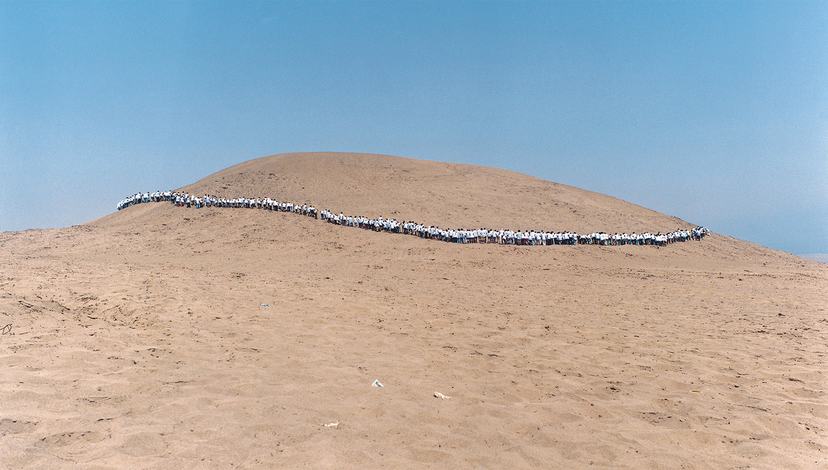
When Faith Moves Mountains, Francis Alÿs
“One person, one shovel, one dune, one image. Five hundred people, one shovel each, one dune, one line, one image, one voice, five hundred actions, five hundred actions five hundred times, one summit, the other side, five hundred voices, one thousand footsteps, five hundred descending, five hundred shoveling… the sand yields, the dune moves, the wind blows, a cloud of dust... and the dune remains there.”
When Faith moves Mountains, Cuando la fe mueve montañas, was an act of miracle.
On Thursday 11th April 2002, the artist Francis Alÿs, together with Cuauhtémoc Medina and Rafael Ortega, gathered 500 volunteers who were each armed with a shovel. Together they formed a single line at the foot of a 500-metre-wide sand dune in Ventanilla, on the outskirts of Lima. Their given task was precise and absurd:
‘Shift its crest a distance of four inches’.
Less than two years before, it was the final days of the Fujimori dictatorship preceded by the violent decades of the ‘Shining Path’. Lima was still bearing the burden of years of turmoil. Against this backdrop came emerging movements of resistance.
On that Thursday, most of the volunteers were students of Peru’s Universidad Nacional De Ingeniería (National University of Engineering). For one day, future engineers working alongside nearby residents, dressed alike in marked white t-shirts and dark trousers, became geological workers, transforming a shifting landform without machines. Under a scorching sun, 500 bodies walked shoulder-to-shoulder, and dug into the ground. Sand and dust flew into their eyes and mouths. Each shovel of sand moved a certain distance. Each footstep moved a little more sand.
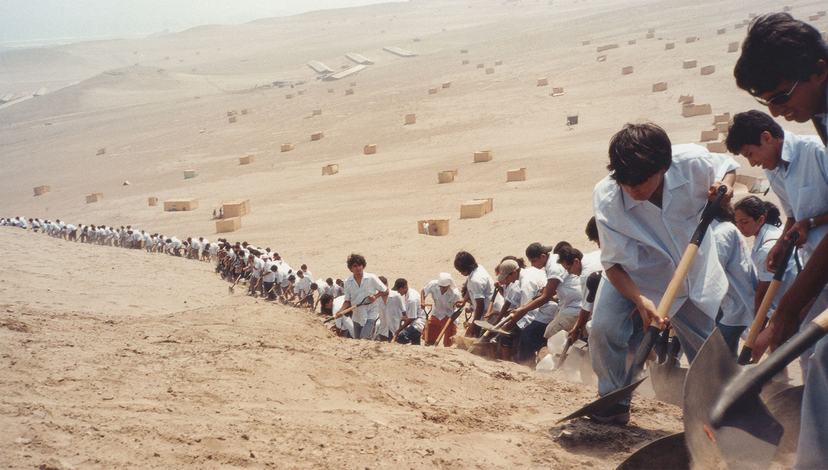
When Faith Moves Mountains, Francis Alÿs
Grain by grain,
step by step,
the dune shifted from its original position.
The displacement was infinitesimal. But it did happen. A few hours of human labour compressed decades of aeolian action into a single afternoon. The mountain moved. Not as a metaphor, not as an allegory, but as a geological fact.
For Alÿs, When Faith Moves Mountains does not concern itself with the realisation of a project. After all, by the end of the day the dune had moved on again by wind and gravity. Nothing remains of the action. It was an act of mass labour that was completely non-productive. 500 people performed a monumental action whose physical consequence was almost imperceptible, yet whose possibility depended entirely on acting together. It made a start and kicked off the possibility of change.
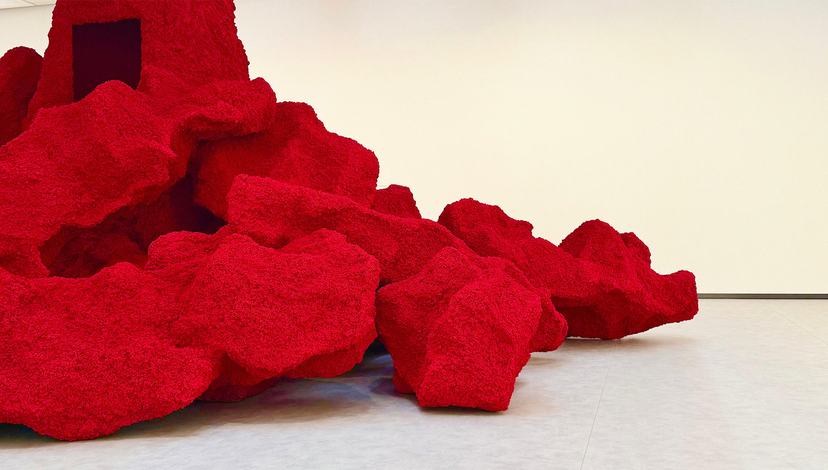
Ha Makom, Anish Kapoor
ADS9 has a deep commitment to creating architecture that is imbued with an urgent beauty. Space is our medium to express, embody, and enable knowledge, ideas, and life. Spatial experimentation is at the forefront of the studio’s methodology.
ADS9 experiments with prototypes and large-scale drawings. We use a highly iterative process which critically questions design. The design project will focus on a 5,000m2 building. For YR1, the spatial experimentation will be accompanied by technical investigation. In ADS9, YR2 students have always pursued deeply personal subjects and obsessions in their work. YR2 students will develop their own personal critical framework and design methodology to achieve a high level of architectural resolution.
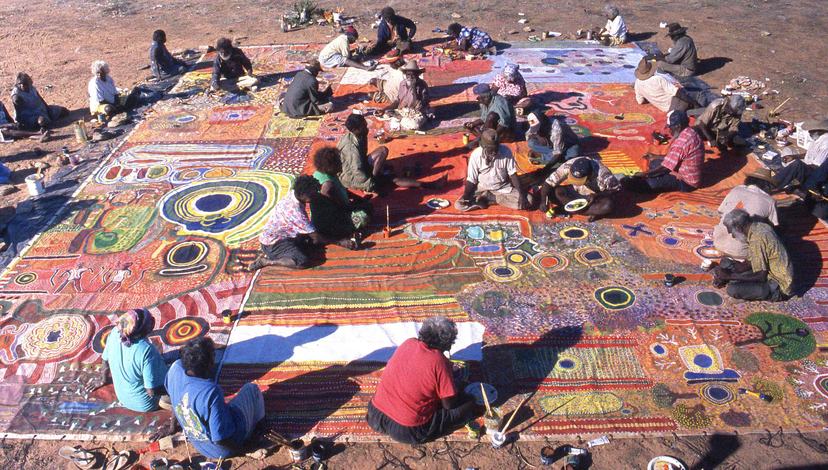
Ngurrara II, 43 Ngurrara artists
In 2026/27, ADS9 asks students to search for how people attune to land.
Like the 500 volunteers in When Faith Moves Mountains, we search for collaborators who may offer us an understanding and perception of land through acts of inhabiting the land. There is an empowerment and knowledge to be rediscovered in the historical and generational understanding of land and how it shapes the way we inhabit space. How do we project this forward to include the uprooted? The wanderer? The global cosmopolitan and future generations yet to come? How do we extend this understanding beyond humans to include the rights of all living things?
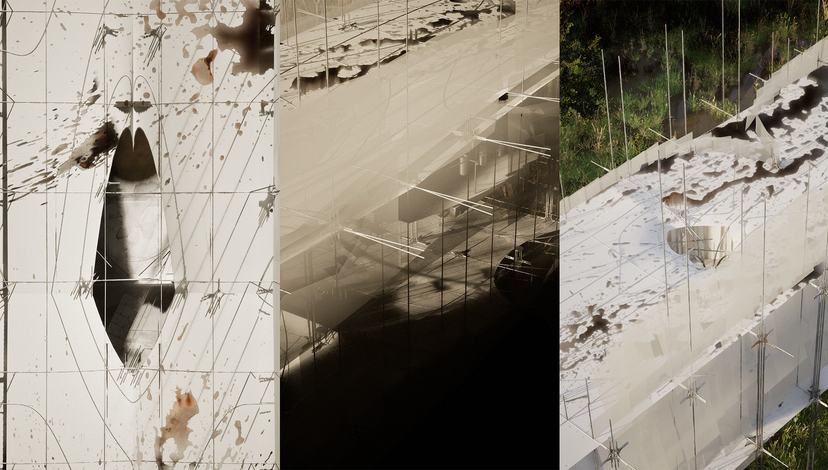
Previous ADS9 Student Work, Anna-Elina Pieber
ADS9 asks students to determine on a scale of land to investigate, from looking in close–up at land and its material composition, or by expanding out to a territorial scale. Each student will be asked to develop a comprehensive study of land that covers forms of living, (hi)stories, meanings, processes, politics, and the economy. The search and research will be compiled into a dossier to understand how these forces are embodied within land and architecture.
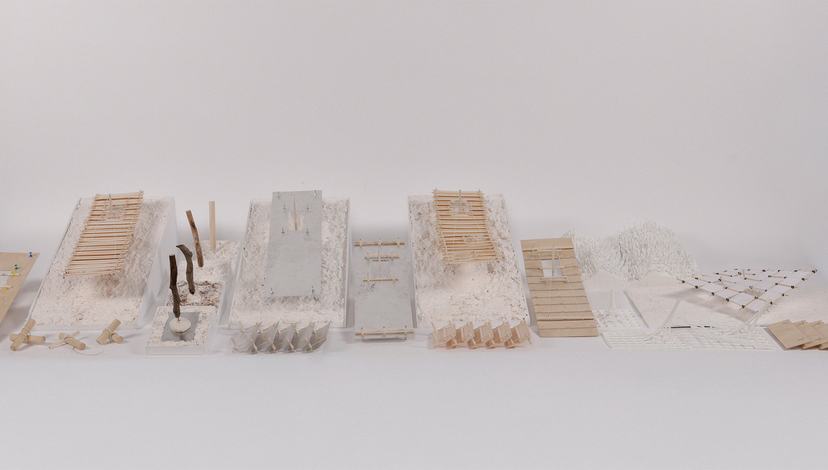
Previous ADS9 Student Work, Chitsanpuong Runglertnirund
In parallel, ADS9 will investigate an individual architectonic experimentations of how architecture touches the ground. This will be developed through a series of experimental prototypes that can re-examine the relationship between architecture and land, and, by extension, the relationship of humans to something greater than the sum of us all.
We ask: Can you imagine a form of beauty that is as absurd, futile, ludicrous, purposeless and useless? We ask not so much what it means, but: what could architecture do with this?
In short, we ask for nothing less than ‘a tiny miracle’.
Tutors
John Ng
John Ng has been an Associate Lecturer at the RCA since 2017. He studied architecture at the University of Bath and the Architectural Association, where he has taught since 2011. He founded ELSEWHERE and practises architecture in London. His work has been shortlisted for, and has won, a number of international competitions.
Michela Falcone
Michela Falcone is an architect and educator with international experience, having worked with Shigeru Ban and Zaha Hadid Architects. She teaches at the AA and Buckinghamshire University, with research on spatial complexity and contemporary practice. Cofounder of Falcone Cavaliere, her projects have been exhibited internationally, including at the Venice Biennale.