ADS8: Sports Stories: Liminal Grounds
Jump to
ADS8 Sport Stories explores the spaces of sport as a critical lens to investigate emerging zones of environmental, social and political tensions, as well as the opportunities they generate. The underlying thesis of ADS8 is that the spatial dimensions of sport unfold across scales from the body to the city and the environment. These scales bring collective life into contact with a series of critical thresholds – cultural, urban, environmental, and technological – that each represent a liminal con
Tutors: Ippolito Pestellini & Erica Petrillo (2050+) & Marisa Musing
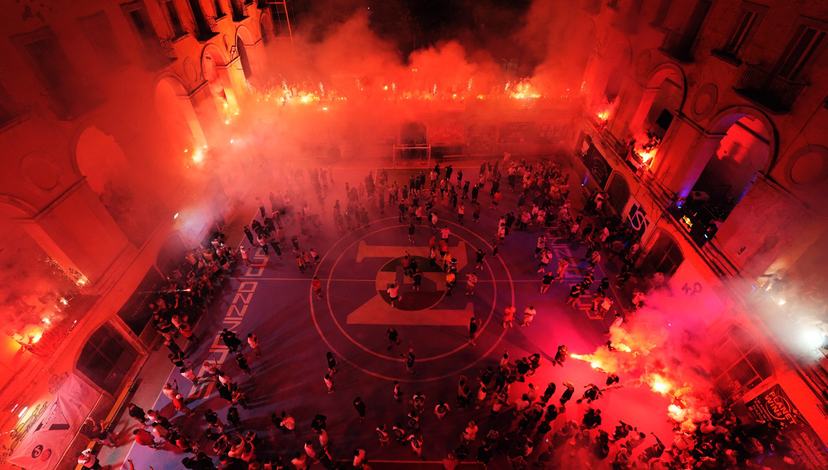
Every year, the courtyard of a late-sixteenth-century former convent in Naples hosts the Scugnizzo Cup, a grassroots five-a-side football tournament. Founded in 1585 as the convent of San Francesco delle Cappuccinelle, the complex was later transformed into the Filangieri juvenile prison and, after years of abandonment, reclaimed in 2015 as Scugnizzo Liberato (Neapolitan for ‘Liberated Street Kid’), a self-managed urban commons. Matches are played within its historic cloister, with spectators pressed against the touchline or overlooking the pitch from the surrounding balconies, reproducing the intensity and immediacy of a street playground. Teams representing different Neapolitan neighbourhoods adopt the identities of clubs from cities across the world – Manchester City, Bayern Munich, Barcelona, Galatasaray, and Olympique de Marseille among others – producing a symbolic network of affinities between Naples and a wider geography of football cultures. Promoting street football and youth participation, the tournament temporarily transforms a space once shaped by enclosure and discipline into a stage for collective occupation, neighbourhood identity, and public life.
This case study reveals how sport is shaped by the spaces that host it, and how those same spaces can become architectures of exclusion, political battlegrounds, or rehearsals for another kind of society. The rules of a game may appear self-contained, but the bodies, spaces and social conditions within which it is played never are.
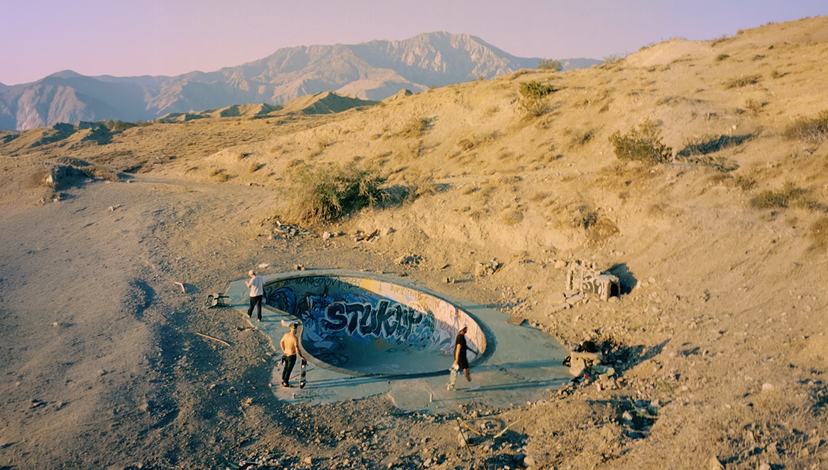
Skateboarders train at an Abandoned Pool in LA. Photo: Tino Razo, 2010
Cities & Commons
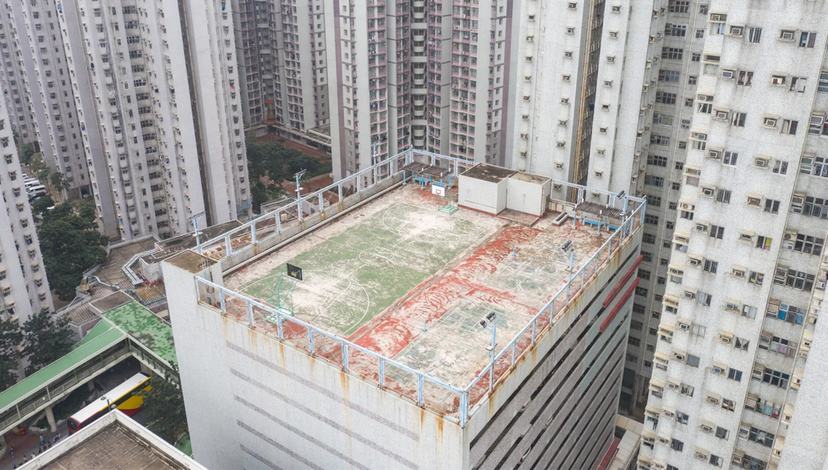
Rooftop Baseball Court in Hong Kong. Photo: Austin Bell, 2017
'Our point of departure must be the conception of an almost childlike play-sense expressing itself in various play-forms, some serious, some playful, but all rooted in ritual and productive of culture by allowing the innate human need of rhythm, harmony, change, alternation, contrast and climax, etc., to unfold in full richness'.― Johan Huizinga, Homo Ludens: A Study of the Play Element in Culture (1938)
Cities have long been the backdrop for everyday, informal sport; played in streets, squares, parks, vacant lots, car parks, or unfinished buildings. In these contexts, sport does not simply occupy public space. Rather, it is one of the practices through which publicness is defined and reclaimed. Here, sporting architecture is concerned less with containing activity, than with enabling bodies to gather, move, improvise, and claim space collectively. At stake is not the provision of exercise space alone, but the preservation – and invention – of spaces where common life can emerge unprescribed, unsurveilled, and uncommodified.
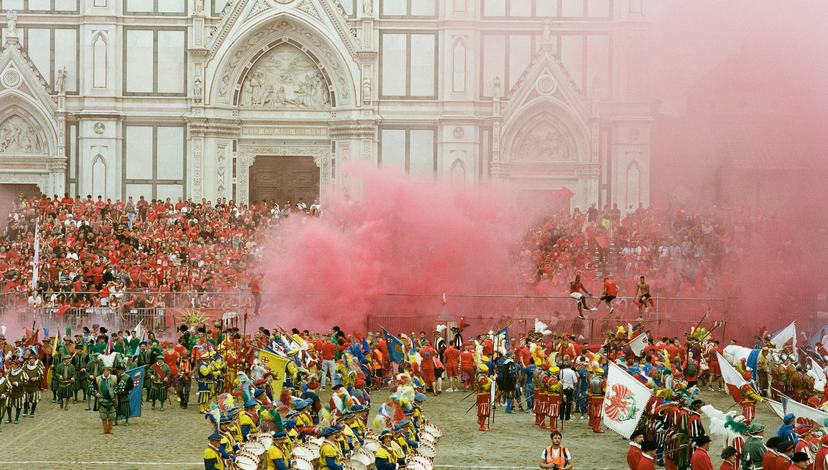
Zara Pfeifer, ‘Calcio Storico’, 2025
This matters because public urban spaces are progressively under threat. Privatisation, redevelopment, hostile architecture, policing, and surveillance are all steadily narrowing the range of activities tolerated within them. Streets and squares may remain publicly owned, while becoming ever more prescriptive in how they can be inhabited. Informal gathering, lingering, loitering, noise, play, and unscripted occupation are precisely the behaviours most easily designed out.
This erosion is not abstract. Across the UK, more than 900 public football pitches have disappeared since 2010[1], while many of those that remain are increasingly subject to controlled access. In London alone, 20% of natural-grass football pitches and 41% of grass cricket pitches have been lost since 1990[2]. Elsewhere, formerly open playing fields have been fenced off, locked or converted from turn-up-and-play spaces into formal pay-to-play facilities.
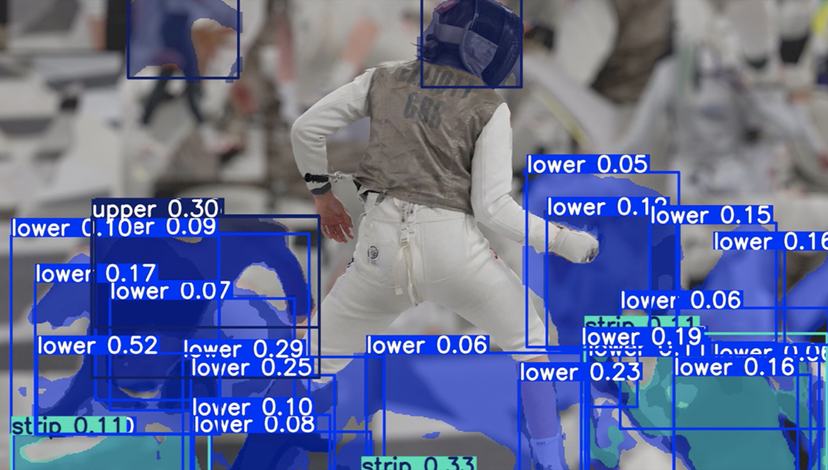
Luke Yeulett, Scraping the Piste, ADS8: Sports Stories, 2025/26
Today, access to public space is also inseparable from the accelerating climate crisis. In an overheating city, the ability to gather, play, or simply remain outdoors increasingly depends on the availability of shade, vegetation, water, and other forms of climatic strategies. Climate mitigation is therefore becoming a condition of access to sport itself. Whether a pitch, court, or playground remains usable increasingly depends on how urban space is shaded, cooled, and maintained. The right to a ‘playable’ public space is increasingly also a right to climatic refuge.
As accessible play areas vanish, so too do the material, climatic, and symbolic conditions that support informal, unregulated sporting practices. From street soccer to skateboarding, basketball to calisthenics and cricket, these activities thrive in interstitial urban spaces, fostering community, inclusion, and often intersecting with the DIY languages of music, fashion, art, and design. Unlike the highly codified environments of professional sport, these spaces depend on publicness and improvisation. Players establish boundaries, invent rules, accommodate strangers, and temporarily claim territory. Their value lies precisely in this open-endedness and improvisation. A community, a surface and a ball can be enough to produce a small social contract, and with it, a temporary urban commons.

Esmaa Mohamoud, One of the Boys, 2018
Other Intersectional Questions
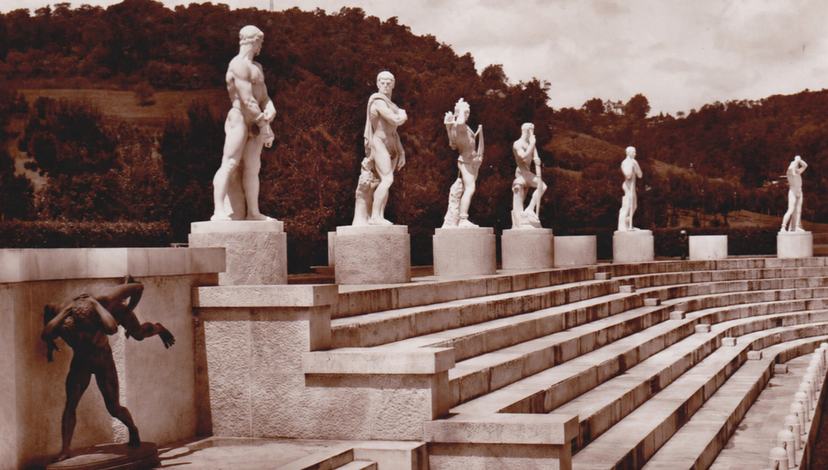
Statues decorating the Stadio dei Marmi, Rome 1930
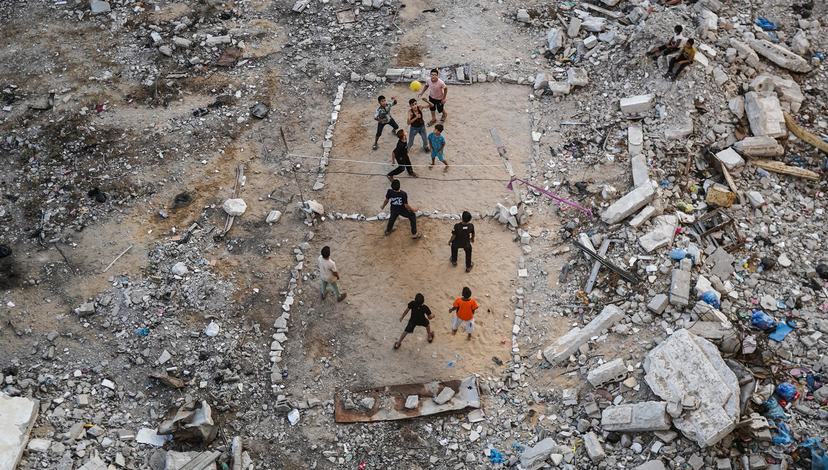
Sport, it can be argued, is a ‘total social fact’. A phenomenon that cuts across multiple spheres of social life – economic, political, legal, religious and aesthetic – at once.¹ What happens on a field, in a pool or inside a stadium is never confined to sport alone[1].
What makes sport particularly revealing is its capacity to contain opposing realities at once. It can reproduce some of society’s most entrenched structures, while simultaneously becoming a testing ground for their transformation. Across questions of gender, disability, technology, race, nationality or political power, sport often offers both an unusually accurate mirror of the present and a glimpse of what might come next. This tension can be understood most clearly through four interconnected themes: bodies, sites, genders and identities.
ADS8: Sports Stories: Liminal Grounds
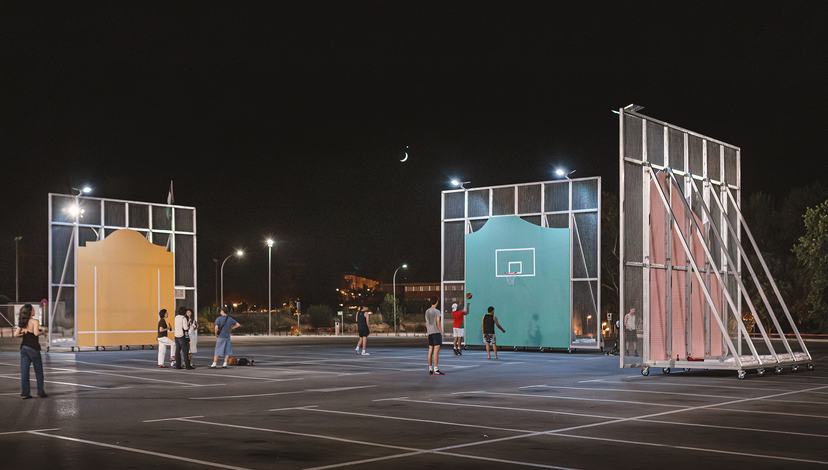
Logrono’s community engaging with Frontones Danzantes. 2050+, Concéntrico Festival, 2026
ADS8 Sport Stories explores the spaces of sport as a critical lens to investigate emerging zones of environmental, social, and political tensions, as well as the opportunities they generate. In this context, the studio embraces an expanded definition of sport, encompassing Olympic and non–Olympic disciplines alike, as well as non-traditional or ‘non-obviously sportive’ practices: activities centered around bodies in movement, play, or community initiatives, which challenge conventional definitions of sport and physicality.
The underlying thesis of the studio is that the spatial dimensions of sport unfold across scales – from the body to the city and the environment – and brings collective life into contact with a series of critical thresholds: cultural, urban, environmental, and technological. Each one represents a liminal condition, both metaphorically and physically: a space in between, which resists precise definitions, and through which tensions are negotiated and other forms of collective life can take shape.
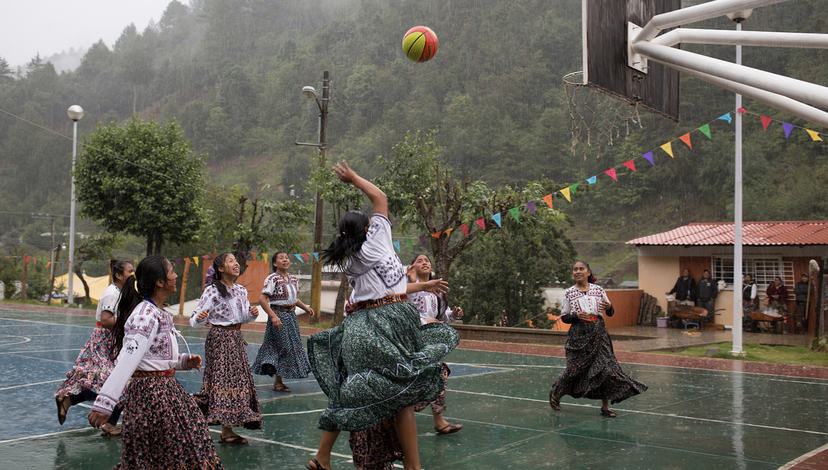
Women playing Basketball at a Cancha Campesina, Mexico. Photo: Alicia Vera, 2021
Tutors
Ippolito Pestellini Laparelli
Ippolito Pestellini Laparelli is an architect and curator whose work encompasses technology, politics, design, and environmental practices. Formerly a partner at OMA/AMO, in 2020 he founded architecture studio 2050+ in Milan to deploy space as a medium rather than a goal, carrying out various projects that span curatorial and research practices, exhibition design, scenography, and architecture. In 2018, Pestellini co-curated Manifesta 12 The Planetary Garden. Cultivating Coexistence, in Palermo. In 2023, he served as President of the Jury of the 18th International Architecture Biennale in Venice. Since 2017, he has been teaching at the Royal College of Art in London. His work has been shown and published internationally across a range of media, institutions, festivals, and exhibitions.
2050+ is an architecture studio based in Milan, working across diverse forms of critical spatial practice at the intersection of technology, politics, and the environment. Founded in 2020, the studio develops projects in architecture, exhibition design, and curatorial practice, as well as independent research that includes moving images and critical writing. 2050+ also collaborates with fashion brands on temporary installations, special events, and films, and is actively involved in academic teaching, leading the design studio ADS8 – Sport Stories at the Royal College of Art in London.
Erica Petrillo
Erica Petrillo is a curator with a background in political philosophy and social sciences. A partner at Milan-based architecture studio 2050+, she develops curatorial and research projects spanning architecture, design, contemporary art, and moving images. Her work has been presented at institutions and cultural platforms including the Venice Architecture Biennale, Triennale Milano, Jan van Eyck Academie, BASE Milano, ADI Design Museum, and Video Sound Art Festival. Formerly a curator at Triennale Milano and a Research and Development Fellow at MoMA in New York, she teaches at IED Milano and, with 2050+, at the Royal College of Art in London, where she co-leads the design studio ADS8. She holds degrees from the University of Cambridge, Università degli Studi di Milano, and Maastricht University.
Marisa Müsing
Marisa Müsing is a transdisciplinary artist and designer exploring the entanglements of the body, architecture and digital identity through feminist lenses. They are completing a PhD at the Royal College of Art (RCA) in London on queer cyberfeminist investigations of ancient frescoes, and are a tutor for the RCA design studio ADS8. Marisa has exhibited work at the Royal Academy of Arts, Fringe Arts Bath, the British Academy, Salone del Mobile, New York Design Week, Collectible Art Fair, Ethereal Maison, Restless Egg, Xpace Cultural Centre and Espace Temps, and have been featured in Toe Rag Magazine, Glitch Magazine, Hypebae, WGSN, Dezeen, Vogue, and the New York Times. They have previously lectured at Parsons School of Design, Harvard GSD, Rhode Island School of Design and taught at ELISAVA Barcelona School of Design and Engineering.
