ADS5: Stoffwechsel
Jump to
‘A chair is a very difficult object. A skyscraper is almost easier’. Mies van der Rohe was not being modest. A chair has no site to hide behind, no programme to excuse it, and no façade to distract from the joint. It can be picked up, turned over, sat on, and judged by a body within seconds. Every decision – where the load goes, how two materials meet, what is shown, and what is concealed – is exposed at arm’s length. It is architecture without the alibi.
Tutors: Nerissa Yeung, Alex Cotterill & Amin Taha (GROUPWORK)
This year ADS 5 begins here. With these difficult objects.
Before a site, before a building, before a folly, each student will make furniture: stools, benches, chairs and tables from timber, stone and found material salvaged from demolition, offcuts, rejected quarry blocks, the leftovers of other people’s making.
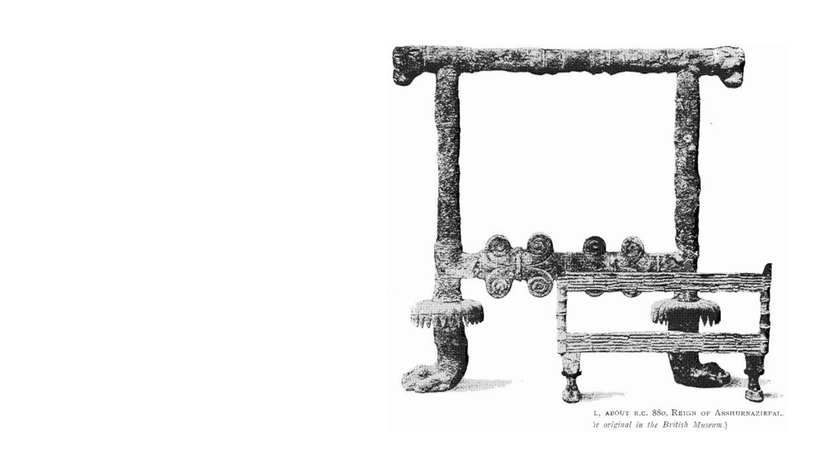
Assyrian Bronze Throne and Footstool, illustration from ''Illustrated History of Furniture, From the Earliest to the Present Time'' from 1893 by Litchfield, Frederick, (1850-1930)
This year ADS 5 begins here. With these difficult objects.
Before a site, before a building, before a folly, each student will make furniture: stools, benches, chairs and tables from timber, stone and found material salvaged from demolition, offcuts, rejected quarry blocks, the leftovers of other people’s making.
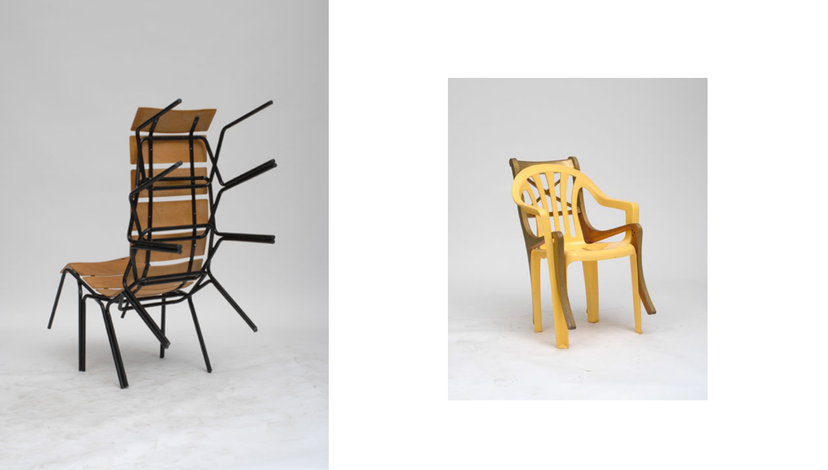
Right: Two-some (14 July 2006), Martino Gamper, Photographed by Angus Mills and Abake. Left: Multiple choices (17 September 2007), Martino Gamper, Photographed by Angus Mills and Abake.
We will work in the manner of Martino Gamper, whose 100 Chairs in 100 Days rebuilt discarded chairs into new ones at the pace of one a day. Or like Max Lamb, who casts pewter in beach sand, splits and dry-stacks quarry stone into seats and turns his grandfather’s felled tree into stools. Or like Mike Hewson, who puts sandstone boulders on castors, on bar stools and into playgrounds so that geology becomes furniture, and furniture becomes play. All three of these designers treat material as something found rather than specified, and the joint as the place where the idea lives.
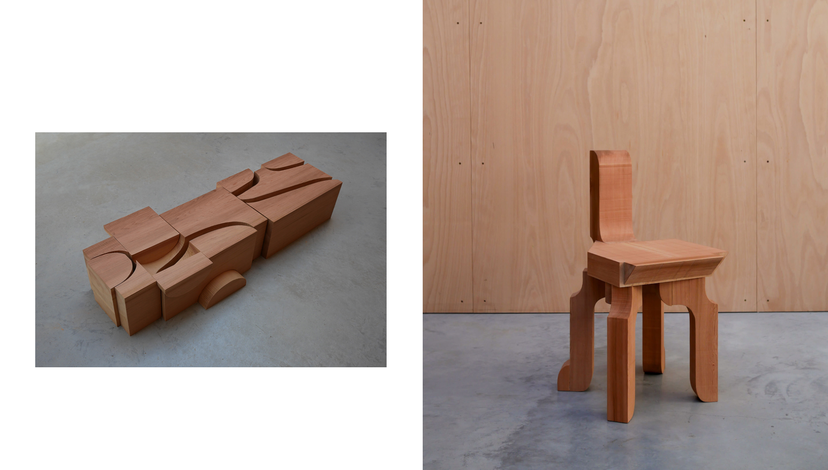
Max Lamb, ‘6 x 8 Chair’, 2021, COURTESY: Salon 94 and Max Lamb
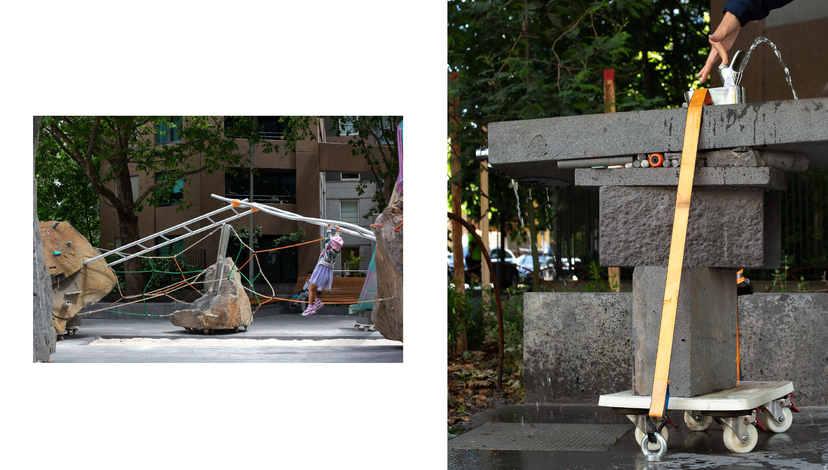
Left and Right: Rocks On Wheels 2022, Mike Hewson, Southbank, Melbourne
For us, the imperative of the architectural joint is much older. In 1850, exiled in London after the Dresden uprising, Gottfried Semper walked the galleries of the British Museum where Austen Henry Layard’s discoveries from Nineveh were being unpacked. Among the reliefs of kings and lion hunts Semper studied a stool – a plain Assyrian seat with turned legs, bound joints, and a fringed cushion – and saw in it the entire history of making. The turned leg remembered the lathe and the branch. The binding at the joint remembered cord. The fringe remembered woven cloth. All these details had been rendered in cast bronze and carved stone, the earlier materials surviving only as motif. Semper called this Stoffwechsel: a material change in which the original form of a material is translated into a new material that bears traces of this inheritance.
Stoffwechsel is the title of this year’s studio as it names what ADS5 will ask students to do. They will make in one material with the full knowledge its origins lie in another, and to decide, consciously, what to carry over and what to leave behind.
Semper inherited the question from Karl Bötticher, whose Tektonik der Hellenen (1844–52) split every element of building into two categories: the Kernform, the core form that does the structural work; and the Kunstform, the art form that clothes it and explains its work to the eye. A Doric capital is a Kunstform: it does not hold the beam, but it tells you that the column does.
This year each piece of furniture will be drawn, made, and read through that duality. What is the Kernform in this stool? What is the Kunstform? Where does the second lie about the first, and is the lie a good one?
Ethics remain our measure. Timber, stone, and spolia are not chosen for nostalgia, but because they are low-carbon structural materials that are readily available to us. And because we believe a chair leg you have cut, jointed, and sat on teaches more about structural and material honesty than any lecture. Embodied carbon, structural performance, fire, cost, and weathering will be introduced through the furniture, and then translated and scaled up during Terms 2 & 3 into the building component and the building.
The stool is the first brick.
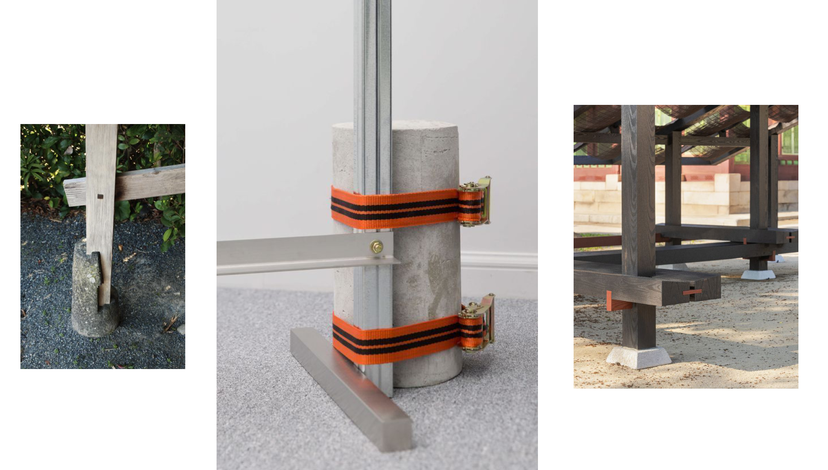
Left: Overlapping joint, kinokoji exblog. Middle: Creative Studio Unravel, Photography: Sunghoon, Han. Right: Structure 02, Baek Jonghwan, WGNB,
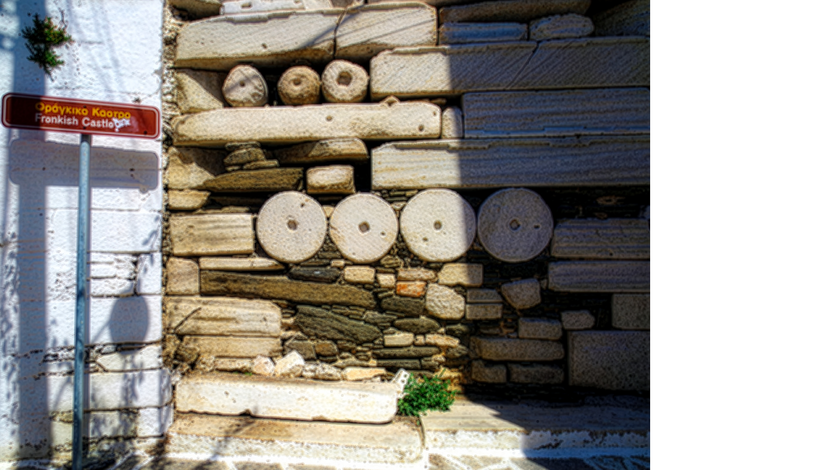
Frankish Castle in Parikia, Paros
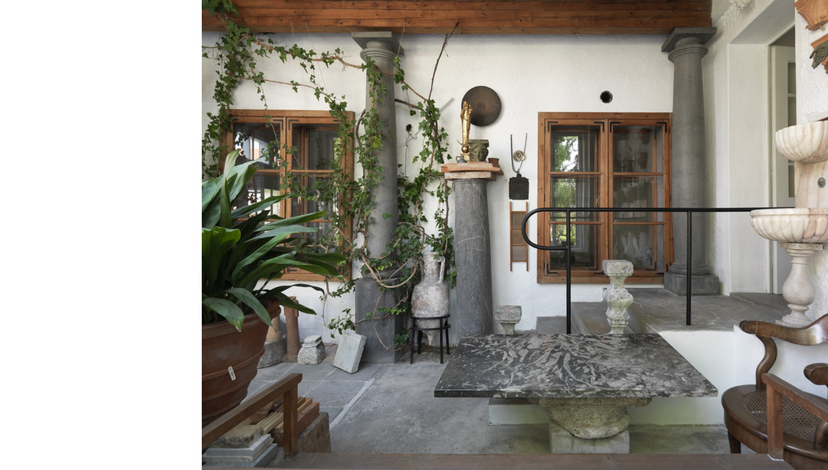
The Plečnik House, Photography: M. Paternoster
A Lexicon of Joints: An Ethical Framework Built at 1:1
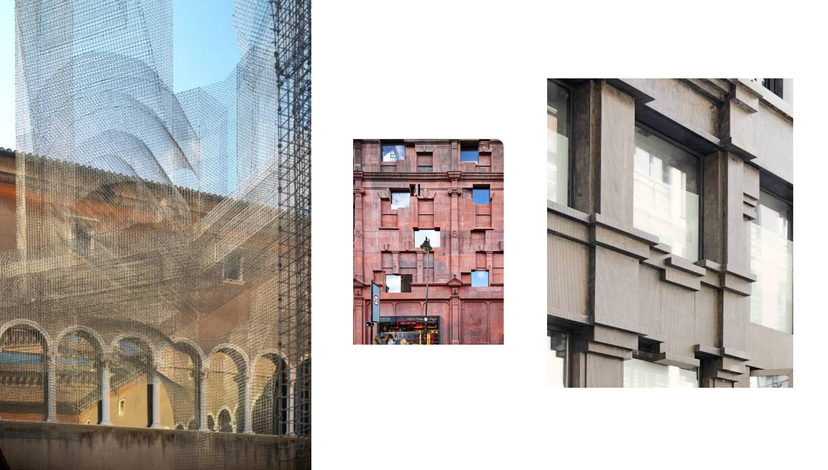
Lef: Edoardo Tresoldi, Sacral, Photos by Roberto Conte. Middle: Upper Street, Credits: GROUPWORK, Timothy Soar. Right: Greville Street, Credits: GROUPWORK, Timothy Soar.
ADS5 treat furniture as 1:1 architectural propositions. These pieces suggest a way to investigate material, junction, detail, labour, tectonic assembly, and construction. Each student will design furniture through research from contemporary interpretation of spolia.
Historically, spolia describes the reuse of architectural elements: columns, capitals, inscriptions and fragments. What might spolia mean within today’s construction industry? How might the reuse of existing materials respond to conservation, embodied carbon, circular construction, and regulatory framework? What are the cultural, political and technological implications of repurposing, and how might digital mannerism enter this process?
To start the year, each student will physically make a piece of furniture through Semper’s principles of joining, binding, and completing. Materials could be sourced from unloaded stone salvaged from stone masons’ yards, standardised component from a builder’s depot, second hand furniture shop, demolition sites, and dimensioned timber from the RCA workshops. We will experiment with how they are joined through tension and compression, creating a dynamic between kernsfrom and kunstform, and expressing the ideas of stoffwechsel.
Mannerism describes the consequence of repeating and evolving these details. The lexicon of joints developed will then become the vocabularies of an architectural system developed in individual projects.
Tutors
Amin Taha
Amin Taha is one of the founding partners at GROUPWORK, an employee ownership trust of architects and designers based in London, UK. Three times shortlisted for the Royal Institute of British Architects Stirling Prize for best building of the year; their work has been described as materially rational and poetically surreal. The studio has helped spearhead research and application of contemporary uses of stone and hybrid stone-steel in construction from houses to 80 storey towers to help achieve both carbon negative outcomes in material construction and building operation. Amin has a permanent teaching post in the school of architecture at the Royal College of Art, London and held visiting professorships at Harvard’s GSD, Yale and is currently the Frank Gehry Chair at Daniels School of Architecture, University of Toronto.
Alex Cotterill
Alex Cotterill is an architect at Groupwork. He studied at UCL and University of Brighton. He has led efforts in materials research, including laminated waste stone and stone exoskeleton structures. Alex has contributed extensively to architectural education, having served as Head of Third Year at the University for the Creative Arts.
Nerissa Yeung
Nerissa Yeung is an Architect at GROUPWORK. Alongside professional practice, she specialises material research on stone vaults, pre-tensioning systems and structural timber across housing, mixed-use, infrastructure and cultural spaces. She studied at Bartlett School of Architecture, UCL, and the Architectural Association.