ADS4: Petrol, Power, & Pantomime
Jump to
‘Toxic definitions of masculinity pose a threat to the livelihood of our planet’.—Liz Plank, For the Love of Men (2019)
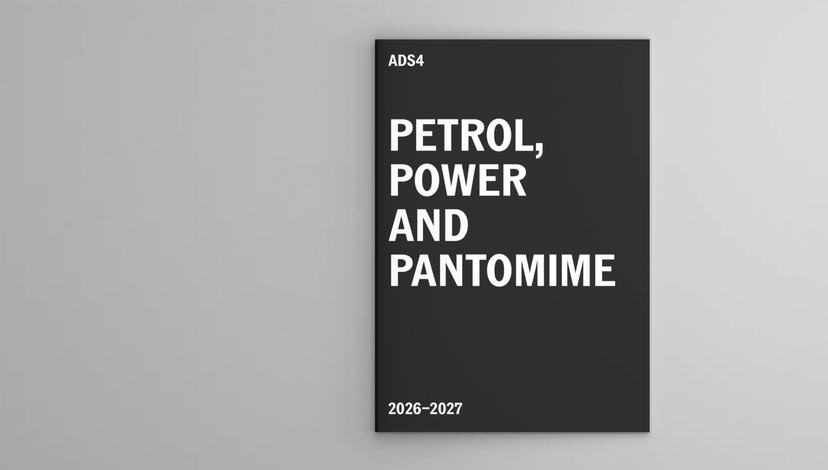
ADS4 Brief Document: Petrol, Power, & Pantomime
Writing this brief was a struggle. It is the beginning of August, and we are in a single-glazed, non-air-conditioned studio in East London enduring the fifth heatwave of the year, distracted by the news that the largest El Niño in living memory will bring a sixth heatwave before the month’s end. As drought is announced across the UK, schools close, trains derail, and wildfires continue to rage, Andy Burnham began his tenure as Prime Minister by announcing he will take a ‘pragmatic approach’ to North Sea oil and gas extraction, with fossil fuels offering a ‘bridge to a renewable future’. Sigh. As the planet warms, new authoritarian movements in the global north are embracing a toxic combination of climate denial, racism, and misogyny. Local councils under the control of the attention-seeking Reform Party are banning pride flags with as much passion as they scrapped net zero pledges.
This year ADS4 will explore the concept of 'petro-masculinity’ to examine the intersection of environmentalism and masculinity, and the historic role of fossil fuel systems in promoting white patriarchal rule.
Petro-Masculinity
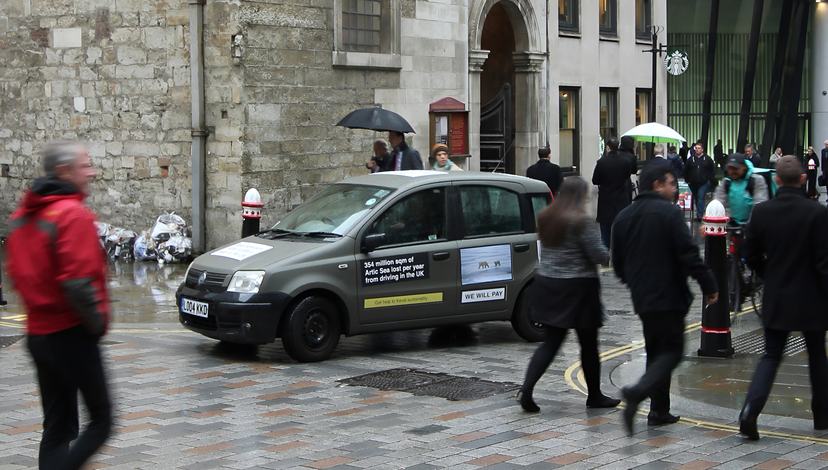
Environmental warning car: ADS4 Live project with Extinction Rebellion, 2020
The term petro-masculinity was coined by the political scientist Cara Daggett to describe the interplay between fossil fuel use, climate change denial, and the defence of white patriarchal masculinity. If fossil fuel extraction and consumption are coded ‘masculine’, and environmentalism and green technology are coded weak and ‘feminine’, petro-masculinity tracks how insecure men have leant into a fossil-fuel inflected identity. An identity that allows them to reassert conventional masculine authority in the face of changing social norms, climate change, and threats to extractive industries. Such beliefs are reinforced by the petro–chemical industry through advertising, lobbying, and other forms of messaging.
Petro-masculinity is important to understand the social and cultural dimensions of the climate crisis, the politics of energy, and how gender might affect our ability to have a shared ecological vision. Although misogyny and extractivism are common features of authoritarian movements around the world, they are often seen as discrete problems. Petro-masculinity reminds us that these issues have developed through and shaped one other. Gender anxiety is climate anxiety, with misogynistic violence tending to emerge out of environmental apathy.
Addressing petro-masculinity (and other contemporary issues like it) requires a multifaceted approach that goes beyond environmental sustainability. It involves recognising the intersection of gender, race, class, and political power in energy systems, whilst also demanding that we work towards more socially equitable and just transitions to renewable energy sources. This requires (amongst myriad other things) incorporating feminist, social justice, and intersectional perspectives in energy policy and decision-making.
Too many discussions of energy transition assume that solutions are a matter of fuel substitution: unplug the bad fuel and plug in a better one (solar or wind). This leads to a technocratic and—as Sherilyn MacGregor contends—arguably ‘masculinised’ focus on cost, efficiency, and capacity, and a tendency to neglect the political and social struggle that is required to dethrone fossil-fuelled power.
By challenging the culture of petro-masculinity, ADS4 hopes to develop an architecture that is socially and politically transformative before it is (or in order that it be) environmentally sustainable.
Fossil Fuelled Architecture

Wallmart Tote Bag, available c.2010
The concept of petro-masculinity suggests that fossil fuels mean more than profit; they also contribute to—if not determine—the formation of cultural identities. In the 1980s, both Ronald Reagan’s re-ignition of the ‘American Dream’ in the US, and Margaret Thatcher’s evocation of the proverb that ‘an Englishman’s home is his castle’ to promote her notion of property-owning democracy in Britain, were visions that were dependent on an abundant supply of cheap fossil fuels. As a result, a link that had been emergent throughout the twentieth century—between cars, suburbs, and the nuclear family—was cemented; a link that also entrenched heteronormative ways of life in urban and suburban spaces. Donald Trump’s “Drill, baby, drill!” motto is therefore a form of petro-nostalgia, reinforcing the apparently inextricable bond that exists between the American Dream and oil.
Petro-masculinity clearly has spatial and architectural consequences. But those consequences are downstream of a dependency on oil that consistently produces insidious social movements and identities. To imagine alternatives is both to question outmoded, misogynistic spatial conventions and to challenge fossil fuel dependency itself.
Pantomime
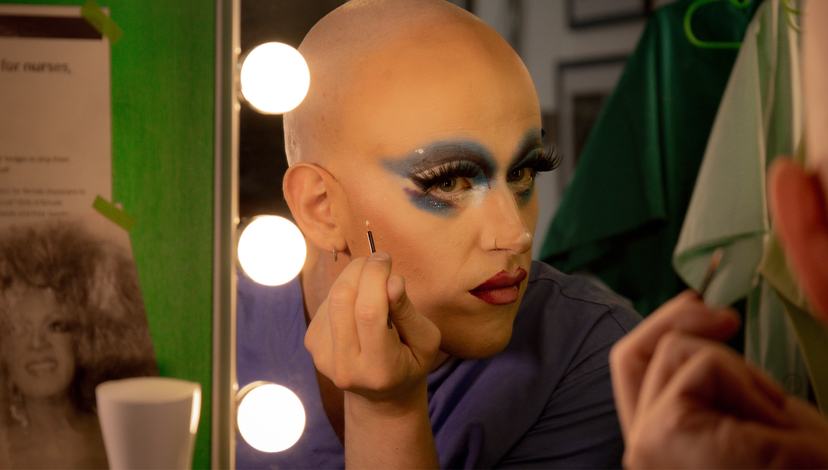
Will Edwards, ADS4 2026
'There is no greater threat to humankind than our current definitions of masculinity'—Liz Plank, For the Love of Men
Liz Plank’s provocation holds true at multiple levels, from the most intimate (how male partners are the leading cause of death for pregnant women in the US) to the most macro (how associating eco-conscious behaviours with femininity and a repudiation of masculinity is literally killing the planet).
The culture industry promotes certain associations that promote problematic forms of masculinity. Feminist discourse has consistently drawn attention to them; one particular aspect will guide our thinking this year—destruction.
Films, books, television, and other media consistently frame destruction as masculine and being nurturing, caring or restrained as not. Knocking things over, smashing things up, or reducing the world to rubble, are behaviours that are nurtured from a young age in boys—justified by the idea that “boys will be boys”. Moments of destruction find their purest expression in the destruction “set pieces” of Hollywood cinema and network television. This attitude arguably legitimates attitudes towards destruction and demolition in the real world.
How can these attitudes be deconstructed? How can the massified and masculine images of destruction that saturate our screens be replaced with a more socially, and environmentally, equitable form of disassembly? And how might this change society tout court?
Paul B. Preciado suggests that gender is not a natural fact, not a private identity, but a political technology that arranges bodies into systems of labour, visibility, and value, determining who is a subject and who is a structural tool. In addition, Judith Butler, in her work on gender performativity, argues that gender is not an internal, fixed truth about who you are, but rather something you do through a continuous series of repeated actions. These actions are gender; and even though Butler is keen to emphasise that gender is not a voluntary mask that one decides to perform with like an actor on a stage, nonetheless alternative ways of performing, nonconforming actions progressing the social reality of gender, can often be found on stage.
Indeed, theatre has always embraced gender nonconformity. From the Romans playing women long before women were allowed to play themselves, to Shakespeare’s portrayal of gender roles as socially constructed, frequently using cross-dressing, subversion, and shifting power dynamics to challenge rigid Elizabethan expectations, to pantomime—a traditional form of theatre that originated in the Renaissance era, was honed during the Victorian era in the UK, and remains a popular form of mainstream theatre across the world.
In the Victorian era when LGBTQ+ identities were marginalised or hidden, pantomime offered a rare and socially acceptable outlet for gender non-conformity and queer expression. Wrapped in the safe packaging of tradition and humour, the ‘pantomime dame’ (played by a man) and the ‘principal boy’ (played by a woman) allowed performers to explore ideas of identity, sexuality, and self-presentation in a way that was both public and protected. But while both pantomime dames and drag performers are male entertainers dressed as a woman, one was accepted by society as far back as the 1600s and the other faced discrimination and criminalisation.
The difference in public sentiment towards panto dames and drag queens comes down to their different histories. Drag artists are seen as a representation of the queer community who are always at the forefront of LGBTQ+ rights; panto dames are not. Today, with the gradual erosion of LGBTQ+ rights, where trans people are subjected to hate crimes and media vitriol, consideration for how our performance of gender affects our attitudes towards it off stage is important. So, can the wildly popular gender bending of pantomime—and theatre more broadly—offer clues towards a performative methodology to counter the perfidious narratives of the petro-masculine political class that currently dominate climate leadership?
Pantomime’s potential to achieve this objective is its propensity to develop alternatives to the set pieces of destruction that dominate the contemporary media landscape—particularly in short-form video content. Panto’s tradition of pausing narrative so that a different kind of work can take place—often reliable variations on a theme of call and response (“He’s behind you!” and “Oh no he isn’t!”, for example)—offers a way of thinking about our fractured media landscape in more inclusive and participatory ways. Panto can help us develop alternative kinds of set piece.
Set Pieces
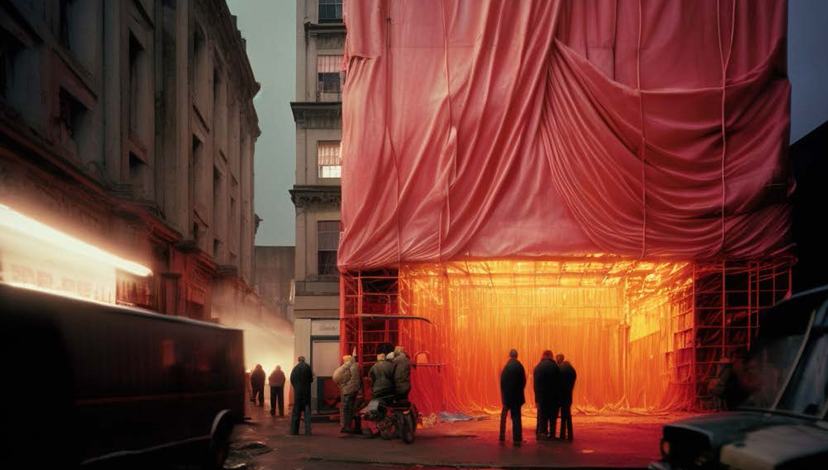
Phoebe Flatau, ADS4 2023
Set pieces—like those found in the theatrical form known as pantomime—describe moments in any storytelling media (whether a film, piece of theatre, opera, even sports matches) when narrative/open play pauses, and other material arrangements are allowed to be foregrounded.
The prototypical set piece is the Deus Ex Machina (literally “God from the Machine”)—a Greek theatrical device (the mechane) that would, when a narrative was struggling for resolution, deliver an act of god (often literally a statue of a god) to resolve the loose ends. In other words, scenes (from the Greek word skene—meaning stage) pause, narrative stops, and a reformatting of ontological/material relationships take place. Narrative then returns, but everything is different.
Indeed, set pieces are named set pieces precisely because they used to necessitate the construction of a new set on the studio backlots of Hollywood. They are fundamentally scenographic/spatial, and their significance resides in their ability to proffer alternative arrangements of things.
However, the set pieces that are offered to us in our feeds and online consistently reinforce inflexible, troubling and misogynistic structures—the very reason we are where we are. Just look at the staging of Donald Trump’s bizarre set pieces—so often centred upon the construction of cheap Rococo structures, or utilising the tropes of WWE. These are the set piece visions of a scared, petro-masculine moron, stuck in the 70s and out of his depth.
Using pantomime as our model, ADS4 will develop a new–and fundamentally spatial/architectural approach towards set pieces. A concatenation of these brief fermata—where existing (material) hierarchies are broken down, reconstructed, transitioned, transported, or transformed—will become the formal logic of the projects we produce. Set pieces well become the site(s) where new relationships are forged in a world of static, sedimented biases and structures.
In many ways, then (and in departure from the work the unit has produced to date) the struggle to generate alternative (more progressive, more equitable) attitudes towards the planet and the things that populate it will be a struggle over set pieces (theatrical pauses), more than it is a struggle over (future) scenarios.
Live Project & Field Trip
Through temporary, meanwhile and performative installations, ADS4’s first years will explore the history of misogyny and the toxic influence of fossil fuel money on the City of London. Working collectively, we will design and install a ‘set piece’ in Smithfield Market—a place described as one of the last masculine strongholds in the city but with a rich history of carnival and performance—to test design approaches and methodologies that will subsequently be translated into your design projects.
ADS4 will agree the location of the field trip in negotiation with our students.