ADS2: Alterworlds: Summoning Fugitive Waters
Jump to
ADS2 designs for life in unlivable waters. Working at the intersection of socio-environmental justice and architecture, the studio explores the hostile conditions caused by capitalist hydropolitics, developing architectural responses that mobilise water as a site of struggle for repair, sovereignty, and care.
Tutors: Merve Anil, Lodovica Guarnieri & Mhamad Safa
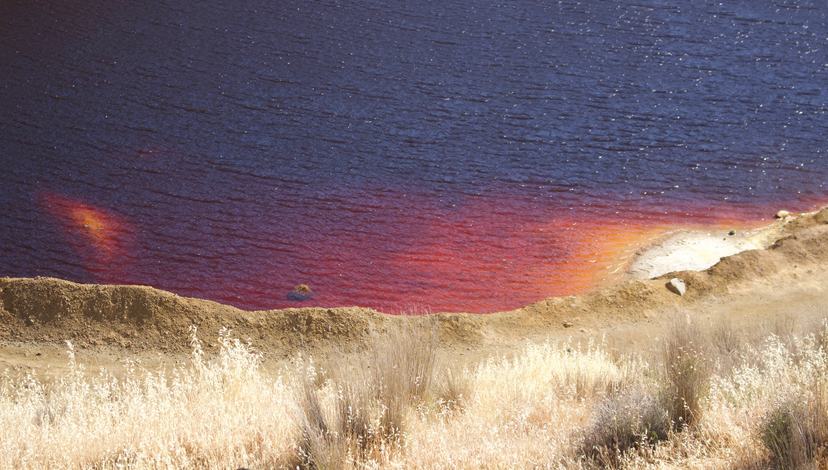
Kokkinopezoula, a toxic and acidic lake formed inside an open-pit copper mine abandoned in 1966. Cyprus, July 2022. Image: Lodovica Guarnieri.
Through the design of community activations, sonic atmospheres, material supply chains, and counter-pedagogical spaces, the studio fosters systemic and reparative projects that support “the struggle to exist again but differently”[1] in the ruins of empire. It remodels architecture as a practice that resists hydrological suppressions by building infrastructure for the living.
Unliveable Waters
Water systems have long been sites through which colonial and extractive infrastructures have shaped the conditions of life, reproducing the structural dispossession of marginalised and racialised ecologies and communities. Decisions made through engineering, planning, agriculture, or warfare reverberate across catchments and ecologies to redistribute both resources and harm. River diversion and damming uphold logistical imaginaries whilst interrupting sediment cycles, fish migrations, and local lifeways. Drainage schemes reclaim wetlands for development, whilst extinguishing ecologies that depend upon inundation. Afforestation projects frame certain habitats as unsuitable for life, legitimising the dispossession of communities whose practices depend on drylands. Groundwater extraction sustains industrial agriculture whilst aquifers accumulated over millennia are exhausted within generations. In these processes, water crises emerge not as isolated ecological phenomena, but rather as a set of spatial conditions that occur simultaneously with occupation, contamination, displacement, and ecological collapse, constraining life and living across bodies, species, and generations.
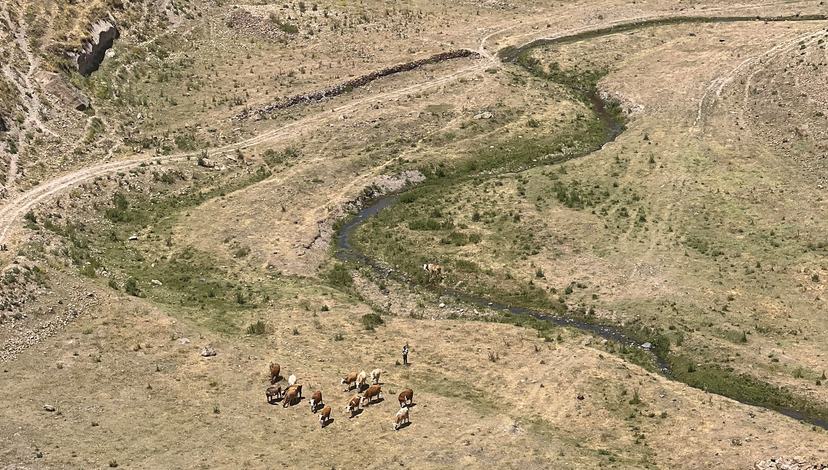
Arpaçay river that forms the Turkey-Armenia border, closed to all except for herds and their shepherds cooling off in the heat. Kars, July 2025. Image: Merve Anil.
Geographies rendered uninhabitable by cumulative hydrological extraction lie at the margins of liveability. These are places where communities, ecologies, and resources have been depleted through colonial, neocolonial, and accelerated capitalist conquests of land and of what lies above and beneath it. As Judith Butler and Frédéric Worms noted in their conversation on 'The Liveable and Unliveable' (École Normale Supérieure, Paris, 2018), unlivability emerges at the intersection of global extractive infrastructures and the systemic dispossession of local ecologies and communities, where “the most extreme point of human [and non-human] suffering and injustice” occurs. Unlivability, then, is not simply an unintended or inevitable consequence of capitalist development but a designed condition that ensures its continuity and expansion. From toxic landscapes bleeding into water contamination and military occupation leading to environmental destruction, hostile conditions are actively produced through spatial means on multiple scales.
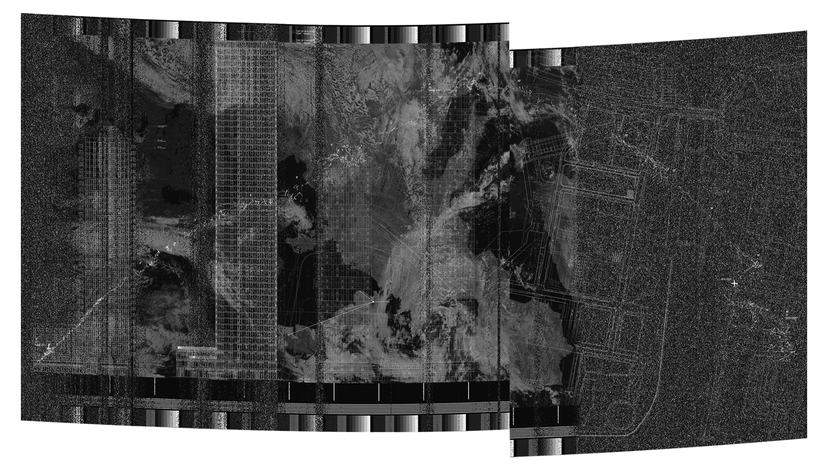
Dan Rhys Wakefield, To see what you're protecting, NOAA flag. ADS2, 2024-25.
Rivers, wetlands, glaciers, and clouds – together with the more-than-human communities that form them – emerge as contested entities. They are withheld, redirected, contaminated, enclosed, and mobilised in ways that reorganise space and life within capitalist and colonial machinery. Such reorganisation depends on practices, epistemologies, and spatial imaginaries that have understood and treated water as a bounded entity to be extracted, depleted, and concentrated. Such a colonisation of wetness, as Dilip Da Cunha argues, designs water and land as separate entities that can then be coveted, made scarce, and violated, while rendering floods, monsoons, tides, and other movements across this boundary into conditions of unliveability.
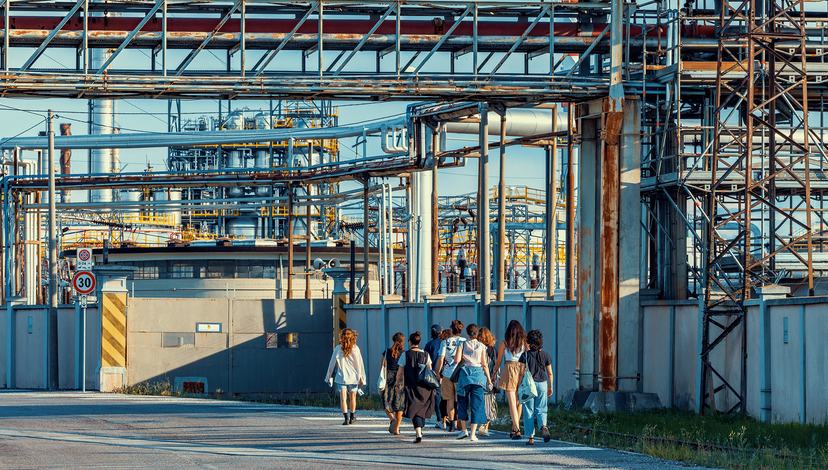
Lodovica Guarnieri, When I Breathe, I Swallow the Lagoon. Commissioned by TBA21 with the support of S+T+ARTS. 2022 Credits: TBA21—Academy/Enrico Fiorese.
In response to this, ADS2 understands water crises – floods, contamination, salinisation, and others – not simply as catastrophes, but also as insurgent processes that can disrupt and unsettle colonial geographies, opening possibilities for resistance, and the reimagination of life beyond extractive governance. Building on technoscience scholar Michelle Murphy’s concept of alterlife, which describes ‘the struggle to exist again but differently’[1] when already in the conflicted, damaging, and deadly conditions of the aftermath of extractivism, colonialism and their infrastructures, the studio asks: how might water crises become grounds from which alterworlds emerge? And how are frontline communities already reclaiming such possibilities through decolonial forms of repair and collective life?

Amber Primus, Grey Life. ADS2, 2025-26.
Marginalised collectivities living in extreme aquatic conditions forge situated practices of resistance and care that challenge these systems of imperial world-making. Within these geographies, communities build from what remains: working with the material residues of damaged landscapes, inherited knowledge, and practices of survival to create new possibilities for life. These practices take many forms, generating novel spatial and relational imaginaries that resist the ongoing assault on human and more-than-human communities. They are not gestured toward a supposed purity, but rather to rehearse life-worlds that make it possible to persist, adapt, and become otherwise in the aftermath. Cooperative stewardship, solidarity economies, and communal forms of repair enact infrastructures that sustain life from within the ruins, composing the grounds for decolonial, non-extractive futures.
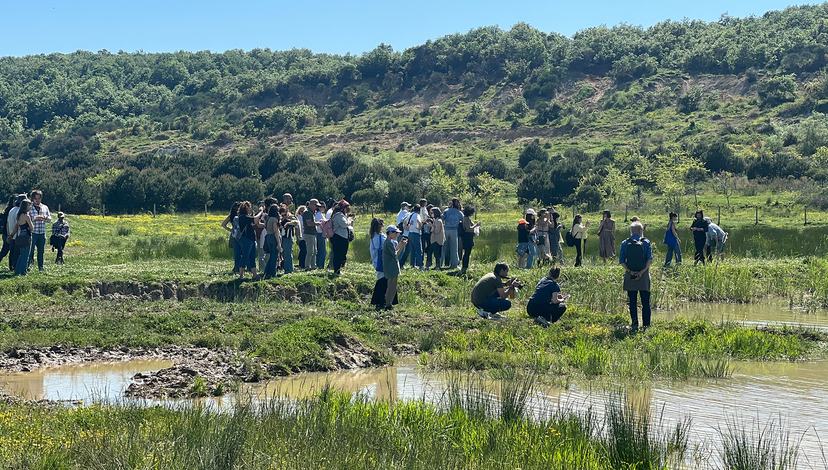
Convening wetland publics, Istanbul, May 2026. Image: Merve Anil.
Summoning Fugitive Waters
Bodies of water possess a fundamentally fugitive quality. They leak, evaporate, infiltrate, flood, and resurface, escaping the boundaries through which states, markets, science, and infrastructures attempt to bound them. Despite centuries of engineering aimed at fixing water in place, through rivers, canals, reservoirs, levees and drainage systems, their infrastructural relations remain untamed and resistant to control.
This fugitivity lies not only in water’s refusal to be fully bounded, but also in its continual capacity to gather worlds. As they move across bodies, soils, sediments, species, and infrastructures, bodies of water compose ecological, social, and political relations that exceed the territorial logics through which they are governed. Like the communities that continue to resist enclosure and dispossession, watery systems repeatedly abolish imposed spatial orders while simultaneously creating the conditions for reimagining collective life beyond extractive notions of livability.
ADS2 responds to these conditions by producing architectures that reinforce the alter-worlds emerging from resisting collectivities. We engage with water’s fugitive qualities, asking how spatial practices might rebuild hydrological relations that colonial infrastructures severed. Projects emerging from the studio will operate with and within human and more-than-human assemblages to build infrastructures of relation that stretch from ancestral pasts into possible futures, offering moments of rupture, reconfiguration, and transformation. Rather than treating bodies of water as a resource to be managed, or a threat to be contained, students will approach them as living systems through which decolonial, non-extractive relations are renegotiated. Through engagements with transgenerational and more-than-human systems and temporalities, ADS2 projects will attend to community-led forms of repair and develop spatial propositions that contribute to structural transformations that abolish, uproot, and dismantle oppressive systems.
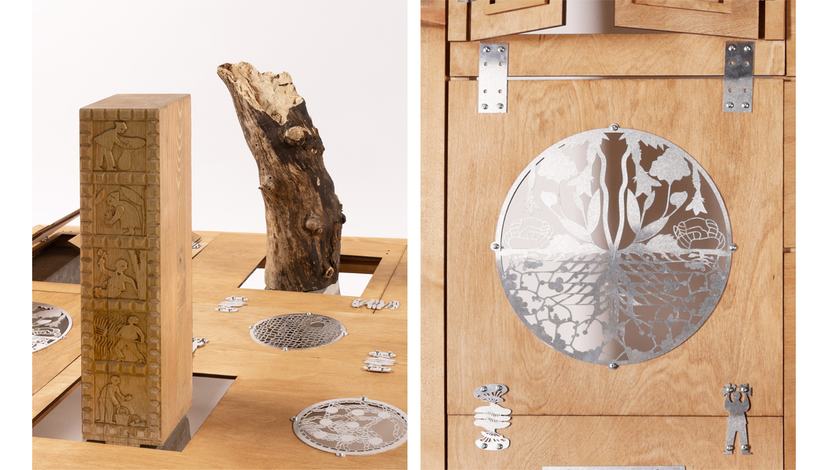
Magda Szeparowicz, Folk Roots. ADS2, 2025-26.
Field Trip and Live Project
The field trip will take place in the Saja-Besaya Natural Reserve of the Cantabrian region (Spain). The studio will be hosted by a local organisation working with land rights and community organising. The live project is tightly connected to the field trip and is in collaboration with local organisations addressing ecological and social issues in the Saja-Besaya Natural Reserve.
Tutors
Merve Anil
Merve Anil is an architect and researcher who has spent the past three years wading through post-industrial wetlands, convening publics, programmes and processes around novel landscapes emerging through climate breakdown that exceed conventional frameworks of architecture, planning and conservation.
She was most recently Research Associate for CLIMAVORE Water Buffalo Commons, a long-term, situated research initiative based at the Royal College of Art, working with pastoral communities across Istanbul’s post-industrial wetlands. Merve trained as an architect at the Architectural Association and has over a decade of experience across private practice, the public sector and practice-based research, including OMA, AHMM, Public Practice and Epping Forest District Council.
Alongside Architectural Design Studio 2 at the RCA, Merve teaches Design and Critical Practice at the London School of Architecture. She previously taught in the AA Diploma School from 2018–2023 and at the RCA between 2023–2024. Her collective and individual work has been presented through exhibitions and public programmes, including at SALT, Marmara Urban Forum and the Royal College of Art.
Merve holds an AA Diploma from the Architectural Association, an MA with Distinction from the Centre for Research Architecture at Goldsmiths, University of London, and is currently undertaking a PhD at the London School of Economics.
Lodovica Guarnieri
Lodovica Guarnieri is a designer, cultural strategist, and educator whose work explores the entanglements between ecology and modern infrastructures. Her practice grapples with technoscience as it relates to colonialism, extractivism and their enduring toxic legacies in aquatic environments. She designs counter-pedagogical initiatives and sites in the form of programmes, performances, and networks where communities collectively envision new imaginaries for socio-environmental justice.
Since 2022, she has been part of The Tidal Garden, curating cultural programming and research by working with artists and academics to develop situated projects that speak to resistance against the narratives of desertification and the forms of dispossession they entail. Alongside co-leading the Architectural Design Studio 2 at the Royal College of Art in London, she is a Thesis Tutor for the MA Critical Inquiry Lab at Design Academy Eindhoven.
Over the years, Lodovica has held curatorial and research roles at Van Abbemuseum (NL) and Manifesta 12 (NL/IT) and contributed to projects such as Hostile Environment(s), Non-Extractive Architecture, and Alexandria: (Re)activating Common Urban Imaginaries. Her work includes commissions for the Lisbon Architecture Triennale, TBA21, Stroom Den Haag, Ocean Space, Bozar, The Anthropocene Campus, and more.
She holds an MA with distinction from the Centre for Research Architecture at Goldsmiths, University of London.
Mhamad Safa
Mhamad Safa is an architect, sound artist, and researcher whose work explores the intersection of multi-scalar spatial conditions and their sonic make-ups. He graduated from the Centre for Research Architecture at Goldsmiths, University of London, in 2019 and received his PhD from the University of Westminster in 2024. He is an Associate Lecturer in Architecture and Media Studies at the Royal College of Art in London. He also lectures in Sound Arts at the London College of Communication. His sound work was featured at the Renaissance Society in Chicago, Sharjah Architecture Triennial, Alserkal Arts Foundation, the Bergen Assembly, the Goethe Institute, Kunsthalle Basel, and the Institute of Contemporary Arts in London.