ADS15: Insignificance: Prototyping Infrastructure for a Socio–Ecological Transition
Jump to
ADS15 uses architectural and fabrication methods to develop forms of resistance to policies that force through (a certain kind of) green transition at any cost. We understand prototyping as a political and research method. Prototype design is not the illustration of research. It is the means through which research becomes public, testable and consequential.
Tutors: Freya Bolton, Freya Spencer–Wood & Rosa Whiteley
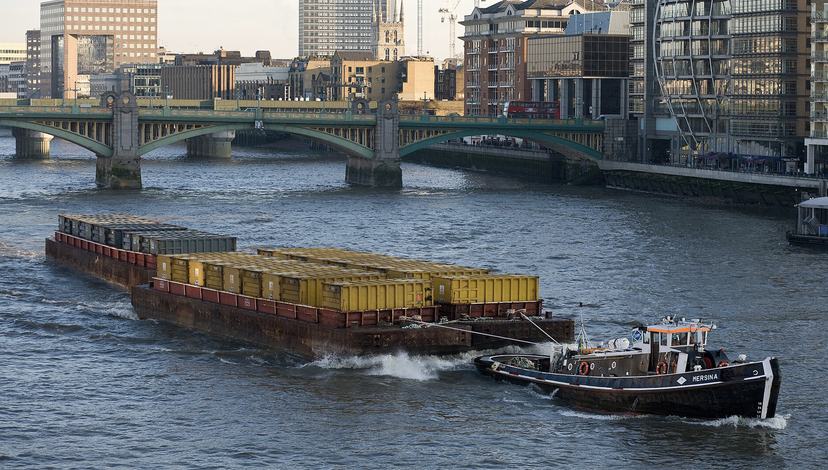
A tugboat pulls barges carrying residual waste along the River Thames towards Cory’s energy-from-waste facilities at Belvedere. The Riverside Energy Park was designated a Nationally Significant Infrastructure Project and consented by the Secretary of State in 2020, despite opposition raised by local residents and the Mayor of London. Photo: David Iliff, via Creative Commons. CC BY-SA 3.0.
Of Critical National Importance
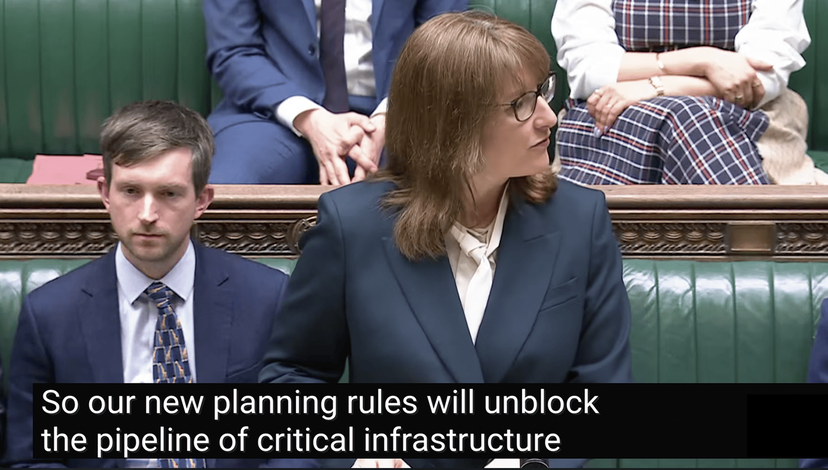
UK Chancellor Rachel Reeves sets out the government’s response to the energy crisis and planned updates to the UK Infrastructure Act to encourage investment. March 2026 Image/Footage courtesy of UK Parliament / Parliament TV. Used for the purpose of fair and accurate reporting of parliamentary proceedings.
In November 2021, Corey Energy announced an NSIP (Nationally Significant Infrastructure Project) application for Crossness Nature Reserve. This project would drain some of London’s last remaining wetlands to burn waste delivered by barge from west London, capture and liquefy its carbon, and transport it to empty North Sea oil terminals for underground storage. Excess heat from the incinerator would be transported through a new pipeline to heat the Houses of Parliament, where new laws are being enacted to accelerate infrastructure growth like Corey Energy’s proposal. As local opposition to this scheme grew around the loss of green space, fragile wetlands, and rare ecosystems, new policy mechanisms disrupted the local communities' ability to protest.
Across the world, an unprecedented wave of investment in ecological transition is rapidly transforming landscapes. Carbon capture pipelines bury emissions beneath emptied oil fields. Vast solar parks buy out agricultural land. Data centres consume water tables atop ancient and recently re-wetted bogs. Reservoirs are proposed, ports dredged, pipelines extended, transmission corridors widened, and new railways announced in the name of national growth. Elsewhere, communities reactivate abandoned irrigation systems, establish repair cafés, create reuse networks, restore wetlands, build cooperative energy networks and reclaim common land.
As states and industries compete to deliver the green transition, infrastructure has become one of the principal ways ecological and political futures are imagined, negotiated, and governed across territory, economy, ecology, and community. On 24 July 2026, amendments to the UK Planning and Infrastructure Act (2025) came into effect, legislating that pre-application public consultation is now no longer mandatory for NSIPs. While NSIPs are large-scale developments deemed vital to the country, governmental priorities often flatten localised cultures and concerns. At the same time, the government has proposed that certain clean energy projects can be designated as being of Critical National Importance, with parliamentary authorisation giving them protection from judicial review, except on on the grounds of human rights violations. These national decisions mark a significant cultural shift toward landscapes being re-designed at huge scales, greenwashing accelerating, and local communities becoming increasingly marginalised. In other words, governmental accelerationism and politicians' headline-hunting have replaced meaningful climate responses that put communities and ecologies at the center of the conversation.
Infrastructural Creep
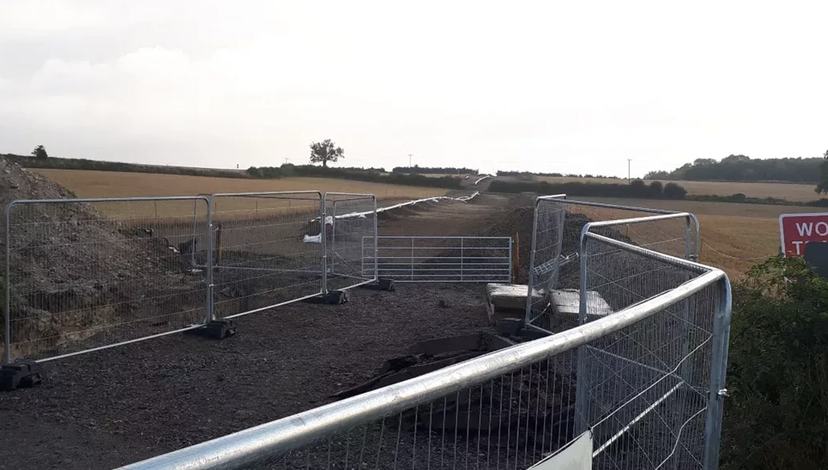
90km Southampton to a London pipeline delivering aviation fuel direct to Heathrow, cutting through ground, hedge and air. Photo courtesy of George Ridgeway
These mega-infrastructures organise access to land, shape economies, distribute labour, and determine whose futures are prioritised. They produce landscapes through the use of concrete and steel, but also through policy, finance, maintenance, ownership, and collective organisation. Infrastructure is rarely experienced at the scale at which it is planned. A pipeline may be territorial in its extent but intimate in its consequences; a reservoir may be nationally significant while flooding homes; a data centre may appear as a building while reorganising energy, water, land, and labour across an entire region. Infrastructure is not simply a physical system, it is also a system of ownership, finance, governance, labour, maintenance, and consent.
While governments push through mega infrastructure through policy amendment, private companies are the ones that own the physical infrastructure. Since the privatisation brought about by the Conservatives in the 1980s, England has been a birthplace of privatised essential services. Privatised infrastructures provide the space and physicality in which debt is levied and finance extracted. When infrastructures are deemed too nationally significant to consult communities, and yet not significant enough to be owned by the nation, NSIPs become a mechanism for capital extraction. Infrastructure becomes both a physical system and a financial asset: creating a new landscape through which capital is invested, extracted, and reproduced. As demand for new infrastructure turbocharges the green transition and green-banking, ADS15 will search for new ways to understand and resist the socio-cultural impact of major infrastructure projects.
Resisting
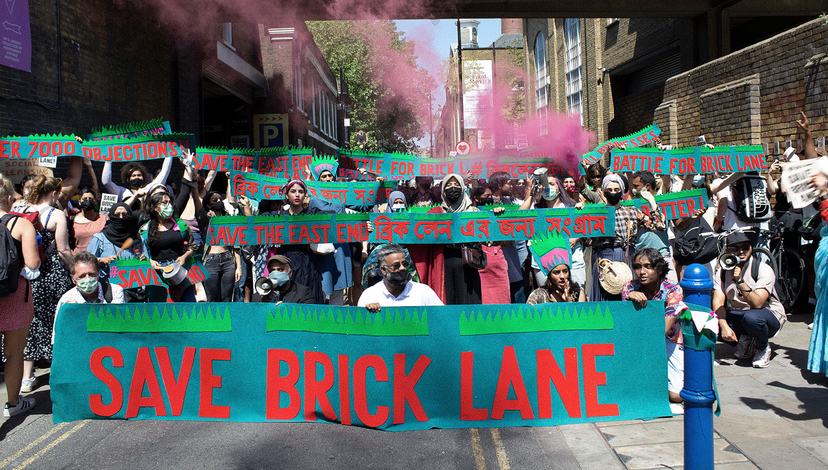
The Save Brick Lane campaign has long challenged development proposals in Brick Lane that threaten the area’s cultural and social fabric. In 2024, Truman Estates proposed a 5,200m² data centre as part of a wider redevelopment of the former brewery. Tower Hamlets resolved to refuse the application in 2025, but following a national planning appeal, the Secretary of State approved the scheme in July 2026. Image Courtesy of Sarah Ainslie, 2021.

Aquifer Spade, developed within Chalkophiles, Rosa Whiteley, Design Museum. Photo courtesy of James Winstanley.
Infrastructures are also sites of protest. Groups gather at logistical ports to challenge the export of military goods; protestors disrupt airports and transport links; workers refuse to handle particular goods and interrupt supply chains; and communities blockade roads, railways and construction sites. Infrastructure becomes a point of leverage. A place where the movement of people, materials, capital and energy can be slowed, redirected or stopped. These acts reveal something that the language of infrastructure often conceals; that systems designed to appear seamless are dependent on people, labour, and consent. ADS15 situates students within these sites of contention, inviting them to collaborate, propose, build, refuse, and test other forms of significance within infrastructural futures.
Communities, activists and organisations are also constantly building infrastructures of their own. From transmission grids to grazing commons, legal agreements to libraries, compost heaps to ports, infrastructures exist wherever relationships between people, ecologies, and resources can be organised. Rather than treating infrastructure as an engineering problem, ADS15 understands it as an architectural, cultural, and political project.
By responding to ongoing policy changes, legislation in flux and sites in states of speculation, ADS15 invites students to act as agents within the built environment. Students will develop the skills and confidence to critically engage with current politics and policy, using architectural practice to research, question, and intervene in live conditions. The studio supports each student to develop a clear and situated position — understanding what they value, what they contest and where they can act — and how to translate this position into new architectural propositions for the immediate future.
As ecological transition accelerates, ADS15 is interested in the space between the infrastructures we are promised and the infrastructures we actually need. What infrastructures do we need if we valued maintenance over expansion; locality over standardization; interdependence over efficiency; or long-term ecological relationships over short-term economic growth? Rather than accepting the inevitability of a particular green future, students will investigate how infrastructure might be redesigned, redistributed, repaired, decommissioned or newly invented. How might forms of cohabitation between humans and more-than-humans produce new forms of planning and living with climate, which are not centred on state-imposed mega-projects? What happens when we stop asking what forms of infrastructure are nationally significant, and instead ask what infrastructures are significant to particular places, communities, ecologies, and timescales? How can we, as architects, operate collectively and equitably. And how can we creatively subvert our current direction of travel toward techno-solutionalist futures within the green transition, with the associated flattening of cultural connection to our lands, seas and clouds?
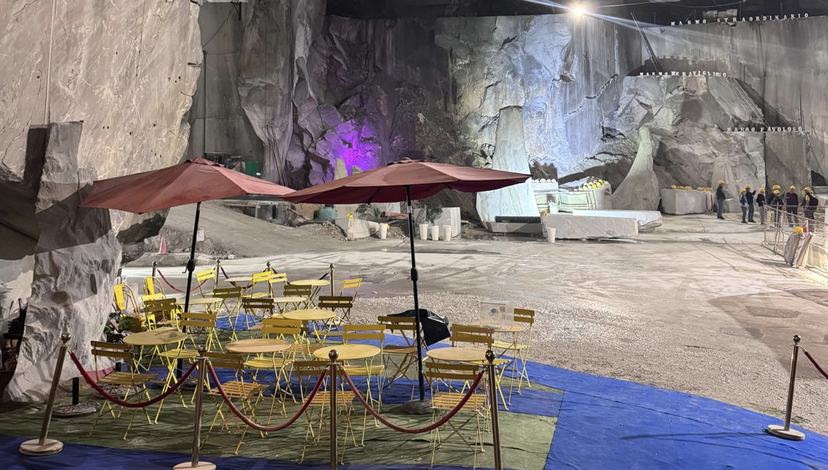
Carrara marble quarry and associated tourist infrastructure, Carrara, Italy. Image: Freya Bolton, 2025
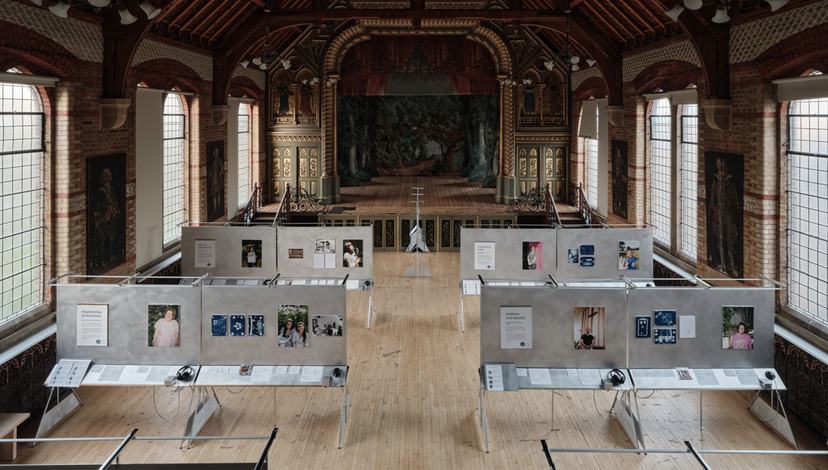
Exhibition infrastructure, Our Life Stories, Langdon Down Centre, Freya Spencer-Wood w/ Mitre & Mondays. Image: Thomas Adank
Prototype as Method
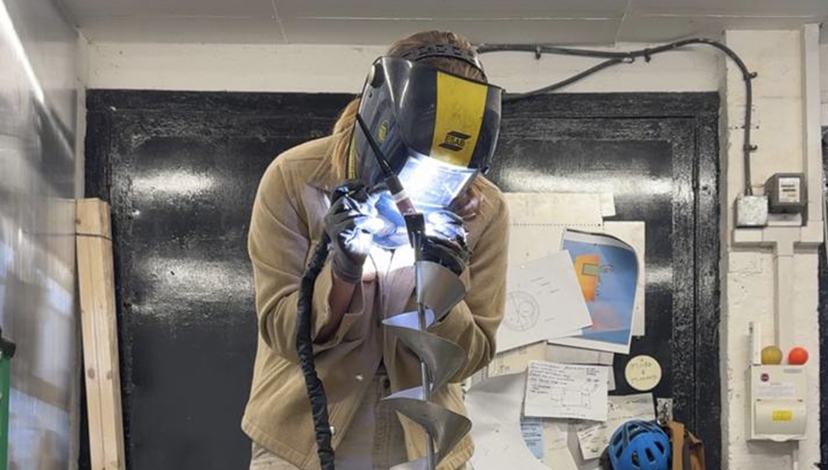
Welding in workshops to test new prototypes, 2023. Image: Freya Bolton
ADS15 understands prototyping as a political and research method. Prototype design is not the illustration of research; it is the means through which research becomes public, testable and consequential. By making and testing these things, students will ask who is able to participate, who is excluded, what forms of labour are required, what resources are consumed, and what futures are made possible?
Material and construction knowledge will not be treated as the final stage of design, but as a means of investigation. Students will work with materials, processes, and techniques to test the social, political, environmental, economic, and tectonic consequences of their propositions. Through hands-on making, students will investigate the infrastructure of fabrication: how materials are sourced, joints are tested, and people and ideas can be assembled into physical environments? Through this approach, students will learn to understand construction not as the final delivery of an architectural proposal, but as a way of discovering what an infrastructure is, what it depends upon, and what it might become.
Intensive periods of construction and fabrication are combined with spatial research, fieldwork, and mapping to understand how infrastructures operate across scales: from the hand-held tool to the territory. Students will be introduced to a range of practice-based methodologies to develop their projects, including mapping, multimedia experiments, participatory research, and spatial ethnography. These will be supplemented by talks from established and emerging research practices. ADS15 will focus on students reflecting on their positionality and proactively developing their own practice, drawing on material politics, and environmental and spatial justice.
The studio will be supported by a bi-weekly reading group that introduces students to theory and draws on key texts, films and works from critical ecology, more-than-human geography, urban studies, and queer, feminist, and indigenous frameworks. ADS15 promotes intersectional thinking, merging architecture and spatial practice with climate justice, rights of nature, environmental justice, ecofeminism, land politics, and activism.
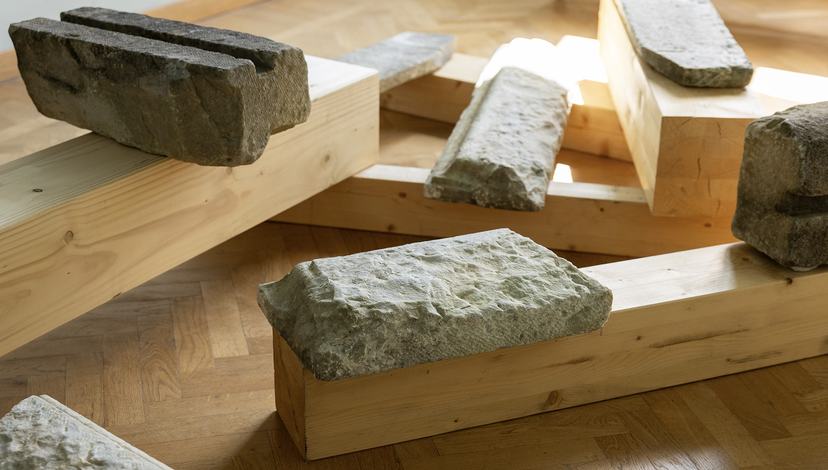
A Stones Throw, BASE Milano, Milan, 2025. Image: Mitre & Mondays
Field Trip: NSIP Road Trip
We will undertake an NSIP road trip tour of the UK, visiting NSIP locations, contested infrastructures, community infrastructures, ecological infrastructures, infrastructures in decline, and construction sites. We will plan this trip in collaboration with the students, allowing their project sites to be stops along the way.
Other sites include: Save Bricklane Campaign, London; Soanes Center, London; Friends of Crossness Nature Reserve and Corey Energy Riverside 1 NSIP; Crossness Pumping Station, Thamesmead; Fens Reservoir Proposal Site; Havant Thicket Reservoir; Chalk Grassland built on the spoils of CrossRail; Tipping Point East; Net Zero Industry Innovation Centre; The Acorn Project carbon storage facility, Aberdeenshire; Hynet (North East); Avonmouth Severnside flood defence and ecology scheme; Cody Dock Ecology Team; Suffolk S.E.A.S (Campaign against NSIPs on the Suffolk Coast); Vantage's hyperscale data centre project on the former Ford site in Bridgend; Bethnal Green Nature Reserve, London; and House of Annetta, London.
Tutors:
Freya Bolton
Freya Bolton is a designer, fabricator and Director of Mitre & Mondays. Her practice brings together fabrication, material research and exhibition-making, with a focus on reuse, repair and circular approaches to making. She works across design and production to explore how materials, people and ideas can be brought together through hands-on practice.
Freya Spencer-Wood
Freya Spencer-Wood is an architect, artist and lecturer working between (public) scenography, landscape politics and intersectionality. She is a co-founder of design and research group TUFF, and currently teaches postgraduate architecture at Central Saint Martins and Royal College of Art. Freya’s architectural practice spans furniture, exhibition design, public realm design, community engagement and policy-making, while her artistic practice is research-based and multimedia. She was a Design Researcher in Residence at the Design Museum 2023/24, and has worked at a number of design and architecture practices in London.
Rosa Whiteley
Rosa Whiteley is an architect, writer and spatial researcher working at the intersection of architecture and critical ecologies. Her practice explores the ecological and political conditions of water, land, atmosphere and infrastructure, with a particular focus on chalk aquifers, wetlands, food systems and material ecologies. Her projects follow weather events, such as high winds, fogs, storms, clouds, sunburns and dew, to explore the politics of meteorology, land management, and toxic regimes. Rosa was a 2025/26 Design Researcher in Residence at the Design Museum Future Observatory, where she established her ongoing project Chalkophiles. This project traces the politics of southern England's chalk aquifers through dew ponds, winterbournes, clouds, tools, maps, and public workshops. Rosa was a 24/25 Research Fellow at Onassis Stegi.
Rosa’s practice is grounded in collaboration with artists, scientists, activists, and makers. She is a co-founder of design and research group TUFF, which works at the intersection of climate, land politics and ecology through interdisciplinary and community-led practices. Rosa is the Director of Material Research at Climavore and has worked as a project manager and lead researcher with Cooking Sections (2019-25).
At the RCA, Rosa co-leads Architectural Design Studio 15 in the School of Architecture with Freya Bolton and Freya Spencer-Wood, previously co-led Architectural Design Studio 3 with Alon Schwabe and Daniel Fernandez-Pascual (2024-26) and taught within the Media Studies programme (2022-24). Rosa also currently teaches postgraduate architecture at Central Saint Martins.