ADS14: Project Unicorn
Jump to
ADS 14 confronts the monsters of our time and employs whichever medium necessary to tell optimistic stories from within. We call them unicorns.
Tutors: Yufei He, James Horkulak & Pan Hu (dorsa)
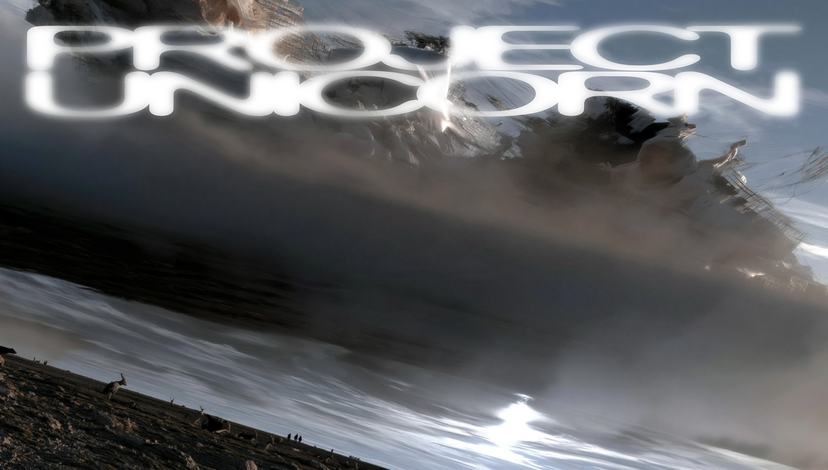
Project Unicorn, image by dorsa
I have no Mouth, And I must Scream
We live among parallel realities.
Some are visible; others remain concealed within systems that are too large, too slow or too distributed for us to fully perceive. From time to time, these hidden realities break through. They surface as strange symptoms: Twelve microscopic plastic particles were detected in four of six human placentas in a study first reported in 2020, in the same year, SAOCOM-1 satellites recorded parts of Chile’s Salar de Atacama sinking by one to two centimetres a year due to lithium extraction3. In May 2024, around 10,000 hectares of future forest in Panama were sold to Microsoft as carbon credits, decades before the trees would mature. In March 2021, the 400-metre-long container ship Ever Given blocked the Suez Canal for six days, delaying an estimated $9.6 billion worth of goods each day. In 2023, researchers reported reviving an ancient giant virus from Siberian permafrost, where it had remained infectious for almost 50,000 years.
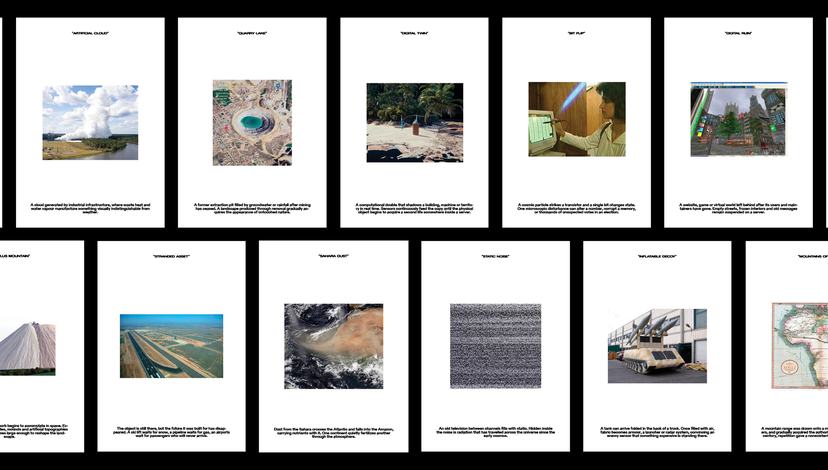
Symptoms, image by dorsa
These symptoms, suspended in some kind of void, are the anomalies we confront today: plastiglomerates, sinking ground, artificial mountains, carbon credits, distant emissions and revived permafrost microbes. They unsettle familiar distinctions between inside and outside, natural and artificial, past and present, here and elsewhere.
They are the monsters of our time.
Unlike classical monsters, they do not have a single body. They are distributed through blood, atmosphere, contracts, code, markets, infrastructure and geological time. We do not know how to confront these monsters. We struggle to locate their boundaries and our own positions. We are left disoriented and displaced.
We have no mouth, and we must scream.
'The crisis consists precisely in the fact that the old is dying and the new cannot be born; Now is the time of monsters'—Antonio Gramsci, Selections from the Prison Notebooks; adapted with wording from Slavoj Zizek, A Permanent Economic Emergency.
Unmasking Monsters
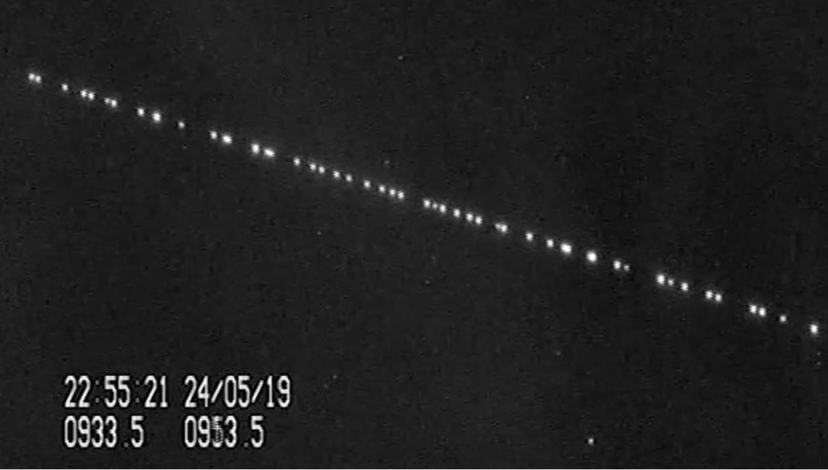
Starlink satellite train, Leiden, 24 May 2019. Video still by Marco Langbroek
How can we confront these monsters? A monster is not a hidden entity waiting to be revealed. It is a distributed object whose body exceeds any single human encounter. Bound to no single place or moment, it is dispersed across bodies, territories, systems and timescales.
A monster is a convergence of multiple symptoms. Unmasking describes an act of implosion: we force all its symptoms into a single point, creating a relational field that we can understand, measure and act upon.
To unmask the monster, we will trace the spatial manifestations of its symptoms and imagine new ways of being human within.
Spatial Manifestation
We explore landscapes of production, facade joints, elevators, public squares, data centre cooling water, the stratosphere, bank vaults, police stations and the humus layer. These spaces can be described through measurable properties such as length, temperature, mass, volume, monetary value or wavelength.
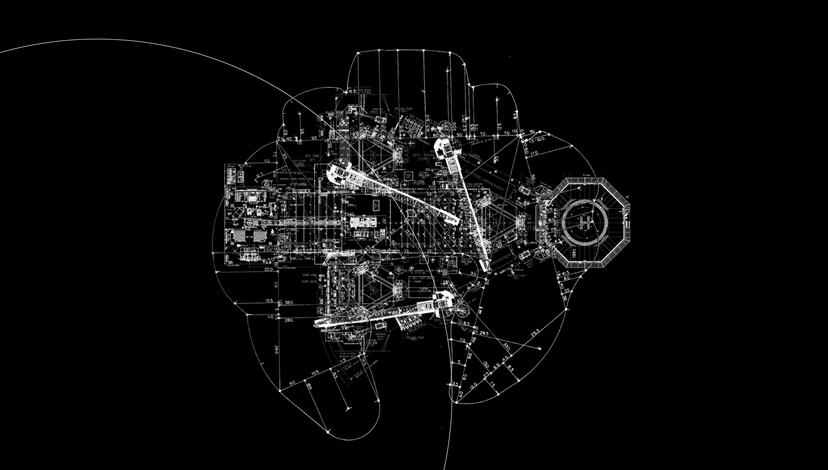
Speculation Manifestation, image by dorsa
These measurable spatial manifestations define a field of the monster’s characteristics that we can investigate rationally through science.
We use visual essays and assemblage drawings to bring these spaces into relation and make their dependencies and conflicts legible.
Speculative Organ
We think, remember, orient ourselves, and act through our bodies. Our bodies have their own way of thinking that we have been neglecting for a long time. Sometimes, our hearts start rushing, we get goosebumps, blush, or start crying. Only afterwards do our minds kick in and try to make sense of our bodies’ thoughts.
At some point in human evolution, our bodies developed ears, eyes, and brains to participate in and understand the world they found themselves in.
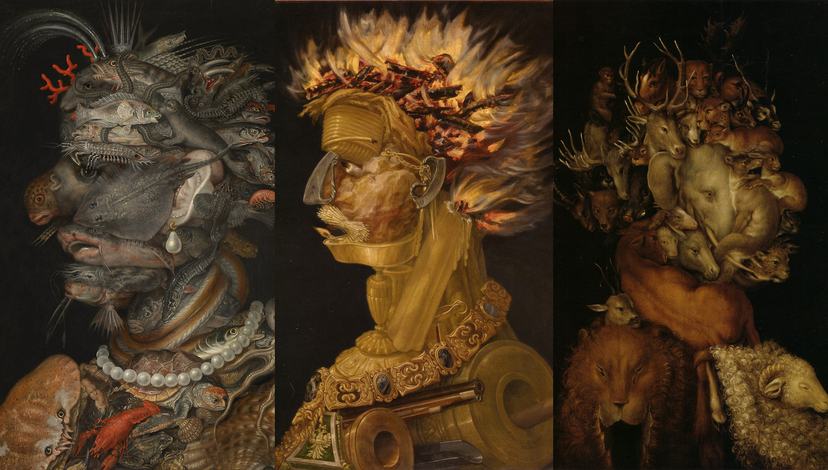
Giuseppe Arcimboldo, Left to right: Water, Fire, Earth, 1566
To unmask a monster, we also need to listen to our bodies. We allow and assist our bodies in developing new organs to make sense of the spatial conditions in an intuitive and emotional way.
Speculative organs give material form to imagined extensions of ourselves and our physical silhouettes. Through them, we construct a new human condition.
Project Unicorn
Unicorns are monsters too.
They are plural, sticky, multiphasic hybrids, inhabiting the cracks and hollows between familiar opposites: human and nonhuman, building and landscape, waste and resource, technology and ecology, myth and fact.
While monsters expose relations that produce fear, paralysis and destruction, unicorns deliberately rearrange them. Emerging from the same bodies, materials, institutions and forces, they produce a different kind of anomaly within the present - one through which a hopeful and solidaristic world becomes imaginable.
Humans are storytelling animals. Paralysed by monsters, we have forgotten how to tell hopeful stories that produce optimistic futures. We seek shelter in the past, be it early modernity, nationalism, or religion. Project Unicorn is an attempt to relearn the storytelling of optimistic futures.
Project Unicorn seeks out possibilities within the monster. Unicorns play, care, adapt, hurt and laugh from within. Sometimes they are awkward. Sometimes they are ugly. Sometimes they are marvellous and beautiful. They hack and reconfigure the relations revealed through the monster.
Project Unicorn takes an architectural position through such rearrangement. It scavenges, reroutes, repurposes and recombines:
A building becomes seasonal, porous, amphibious. A landscape stores, filters, cools, feeds, shelters or migrates. A material flow gets hijacked. A residue crosses into another economy of value. An infrastructure opens itself to another function, occupant or ecology. Everyday life reorganises around another species, another climate, a scarcity or a surplus.
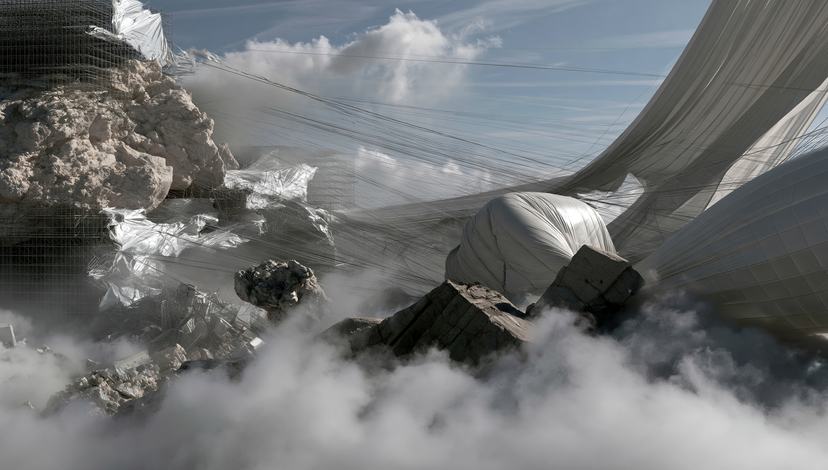
Project Unicorn, image by dorsa
Through these architectural positions, we neither clean nor tame the monster. We irritate its existing arrangements. We interfere with its habits, disturb its dependencies and whisper in its ear that we are scared no more.
Field Trip & Live Project
In February 2027, the studio field trip takes us to Sicily, where we will explore the subterranean world of salt extraction.
We will collaborate with the Museum of Contemporary Art Under Salt (MACSS SottoSale), which is situated within the Raffo Rock Salt Mine (Miniera di Salgemma di Raffo), an active underground salt mine near Petralia Soprana. The mine will serve as the site for the development and installation of our Live Project.
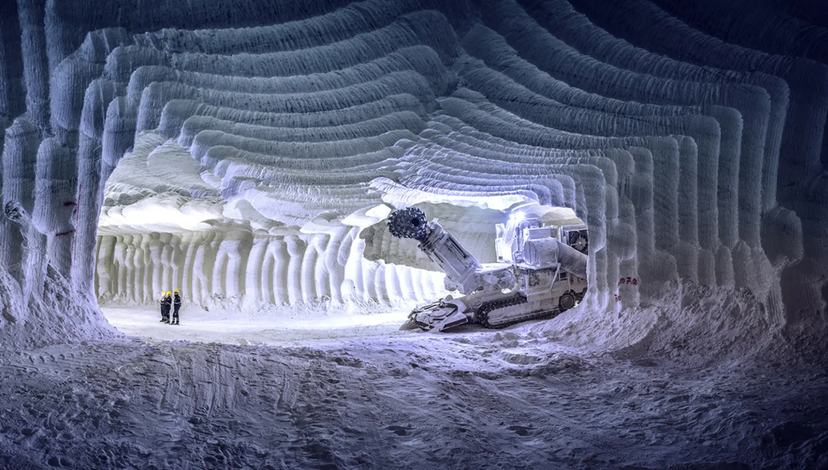
Italkali Salt Mine of Raffo
Formed millions of years ago through the evaporation of the ancient Mediterranean Sea, the underground salt deposits reveal a landscape shaped by geological time and industrial extraction. Our trip will investigate salt as a geological material and a medium through which new environments and hybrid forms of life can be imagined.
During the Live Project, we will work with Gerda Stöckel, a textile designer and landscape architect. We will apply plissé techniques to develop and fabricate lightweight folded textile structures. These structures will become speculative devices for intervening in the subterranean landscape and incubators for unknown salt-loving crystalline beings.
Tutors:
ADS 14 is led by Yufei He, James Horkulak and Pan Hu. Educated at ETH Zurich, they co-founded dorsa in 2021, an architectural practice based in Zurich. dorsa seeks to capture the multiple, parallel realities concealed within our time and to create optimistic narratives for an empathic future. Responding to the urgent state of our planet, dorsa understands architecture as a practice of negotiation between different realities and as a medium through which new vocabularies, forms of coexistence and visions for the built environment can emerge.
dorsa’s work has received numerous awards and distinctions, including the Swiss Art Award in 2026 and the Wilde Karte in 2025, both as dorsa + 820, as well as the LafargeHolcim Next Generation Award, the Fritz Schumacher Prize, and the Theo Hotz Prize. Further distinctions include nominations for the VFG Young Talent Award in Photography and the Mies van der Rohe Young Talent Architecture Award, alongside a fellowship from the Ernst Schindler Foundation.
dorsa was involved in teaching at ETH Zurich from 2020 to 2026 and has been invited to lecture and serve as guest critics internationally, including Vienna University of Technology, the University of Hong Kong, Bern University of Applied Sciences, Lucerne University of Applied Sciences and Arts, University College Dublin, Nanjing University, UdK Berlin, and the Technical University of Munich.