ADS12: Sandbox
Jump to
An exhalation is the thing you cannot take back. Biology now murmurs in datasets: breath, pulse, sleep, gait, temperature, and attention are captured, priced, and recombined. Every exhalation trains a model. Recorded behaviour establishes probability. Then probability informs prices, schedules, classifications. Behaviours become vectors that accumulate and are easier to model when they repeat.
Tutors: Valle Medina & Benjamin Reynolds (Pa.LaC.E)
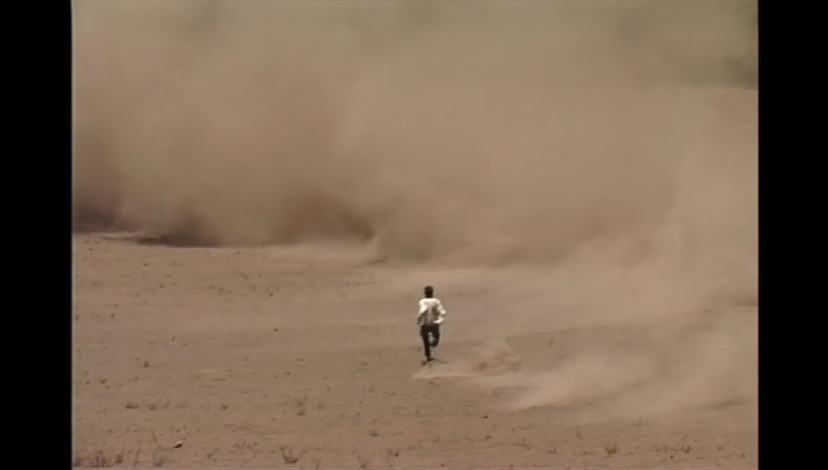
‘Tornado’. Francis Alÿs repeatedly runs into dust devils, turning an unlikely encounter into a practised one. Source: youtube.com
From weak signals, models triangulate wholes: a person, household, neighbourhood, risk, or desire. Prediction becomes political when probability starts distributing access, risk, and opportunity before anything has happened.
Yet in theatre somebody announces that for the next two hours gravity is optional, or that nobody may speak unless touching a wall, or every stranger is next of kin. And everyone complies. And it holds. And no one mistakes the rules for nature.
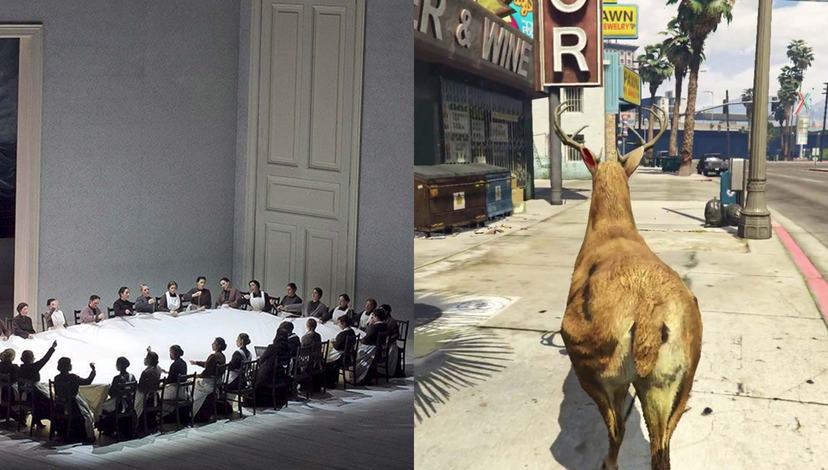
Left: 'The Flying Dutchman': a table, monumental door and painted sea reorganises the play. Source: olyrix.com; Right: Brent Watanabe’s San Andreas Deer Cam, 2015–16. Source: The Photographer’s Guide to Los Santos.
Architecture cannot do this quite so easily. Architecture builds the box and then spends decades trying to stabilise behaviour inside it.
Theatre imagines its own physics. The Greeks had a word for the shelter behind the stage where actors changed masks, skene, from which we get ‘scene’. A room for becoming someone else. Or, in the terms of software, a sandbox. A bounded environment where you can run a law that is farcical and watch what it does before it hardens into a rule.
This year, in Sandbox, ADS12 will give unlikely behaviours time to be rehearsed, to register other forms of living, and to deviate from the models that are being created.
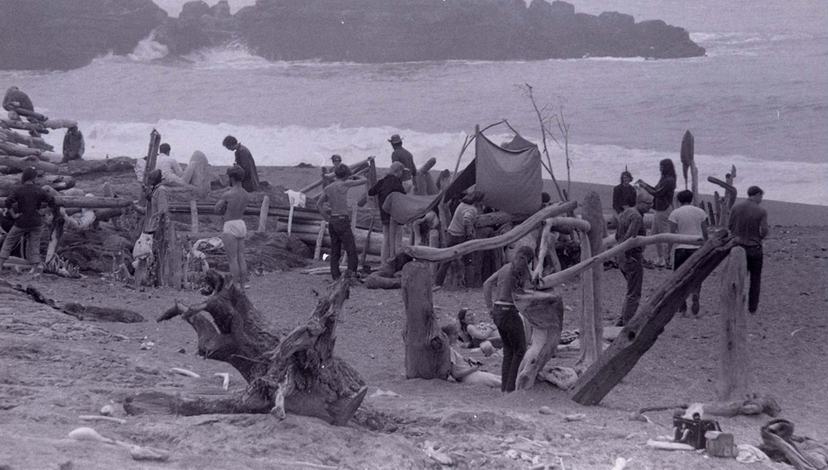
‘Driftwood City’: a temporary settlement collectively built from materials found on the shore. Source: University of Pennsylvania Architectural Archives.
Swaying Models
Last year in Room-spring, ASD12 traced how information enters bodies, homes, and forms of collective life. This year, we will explore how the same information gets assembled to form models that map spatial behaviour and attempt to anticipate what comes next.
Predictive systems require us to become legible as characters: the worker, patient, pupil, prisoner, consumer, or parent. These figures are increasingly persuaded to move through expected patterns of bodies, spaces, and durations. An ordinary sequence of events may already contain assumptions about who waits, who moves, who is seen or withdraws, who cares for whom, and whose daily rhythm governs others. Prediction does not stop at movement. Rather, it occupies attention, expectation, and imagination, narrowing what can be thought before it can be lived.
Swaying models work through the accumulation of slight deviations. We start with changing one threshold: who eats first, who waits, when daylight enters, or when three generations encounter one another while bathing. A seemingly minor alteration to privacy may begin to reorganise intimacy, care, and kinship.
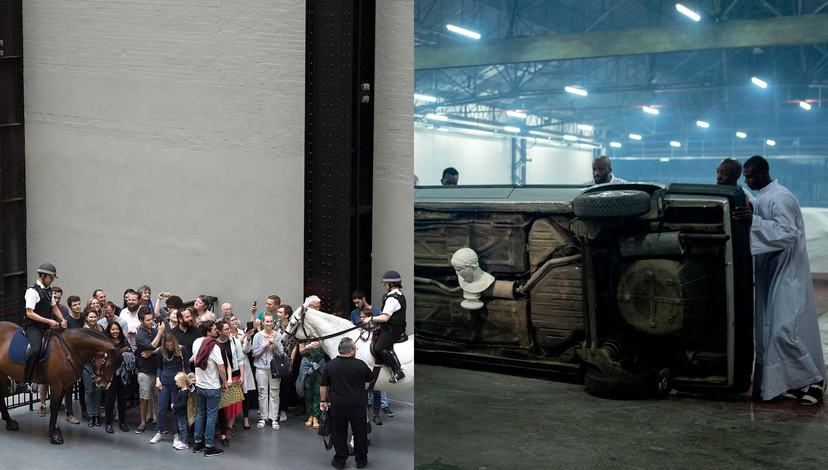
Left:’Tatlin’s Whisper #5, Tania Bruguera’: mounted police alter how visitors move through the museum without changing the building. Source: tate.org.uk; Right: ‘La Vita Nuova’: an overturned car becomes the support for another order of objects and gestures. Source: kanal.brussels
Some projects may begin with a weak signal: an overlooked relationship, a noisy behaviour, a fuzzy gesture, or a practice that exists without enough repetition to appear statistically, or culturally relevant. Enough slight deviations can accumulate into a collective force before they become a consensus.
Students are empowered to introduce unlikely realities and interfere with moments that trade on anticipated behaviours. But this is not about protest, retreat, or cultish refusal. We are interested in counterfactual realities that are already latent within the present: unfamiliar ways of living, gathering, and relating, which can be given the spatial and temporal forcefulness to become credible.
Can architecture keep reality unsettled enough to resist being mistaken for a stable pattern? Rather than escaping the predictive model, we will attempt to give it something else to learn.
Durations / Encounters
Events that reorient our lives usually occur too rarely to register as a meaningful pattern. A person falls in love. A building is built. A death reorganises a household. A conversation redirects a career. Or an encounter permanently alters one’s sense of scale. Such events may be weak in frequency, but enormous in consequence.
Sandbox asks how architecture can modulate these encounters? How can our projects prolong an exchange that would normally end? Or allow incompatible routines to converge? Or produce moments of spatial intensity with effects that persist long after occupation? Such projects might begin less from programme, than from events after which life begins to revolve.
Duration matters because repeated performance can acquire the force of reality. What begins as an exception may, through rehearsal, produce memory, competence, obligation, and eventually new social patterns.
ADS12 will attempt to design architectures spaces that allow perceptions of relations made invisible by routine. A family meal, for example, might require a table to be assembled across the threshold between kitchen and courtyard, making the distribution of labour, care, and attention newly perceptible.
Architecture can stretch encounters until their consequences become memorable. The question is not simply what happens in a space, but rather what happens after it alters someone in a meaningful way?
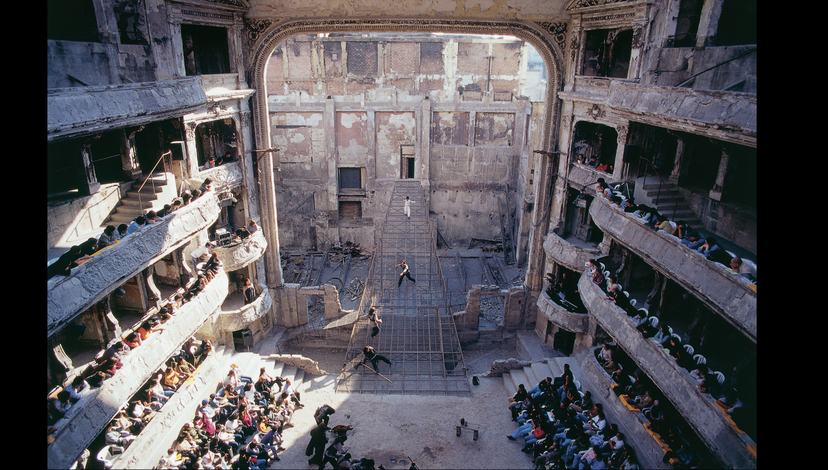
‘King Lear, Teatro Municipal de Lima’: a steel ramp carries performance through the fire-damaged theatre. Source: hiddenarchitecture.net
Material Scores
This year, drawings will go beyond just describing finished architectural environments. These environments will be developed through scores that operate across bodies, instructions, voices, materials, and time.
A score establishes conditions without fixing outcomes. Architecture alters probability by experimentally suggesting who encounters whom, for how long, under what conditions, and with what after-effects? It can propose how long something remains, when a material transformation can begin, or how one action might complement another? Students Participants will score periods of time: an hour, a night, a season, a hormonal cycle, a tide, a heatwave, a migration, a market opening, a fermentation, or the slow decay of a material. These scores will be rehearsed to practise unfamiliar forms of life until the point that prediction begins to loosen.
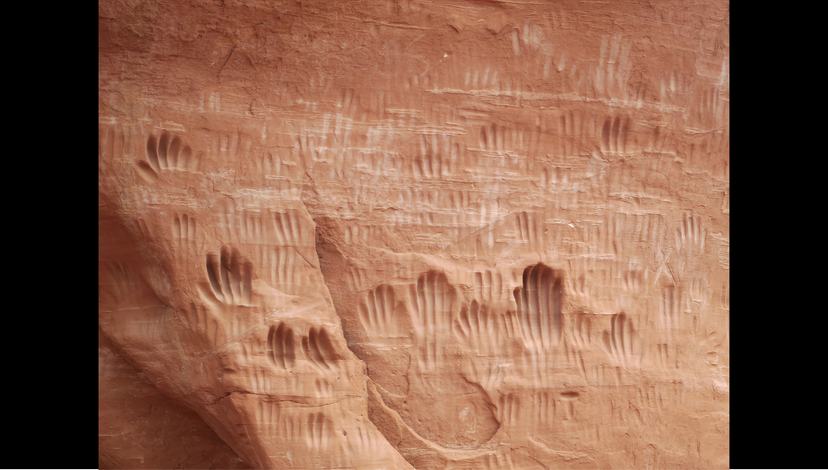
‘Handprints in Entrada Sandstone’: repeated touch leaves a record embedded in the wall. Source: geology.utah.gov
Staging Rehearsal
Theatre offers an important architectural precedent because it can repeatedly generate different worlds within the same bounded stage. A performance can be recorded, but never fully preserved: each iteration differing through bodies, timing, atmosphere and audience. Theatre works through entrances, exits, voices, light, props, duration, and collective attention. Within it, ordinary rules can be temporarily suspended, and possible realities acquire bodily evidence.
Architecture can act similarly. The aim is not theatrical architecture, but architecture that is understood as a device for sustaining behaviours whose outcomes are not yet known.
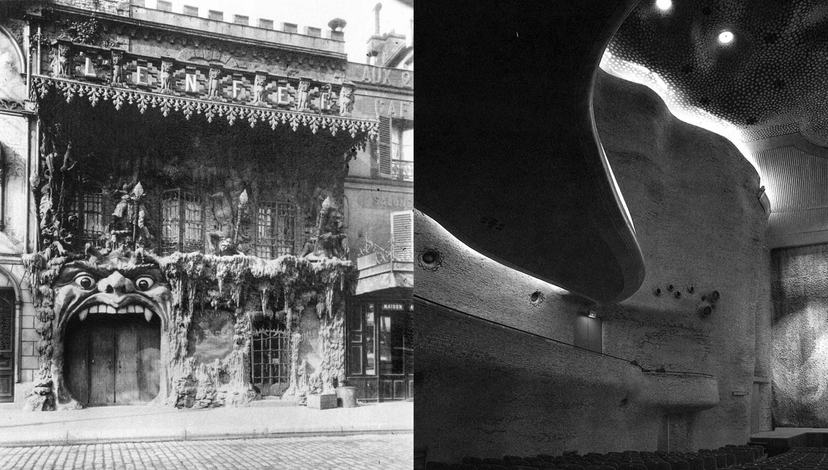
Left: ‘Nissay Theatre’: Togo Murano’s auditorium makes the room itself part of the perceptual event. Source: nissaytheatre.or.jp; Right: ‘Cabaret de l’Enfer’: a Montmartre doorway marks the threshold to another set of rules. Source: parismuseescollections.paris.fr
Pulselets
To begin the year, we will again develop Pulselets: small sensing fragments, fittings, and material experiments that test how architecture might listen, exhale, transmit, or respond. In 2026/27 these Puslelets will be placed in concert. A sound, scent, signal, or material process might travel between several Pulselets, allowing actions in one space to alter conditions elsewhere. Through proximity, timing, and exchange, individual fragments will begin to behave as a distributed collective.
ADS12 is an experimental architecture studio. We use fieldwork, material experiments, drawing, film, and live rehearsal to examine our mental lives and contemporary conditions of estrangement. These examinations culminate in architecture.
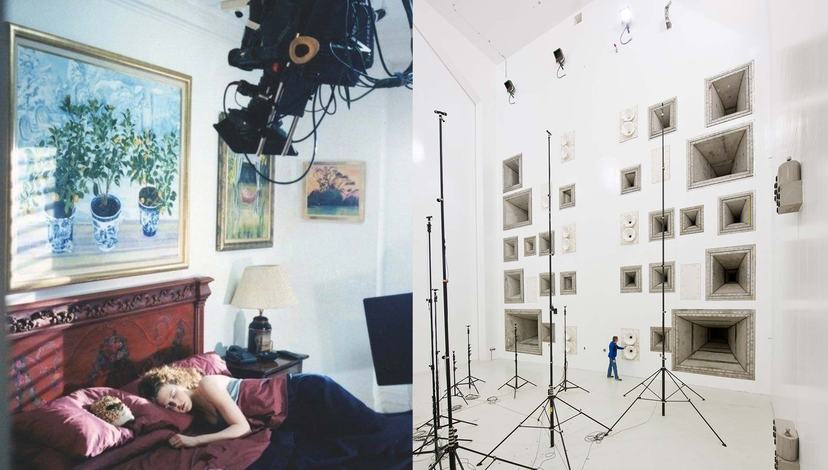
Left: ‘Sleep under observation’: a private duration unfolds beneath the apparatus recording it;Right: ‘Reverberant Acoustic Test Facility’: an interior where sound becomes an environmental condition to be tested and endured. Source: nasa.gov
Live Project & Field Trip
This year, ADS12 will travel to Tokyo to work alongside students of Musashino University. This continues our multi–year collaboration with Musashino and will drive our live project.
Tutors
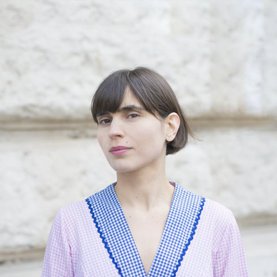
Valle Medina
Valle Medina is an artist and architect whose work is formed at the intersection of lyrical substances and psychic limits.
She is a co-founder of Pa.LaC.E a practice based between Basel and London.
She has been a principal resident at La Becque Artists Residency (CH). Previously she has been a resident at the Misk Art Institute (SA), Jan van Eyck Academie (NL), OMI New York (US), the Andreas Züst Library (CH) and elsewhere.
She is a first prize recipient of the 50th annual Shinkenchiku Award in Tokyo, and her work has been shown at ICA (UK), Van Abbemuseum (NL), La Becque (CH), Venice Biennale of Architecture (IT), Oslo Triennale of Architecture (NO), the Centre of Contemporary Culture of Barcelona (ES), Ausstellungsraum Klingental in Basel (CH), Basis voor Actuele Kunst – BAK (NL) and the Architecture Foundation in London (UK).
Her works have been published in Sternberg Press (DE), Texte Zur Kunst (DE), e-Flux Journal (US), Ecocore (UK) and Volume (NL) and are part of private collections such as the Permanent Collection of the Metropolitan Museum of Art in New York. She has delivered talks at Columbia University in New York, ETH Zürich D-ARCH, UdK Berlin, the Venice Biennale and the Architectural Association in London.
Her first major monograph—Paris Hermitage—was released in early 2017, followed by a second book published in 2023 entitled Zenith Boil, both co-published with Cooperative Editions (New York).
Valle Medina is a former Geisendorf fellow at the ETH Zürich D-ARCH, where she graduated summa cum laude from its Laboratory for Applied Virtuality, and she has been a fellow of the Danish Arts Foundation.
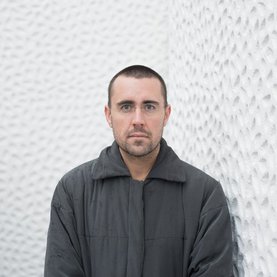
Benjamin Reynolds
Benjamin Reynolds is an architect and artist. He is a founder of Pa.LaC.E , a practice based between Basel and London.
In 2026, Reynolds was a Senior Fellow at the Swiss Institute in Rome, and in 2020-22 Reynolds was a principal resident at La Becque Artists Residency (CH). Previously he has been a resident at the Jan van Eyck Academie (NL), OMI New York (US), the Andreas Züst Library (CH) and elsewhere.
Reynolds is a first prize recipient of the 50th annual Shinkenchiku Award in Tokyo (JP), and Lausanne Gardens (CH), among other international prizes, and his work has been shown at Tate Modern (UK), ICA (UK), Van Abbemuseum (NL), La Becque (CH), Venice Biennale of Architecture (IT), Oslo Triennale of Architecture (NO), the Centre of Contemporary Culture of Barcelona (ES), Ausstellungsraum Klingental in Basel (CH), Basis voor Actuele Kunst – BAK (NL) and the Architecture Foundation in London (UK).
Reynolds' works have been published in Sternberg Press (DE), Texte Zur Kunst (DE), e-Flux Journal (US), Ecocore (UK) and Volume (NL) and are part of esteemed private collections such as the Permanent Collection of the Metropolitan Museum of Art in New York. He has delivered talks at Columbia University in New York, ETH Zürich D-ARCH, UdK Berlin, the Venice Biennale and the Architectural Association in London.
Pa.LaC.E's monographs include Paris Hermitage (2017) and Zenith Boil (2023), both co-published with Cooperative Editions, New York.
Reynolds received a diploma with honours from the Architectural Association, London.