Scoring Warnings mobilises artistic practices to interrogate the instructional mode of address in disaster preparedness. It examines crossovers between emergency communication and contemporary art to explore more inclusive, engaging, and effective ways of communicating risk.
The project will:
- Examine crossovers between emergency communication and contemporary art to explore more inclusive, engaging, and effective ways of communicating risk.
- Set up a dialogue between historical and contemporary instructional images, texts and sounds from the fields of risk communication (warnings) and contemporary art (scores), in order to create a critical interdisciplinary framework examining the ways in which these can reciprocally inform, resonate, and provoke one another.
- Develop a new methodology across Art and Warning research devised through a series of co-creative and collaborative workshops that address questions of risk mapping, emergency communication, and localised, effective, accessible instructions.
- Evaluate, consolidate and disseminate findings through practice-led research outputs, including a documentary film, audio-essay, culminating exhibition and co-authored academic publications.
Key details
Gallery
More information
The challenge
In a time of intersecting disasters, alarm fatigue is ubiquitous, and we are often unable to hear warnings or effectively respond to their calls.
By bringing together artists, curators, warning scholars, NGOs and tech developers of life-saving apps, Scoring Warnings is critically placed to develop new hybrid interdisciplinary research methods applied to the field of warnings and disaster preparedness, of benefit to civil society, academia, policy, and wider stakeholders across the arts.
Our approach
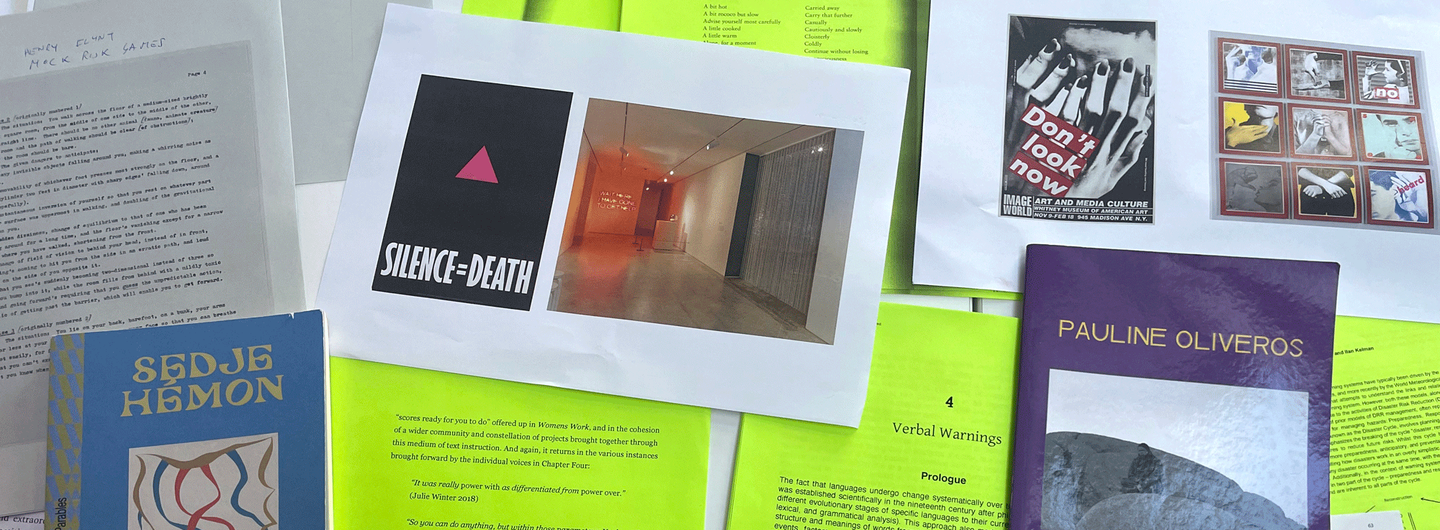
Warnings, like scores, are prompts for action with an aesthetic and sensory dimension, whether visual, textual, or sonic, that deploy an instructional mode of address to present possible disasters as risks to be managed (Cavallo). The scores we reference instigate forms of attunement (Oliveros) and relations to social and environmental surroundings (Chacon), that can respond to the long-term crises we face today. In an unprecedented juxtaposition, we read these two fields (scores by artists and warning materials) through each other, to explore the potential of the score as a tool for developing people-centred warnings.
Scoring Warnings addresses a gap in scholarly and artistic research, informed by historical insights and a new methodology based on workshopping this material with different audiences and communities, culminating in a final exhibition. Our workshops' participatory consultation format will test pathways to impact by embedding an imagination-focused and bottom-up approach, ensuring a comprehensive and inclusive research process.
We will also be commissioning new artworks, as well as folding into the research process a practice-led film which both documents the wide array of research materials, whilst enacting the instructional score-logic through audio-visual means.
Outputs & Events
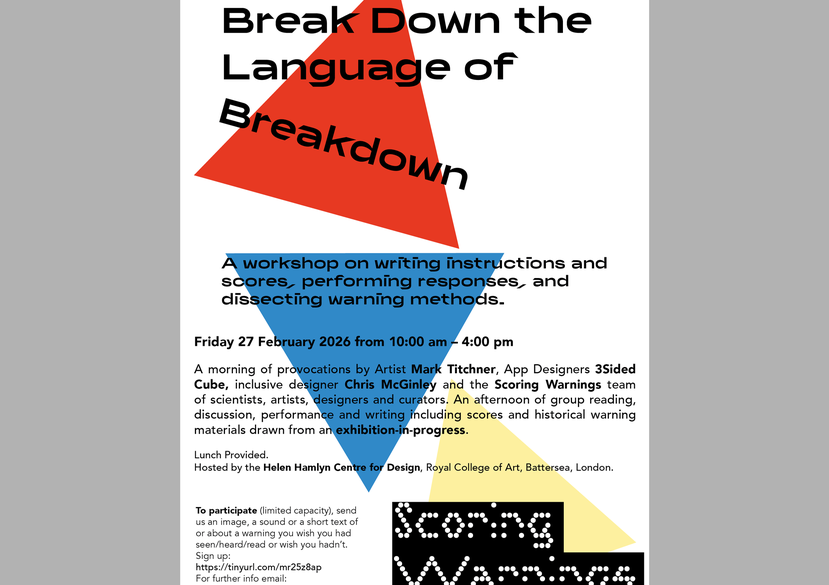
Forthcoming workshop:
Friday 27 February 2026
Break Down the Language of Breakdown: A workshop on writing instructions/scores, performing responses, and dissecting warning methods.
Including Mark Titchner, app designers 3Sided Cube, inclusive designer Chris McGinley and the Scoring Warnings team of scientists, artists, designers and curators, Aura Satz, Francesca Laura Cavallo, Amina Abbas-Nazari, Nathalie Cooper (RCA), Carina Fearnley and Ilan Kelman (Warning Research Centre, UCL) and Irene Revell (CRiSAP, UAL). Hosted by the Helen Hamlyn Centre for Design.
For further info email: [email protected]
Partners
Scoring Warnings is a collaboration between the Royal College of Art, University of the Arts London’s Creative Research into Sound Arts Practice (CRiSAP), University College London’s Warning Research Centre (WRC), the Global Network of Civil Society Organisations for Disaster Reduction (GNDR), Tate Modern, East Gallery, Arnolfini, Hangar Barcelona and more.