An exploration of the technique of fire assay using an charcoal-fired assay furnace, drawing on historical written sources and involving a series of experimental reconstructions.

At a glance
- Charcoal Fire Assaying is led by Professor Peter Oakley.
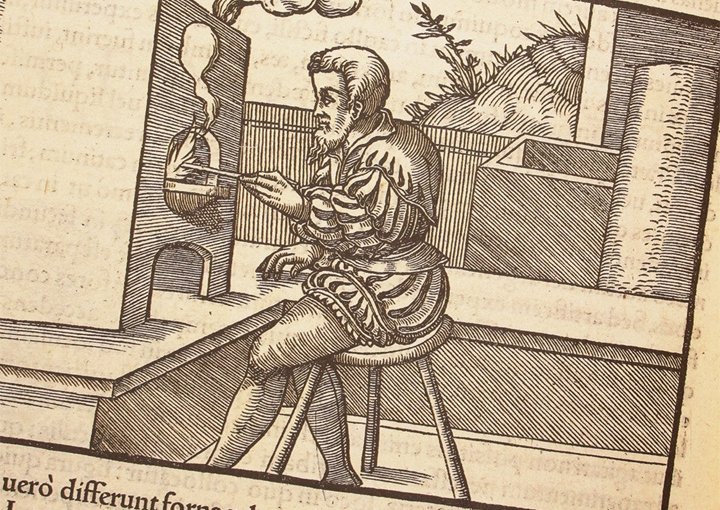
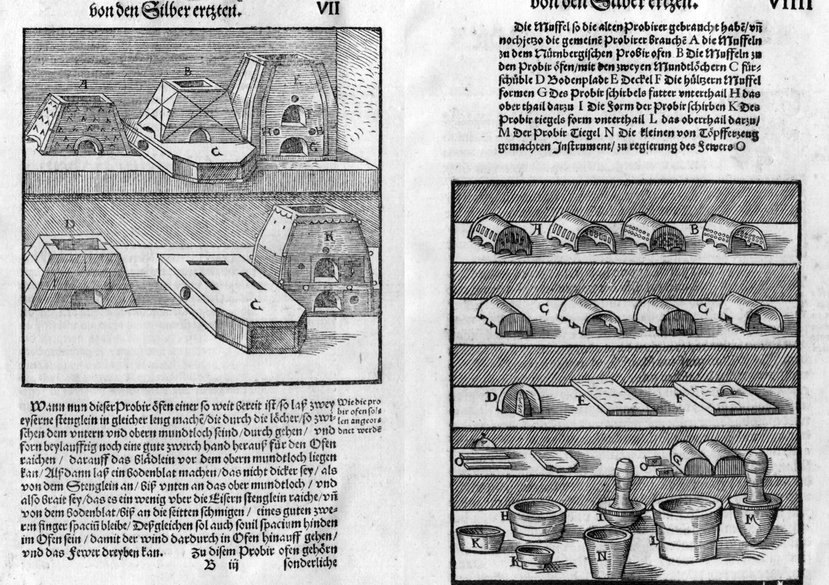
- The project has been informed by two sixteenth-century texts: Agricola’s De Re Metallica and Ercker’s Treatise on Ores and Assaying, as well as nineteenth and twentieth century assaying manuals.
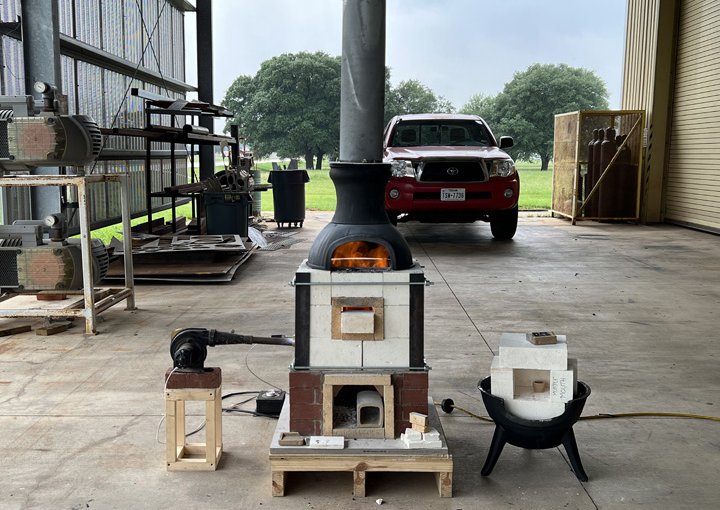
- The project has involved the construction of an iterative series of working charcoal-fuelled 'chimeric' furnaces.
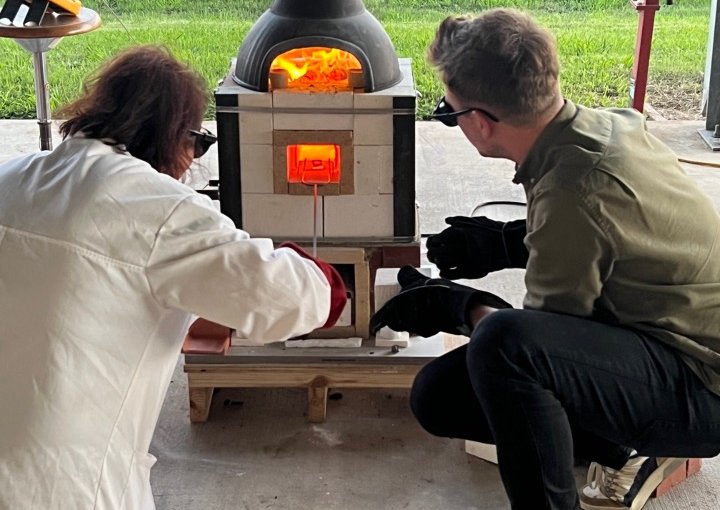
- An early 'chimeric' furnace was built and fired at the Fire Arts: Pasts and Futures workshop, held at Texas A&M in November 2023.
- Initial findings from the project were presented at the SHAC Spring Meeting, held in Oxford in May 2024.
- Results up to mid 2025 were published in two articles that were part of the Ambix 2025 Special Edition "Fire Arts: Heat Technologies, Matter Theory, and Agency in the Premodern World".
Key details
Gallery
More information
The challenge
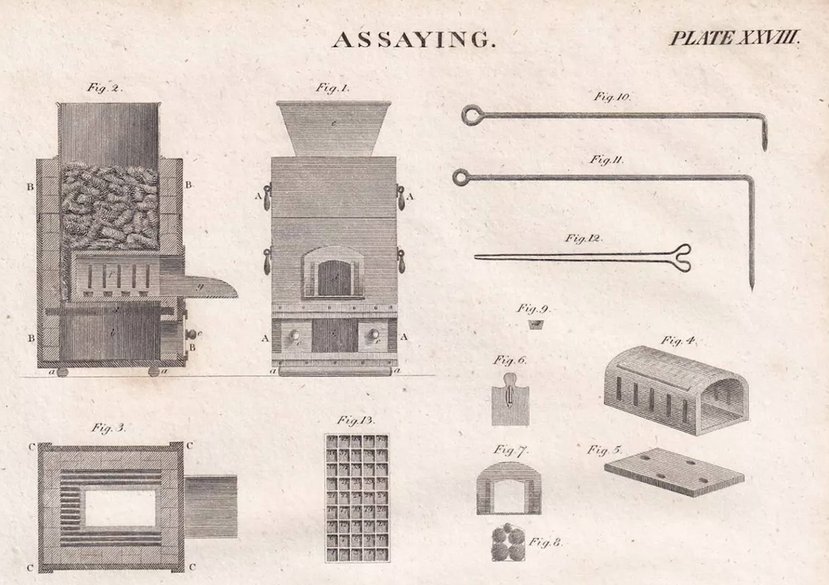
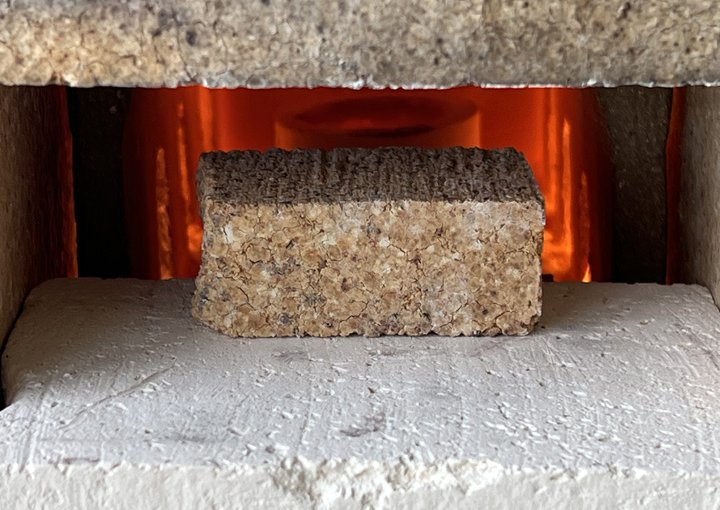
During the sixteenth century, the assaying of gold and silver by cupellation (the first stage of fire assaying) was undertaken in charcoal-fired furnaces. Though the process of fire assay is still practiced, assayers now use electricity to power their furnaces. As a consequence, the fire management skills needed to manage a charcoal-fuelled assay furnace and knowledge of conducting assays through observation and in-process interventions have been lost. This means it is no longer clear why the furnaces described and illustrated in specialist texts from the sixteenth to twentieth century took the forms they did, or how they were controlled, or why many of the the changes in assay furnace design that are evident when comparing the sixteenth and nineteenth century sources were adopted.
Approach
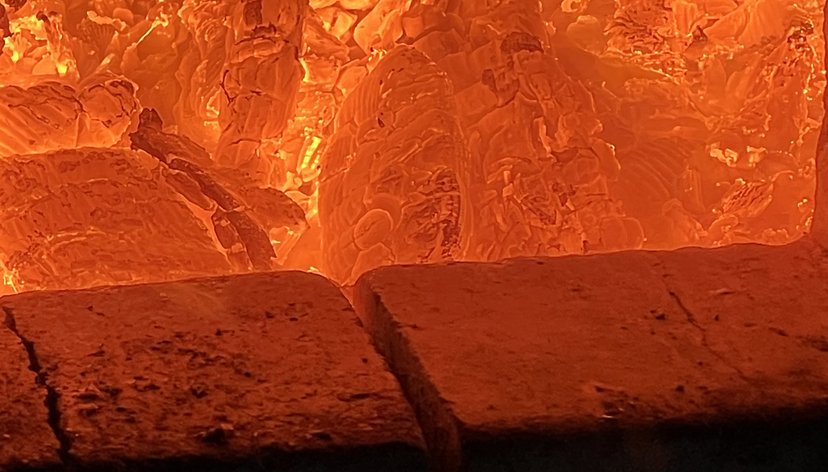
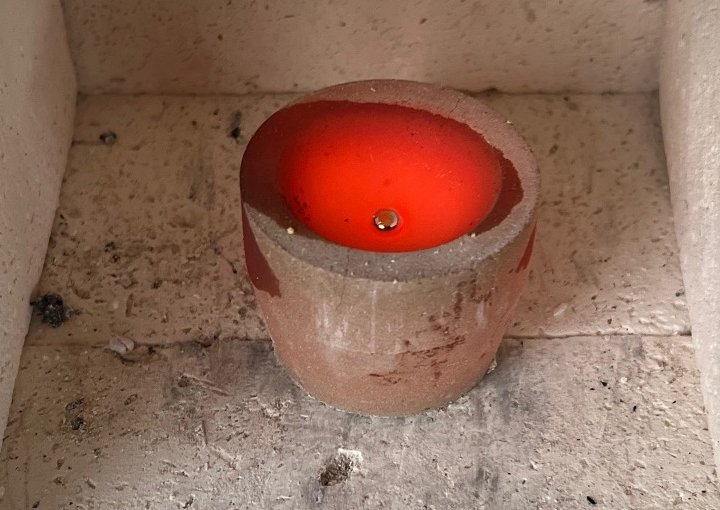
The research involved the close reading of sixteenth, nineteenth, and twentieth century sources, combined with a programme of experimental reconstruction, involving the building and firing of a series of charcoal-fired assay furnaces. These furnace builds drew from designs described and illustrated in nineteenth and early twentieth century technical manuals written for assayers and two key sixteenth-century texts: De Re Metallica by Georgius Agricola and A Treatise on Ores and Assaying by Lazarus Ercker. Considering the resulting “chimeric” furnaces’ performance and demands generated insights into how solid-fuel assay furnaces behave in practice and what roles specific structural elements described in primary sources played in a furnace's overall function. The chimeric furnaces built for the project have proved to be viable pieces of equipment in their own right. As well as cupellation, they have been successfully used for other pyrogenic processes, such as granulation, small-scale smelting, and enamelling. As the flow of air into the muffle chamber can be altered to make the atmosphere in the chamber either oxidising or reducing, they can be used for processes that are more difficult or impossible to achieve in a furnace powered by electricity.
Activities
The project has involved the close examination of historic texts and imagery from the sixteenth century onwards, including original printed publications held in the Rijksmuseum in Amsterdam and digitised versions uploaded by Bayerische Staatsbibliothek/Münicher Digitalisierungszentrum, as well as twentieth-century academic translations. The textual research also included scrutinising technical manuals published during the second half of the nineteenth and first half of the twentieth centuries that described the equipment required for fire assays (including furnace designs) and explained how to conduct cupellations in solid-fuel furnaces.
The knowledge gained from this work informed the practical programme of iterative furnace building and testing. This started with the aim of constructing a viable charcoal-fuelled furnace similar to a nineteenth-century model using industrially manufactured components. Once this had been achieved, it was followed by a sequence of alterations which introduced features found in older designs of furnace. Reflections on the results of each firing, the behaviour of the furnace during firings, and the practice of furnace management during the firing together built up a picture of the consequence of each structural and management change and their implications for the practice of fire assaying.
Considerations of the style and possible intended audiences for the primary sources, as well as their author’s claims to authority and the relative veracity of the material presented, has led to insights concerning the social construction of the precious metal assayer as a specialist technical professional during the sixteenth century, as well as how the role was redefined over the nineteenth and early twentieth centuries. This has informed reflections on the relationship between precious metal assaying and alchemy during the early modern period.
Outputs
Publications
Peter Oakley, "The Magician, the Alchemist and the Assayer: Characters on Stage and at Court in Early Modern Europe", The Goldsmiths Review 2024/25 (2025).
Peter Oakley, "Fire Management in Practice: Building and Managing Charcoal-Fired Assay Furnaces as Experimental Reconstructions", Ambix 72 (2025).
Katharina Vones and Peter Oakley "Rounding Up: Undertaking Experiential Research on Granulation Techniques in a Charcoal-Fired Furnace",Ambix 72 (2025).
Presentations
‘Reconstructing a Sixteenth-Century European Goldsmithing Furnace: Technical Principles, Structural Requirements, and Practical Issues’, Fire Arts: Pasts and Futures workshop, Texas A&M College Station Campus, College Station, Texas, 7 Nov 2023.
‘The Magician, the Alchemist, and the Assayer: Elizabethan Characters on the Stage and in the Streets’. Presentation given to the Early Modern Studies Working Group at Texas A&M RELLIS Campus, College Station, Texas, 13 May 2024.
‘How to Regulate the Fire’: Early Modern Cupellation and Furnace Management’. Presentation given at the SHAC 2024 Spring Meeting, held at the Maison Française d'Oxford, Oxford, 28/29 May 2024.
Panelist for 'New Computational and Experimental Methods in the History of Alchemy and Chemistry - Experimental Reconstructions', at the 14th International Conference on the History of Chemistry, held at the University of Valencia, Spain, 11-14 June, 2025.
'Alchemy, Assaying and Experimentation', a History at the Hall presentation for the Goldsmiths Company's' History Group, held at Goldsmiths' Hall, London, 1 September 2025.