Key details
Date
- 19 January 2026
Read time
- 6 minutes
A new MFA prize offers graduating RCA artists two funded weeks in rural Devon to pause, reflect and reimagine their practice beyond education.
The completion of a Masters can be both a moment of celebration and uncertainty. While a final project is released into the world with ceremony and scrutiny, there is often a more disorientating question that follows: what comes next, and how does an emerging practice survive beyond the protective architecture of education?
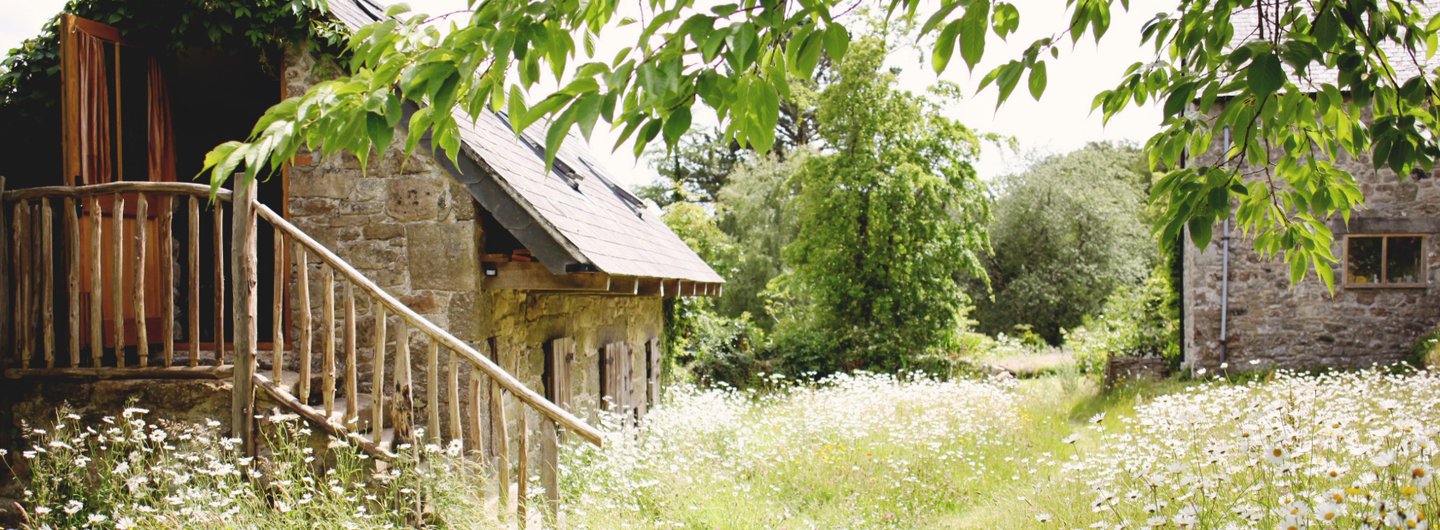
An opportunity to ground and centre at this crossroads can be transformative. That is precisely what is on offer to one graduating MFA student each year at Southcombe Barn, an arts and residency space set within the wide, elemental landscape of Dartmoor in South Devon. The two-week residency, established in 2025 by RCA MFA alumna Vashti Cassinelli, was conceived as both a practical resource and a gesture of care to fellow RCA alumni.
“I think coming out of study can be a difficult and daunting time initially,” says Cassinelli. “I hope the residency offers students a nurturing and inspiring time, post-studies, to really reflect on their practice and studies, as well as time away from a structured timetable at college. A chance to try out new ideas and work in an inspiring and supportive environment away from everyday life.”
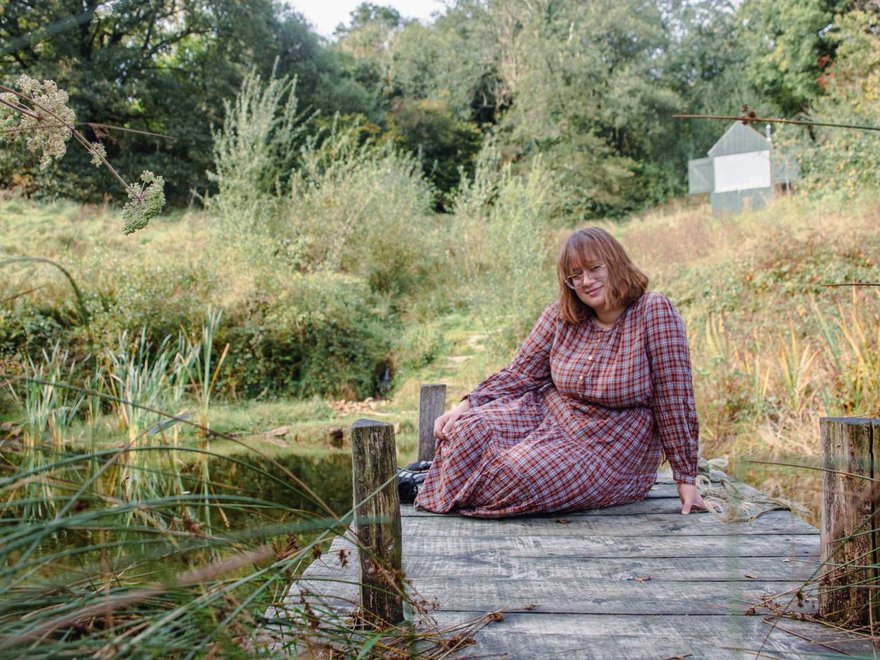
Gabriela Lehmann Rodriguez enjoys nature during the Southcombe Barn residency
Southcombe Barn itself is the product of a similar transitional moment. Cassinelli founded the space in 2020 with her partner, converting disused farm buildings near their family home into studios and accommodation after relocating from Bristol. What began as a response to lockdown and rural isolation has since grown into a vibrant site for artistic exchange, environmental thinking and community engagement.
My time studying at the RCA hugely influenced how I’ve developed and curated Southcombe Barn’s vision,” she says. “There’s a strong focus on bringing artists together to exchange ideas around more-than-human connection, social and ecological resilience, and sustainable futures.”
Alongside hosting residencies, the space collaborates with organisations including RAMM, Karst, Radical Ecology, Exeter University and The Box in South West, and regularly supports artists to test new work through performances, open studios and workshops. Its apothecary garden was developed with local refugee communities, and the wider site — sixteen acres of meadow, woodland and pasture opening directly onto the moor — is also used for forest school sessions with local children.
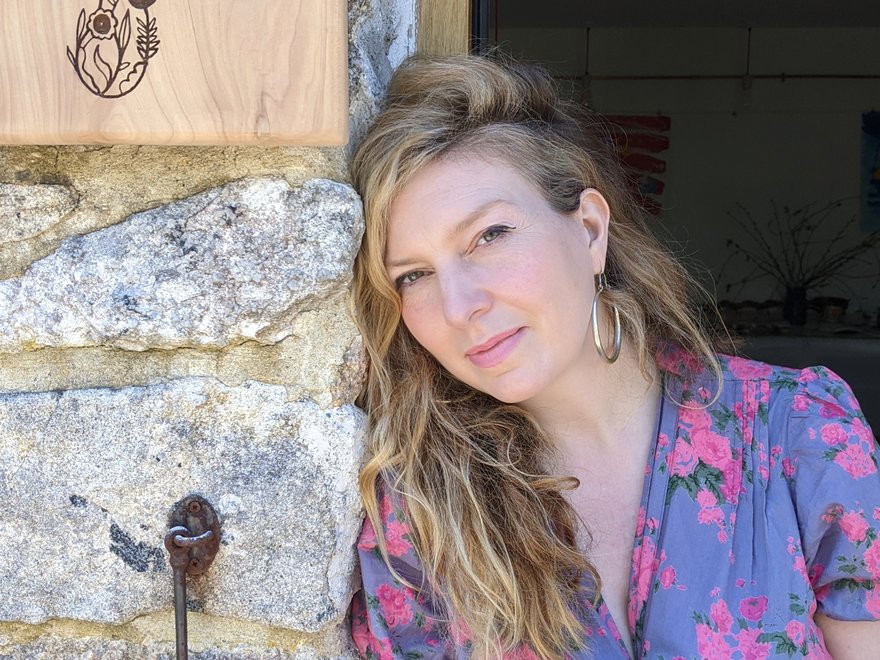
Vashti Cassinelli, RCA Alumni, founder of the Southcombe Barn residency
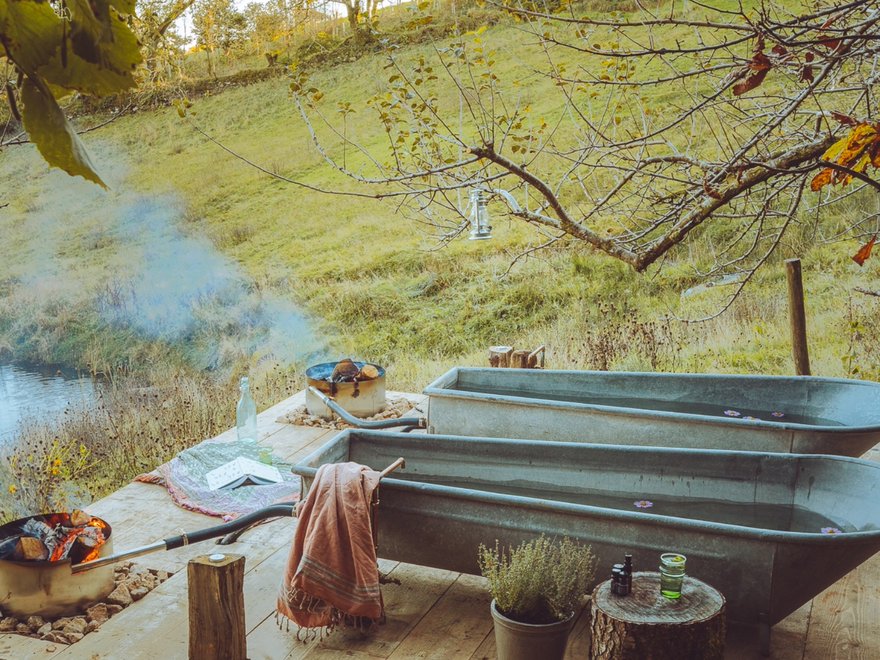
Outdoor baths in Southcombe Barn, which Cassinelli founded with her partner
This ethos of reciprocity and long-term support underpins the RCA x Southcombe Barn Prize. Cassinelli conceived the award while completing her own final project and co-founding Cassinelli Mills, a curatorial and mentoring platform supporting women and non-binary artists. “I had the most transformative experience at the RCA,” she says. “I wanted to leave an offering of my own, something that would continue to give something useful to new cohorts each year.”
The inaugural recipient of the prize was Gabriela Lehmann Rodriguez, whose practice moves between illustration, storytelling and comics, exploring how identity is shaped by gender, sexuality, environment and social expectation. During her MFA, Rodriguez focused on the concept of “self-concept” — the way people perceive themselves — and how this is inflected by performance, visibility and belonging.
By the time graduation arrived, she found herself at a familiar threshold: proud of what she had made, but uncertain about what should follow. “I had just finished a comic about the fear of erasure and being closeted, a project that had been with me for a long time,” she says. “Afterwards, I felt a kind of mental block. The residency presented an opportunity for me to explore my practice outside of the boundaries I had previously set for myself.”
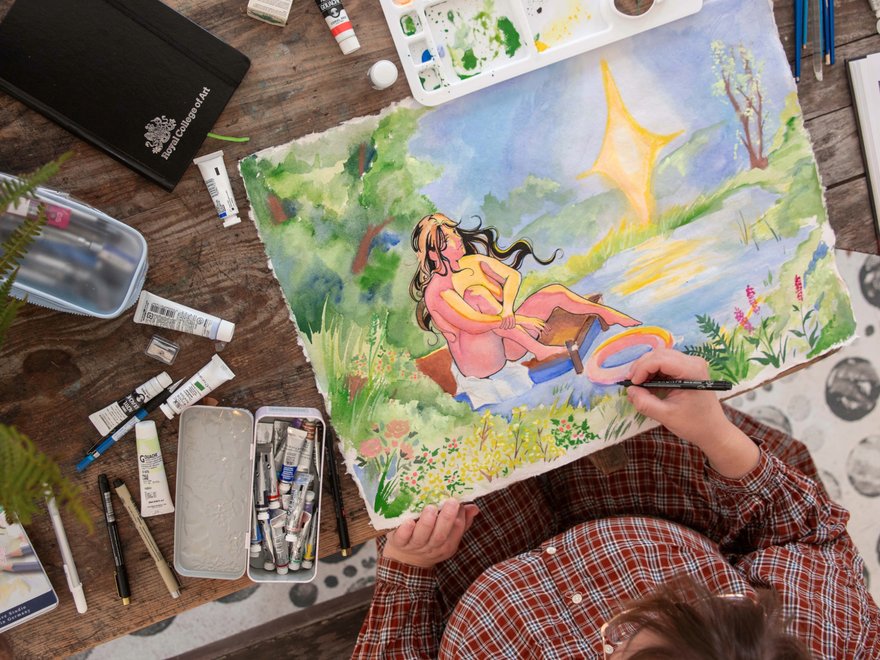
Gabriela Lehmann Rodriguez works in the studio during the Southcombe Barn residency
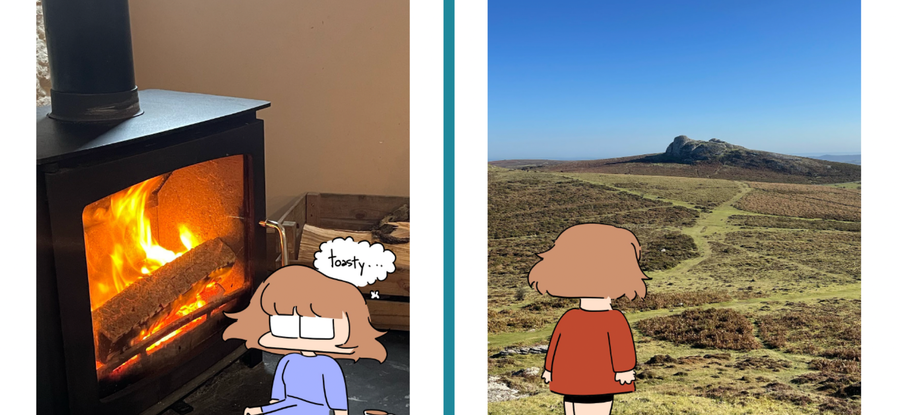
Southcombe Barn offered a radical change of tempo. For the first time, Rodriguez found herself living and working in a rural setting, surrounded by sheep, open fields and long, uninterrupted hours. “Often working in urban environments and under tight deadlines, my whole world flipped around at Southcombe,” she says. “With fewer distractions and external worries, working at a slower and more mindful tempo, and to really concentrate and engage with fully experiencing this new world around me and the kind of work it would lead me to create.”
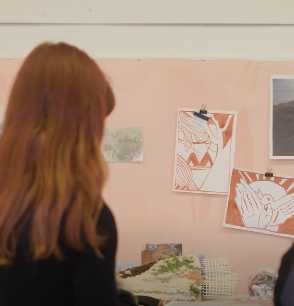
Her days developed a gentle structure: walking across the moor at sunrise, collecting plants and soil from the apothecary garden to create natural pigments and working into the evenings in the studio. She learned to make paper from pulp, combined earth and herbs with watercolours, and began a new series of illustrations centred on embodiment and belonging, later compiled into a zine.
There were moments of uncertainty at first. Accustomed to setting rigid goals, she struggled with the absence of deadlines and expectations. Then came a small, unexpected turning point, while she was outdoors observing her surroundings. “I saw on the ground there was a slug dancing around and feasting on an entire apple,” she recalls. “Seeing that slug in the equivalent of bug heaven, fully present in its unhurried life was a big wake-up call. My mindset shifted to fully take in what this new world had to show me.”
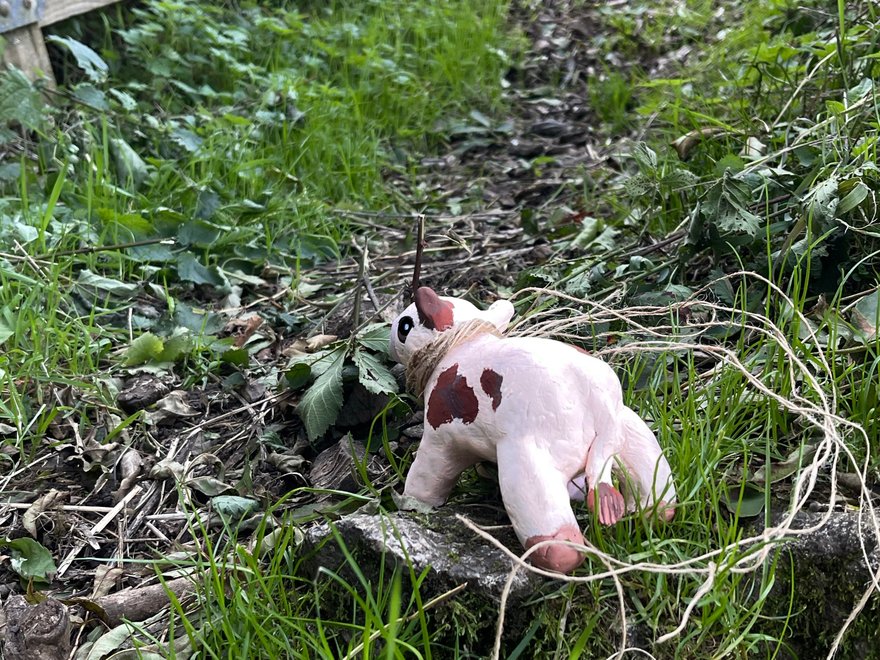
Gabriela Lehmann Rodriguez explores the surrounding countryside with a cuddly companion
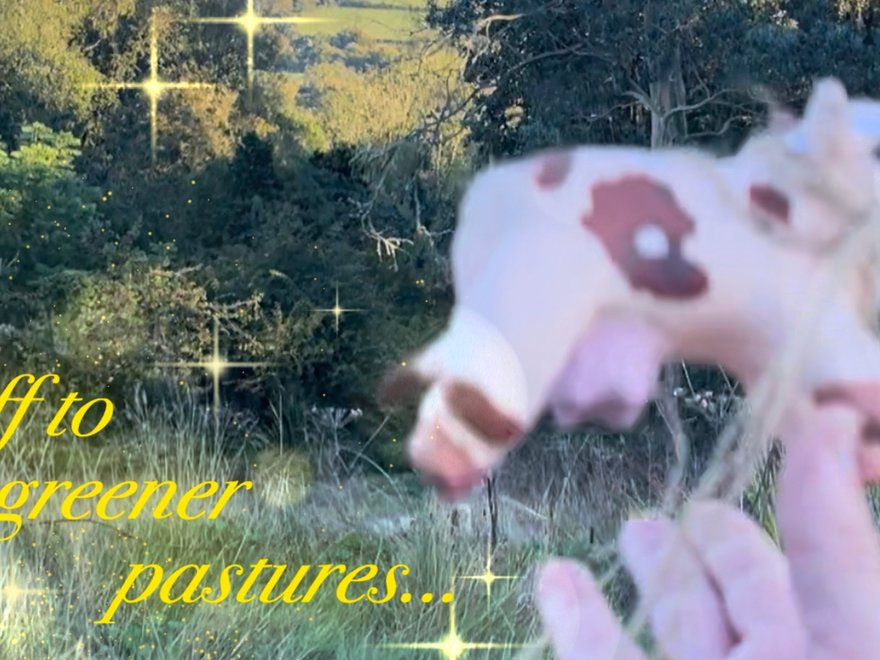
For Cassinelli, this evolution exemplifies the purpose of the prize. Rodriguez was selected not only for the strength of her proposal, but for her commitment during the MFA and her sensitivity to landscape and identity. “During the residency, Rodriguez was able to immerse herself in the local ecology,” says Castinelli. “And explore alternative and sustainable processes.”
The award itself is deliberately comprehensive: two weeks of self-catered accommodation, studio access, use of the garden, sauna and yoga space, a materials and travel allowance, and a one-to-one mentoring session through Cassinelli Mills focused on professional development and long-term practice.
Rodriguez describes the alumni-to-alumni support as particularly meaningful. “Post-graduation can feel overwhelming,” she says. “Having the support from another alumni, and with the relationships I’ve built at the RCA, has built the foundation of a sustainable community around mutual care.”
Looking ahead, Cassinelli hopes to expand the residency programme to include longer stays, group residencies, and dedicated opportunities for artist parents and carers. New patrons and partnerships are planned for 2026, alongside a commitment to maintaining relationships with former residents. “I’d love to see artists return, to keep building something that extends beyond this place,” she says. “A community that connects rural and global perspectives.”
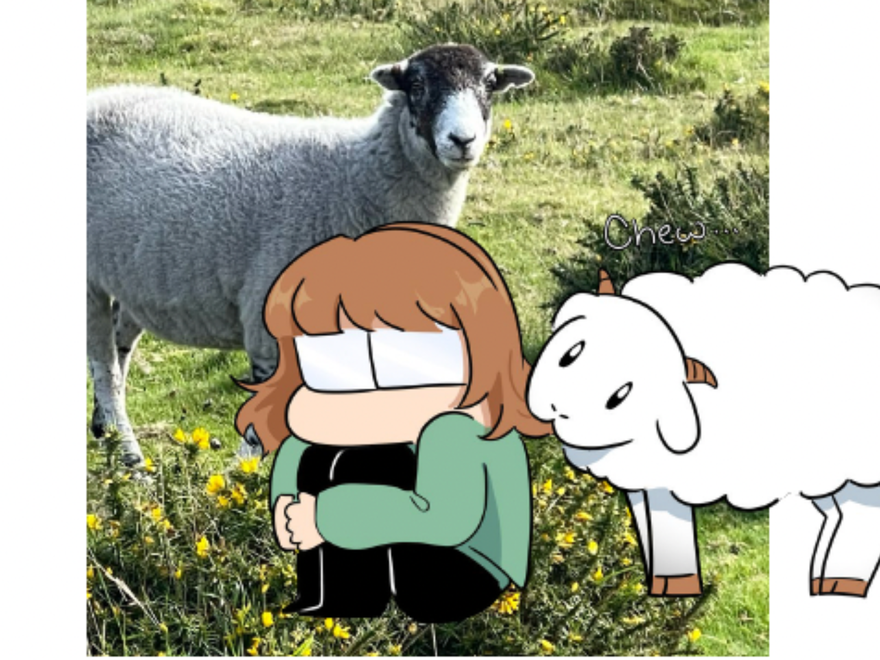
Extract from the zine created during the residency by Gabriela Lehmann Rodriguez
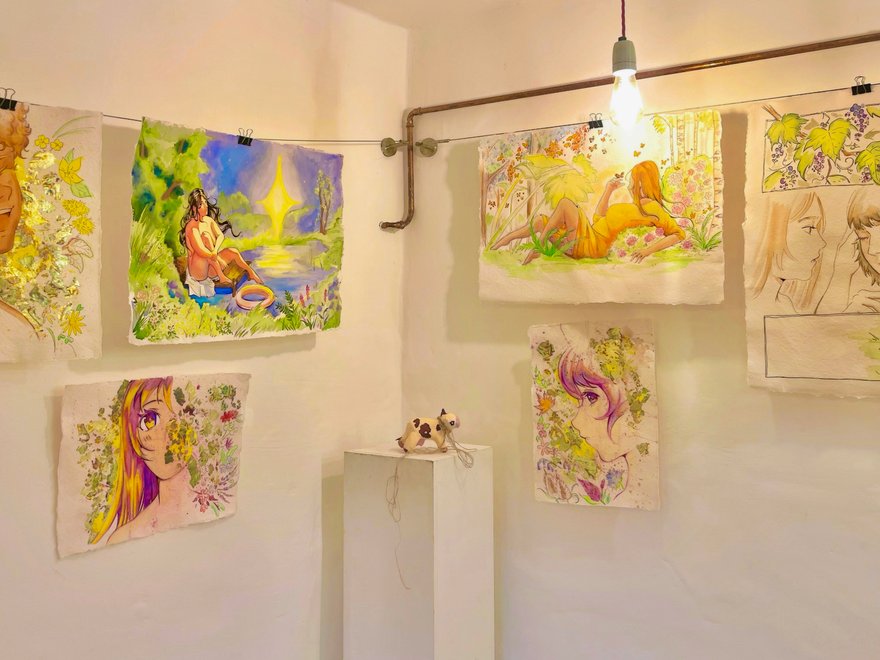
Collection of Rodriguez's work made during the Southcombe Barn residency
For current MFA students, both founder and recipient offer the same advice: apply, even if the fit feels uncertain. “Residencies are crucial in giving artists the time and space to create and reflect without pressure,” says Castinelli. “They are hugely beneficial for learning, testing, networking and offering dedicated time to expand thinking, research and output.” Rodriguez agrees: “Even if you think your practice differs greatly or feels out of place, there is always a possibility to explore your practice in new ways, or expand what’s already possible in your work.”
The residency reflects what the MFA builds: an infrastructure for learning, but also a living community of practice that continues beyond the degree. "It's is a rare, alumni-led gift back to the programme: a place to land, breathe, and return to practice with intention after graduation," says Adam Kaasa, Senior Tutor of the Arts & Humanities MFA. "We’re thrilled that the inaugural recipient, Gabriela Lehmann Rodriguez, will be the first to carry this invitation into the next chapter of her work—proof that the prize loops back: generated from within the MFA, and offered back to future graduates."
At a moment when many emerging artists face precarity or exhaustion entering into the art and design world post study, the Southcombe Barn residency offers something increasingly rare: permission to pause and to wonder.
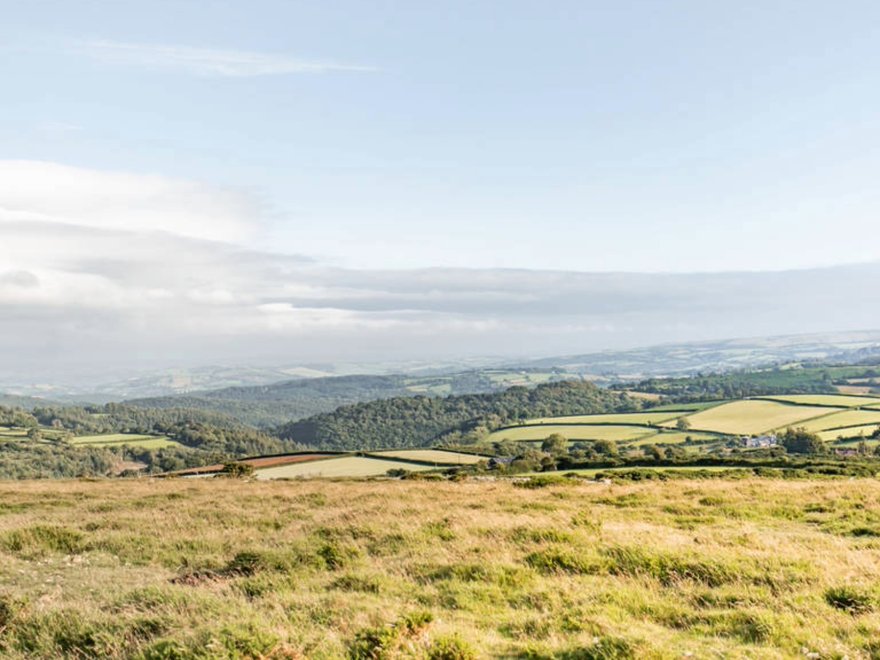
The surrounding Dartmoor landscape near Southcombe Barn