Key details
Time
- 1pm – 2pm
Location
- Online
Price
- Free
Who could attend
- Everyone
Type
- Webinar
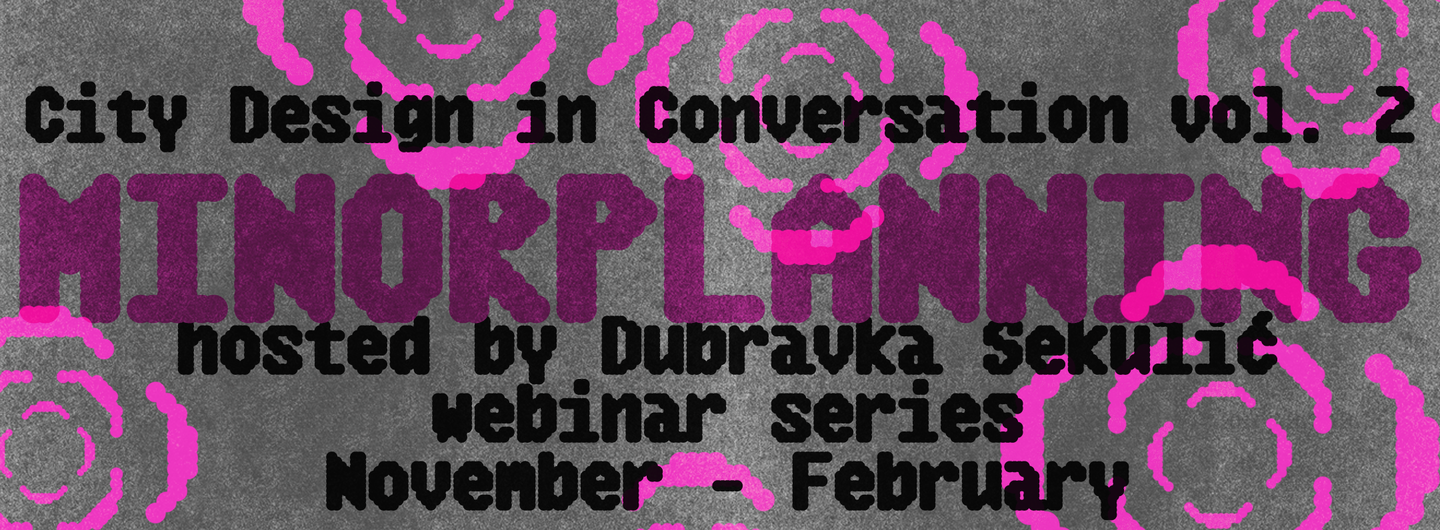
Join us online for the second series of City Design in Conversation. Hosted by Dubravka Sekulić, Head of Programme.
Join us online for a second series of City Design in Conversation. Hosted by Dubravka Sekulić, Head of Programme for City Design MA, the series will explore MINORPLANNING; practices of designing the city that support liberation and empowerment of those who live and struggle in the cities.
Refusing abstraction of masterplanning through spreadsheets, we will talk with those whose work shows us a way forward, who work within and outside the system to empower those who already live and work to be in better control of their future, which is always at danger by being erased from large scale urban development and other processes of dispossession.
Against the backdrop of destruction both by war and reconstruction, climate collapse, and intersecting and compound injustices that add further pressure on the existing built environment, it is urgent to rethink how we design cities and what are new forms of spatial practice and spatial practitioners.
At the City Design MA we are committed to holding space to both bold and quiet proposals that challenge disciplinary status quo and can bring the discipline into the future.
Understanding that how we live, individually and collectively, is framed through what we can do in physical space, this urgency is not only professional but societal. Exploring how night life policy planning, repair as liberation, transformation of vacant and underused buildings into lifehouses, moratorium on new construction, civic assemblies and forums design cities otherwise, we will virtually cross different geographies to study.
Together, we are going to explore ways of building more just, equitable cities, which work as a support system for all its inhabitants, both humans and non-humans, to not only survive, but thrive.
Programme of sessions
- 27 November, 1pm GMT – On Public Spatial Literacy with Iva Čukić / Ministry of Space
- 11 December, 1pm – On Policy and Advocacy as Design Interventions with Olympia Kazi
- 18 December, 1pm GMT – On Repair as Liberation with Khaldun Bshara
- 15 January, 1pm GMT – On Moratorium on New Construction as the City Design Intervention with Charlotte Malterre-Barthes
- 29 January, 1pm GMT – On Lifehouse on every block! with Adam Greenfield
- 12 February, 1pm GMT – On A People’s Design Service with David McEwen / Unit 38
18 December, 1pm GMT – On Repair as Liberation with Khaldun Bshara
- In his recent text “Space, Time, and the Re-Making of Gaza,” Khaldun Bshara writes that “repair signifies survival rather than nostalgia—a refusal to allow rubble to be forgotten or erased, born out of necessity.” Not only an act of urgency born in the context of occupation, but it is also urgent to reconsider repair as one of the key approaches to city design, which informs minorplanning. Bshara draws this connection, positing that “this approach to repair challenges prevailing norms of disposability, where objects, structures, and even entire cities are demolished to make way for the new. In Gaza and other colonised regions, repair is not merely a choice but a tactic of resistance. It repurposes historical remnants, rearranges rubble, and asserts value where others perceive waste or a “demolition site.” Born out of the necessity of struggle against the ongoing occupation for almost 80 years, this steadyfast dedication to repair and reconstruction as a form of city making, as a form of heritage from below, as a form of staking claim for life not just in the past, but more importantly for the future, that refuses linearity and progress, is not only a minorplanning, but a praxis which creates an opening and a hope for many other geographies. In the moment when images of the violent destruction: urbicide, genocide and ecocide, of Gaza are being slowly replaced by the top-down fantasy of glitzy towers and urban space optimised for profit, with stratification and hierarchies between people normalised and reinforced by spatial planning, and a local population excluded and enclosed, images which epitomise planning of cities without people and life, we will discuss how repair, as a defiant act from below, is crucial for liberation as it opens up space for emancipation and restoration of everyday life.
- Khaldun Bshara is an architect, restorer, and socio-cultural anthropologist. He serves as an assistant professor in the Department of Social and Behavioral Sciences at Birzeit University and is the Editor-in-Chief of the Jerusalem Quarterly Journal. From 1994 to 2024, Bshara was actively involved with the Riwaq Centre in Ramallah, where he served as director from 2010 to 2020. His work at Riwaq focused on documenting, protecting, and restoring Palestinian built heritage.
How to join
- The online sessions will take place virtually on Zoom. The events are free to attend, but you will need to register to guarantee your spot and receive the Zoom link.
- To avoid any technical issues on the day, we recommend you download the latest version of Zoom in advance.
- When it’s time, come back to this page to join the event - you’ll get an email reminder on the day too to remind you of what is happening at which times.
Joining from a country where Zoom doesn't work?
Cuba, Iran, North Korea, Syria and Ukraine (Crimea, Luhansk, Donetsk regions) have restricted Zoom for regulatory reasons. Please reach out to [email protected] if this affects you.
Other events at the RCA
We are continually adding to our diverse programme of events: conversations on key topics such as funding advice and portfolio development, symposia, exhibitions, open days and more. Many are free and open to the public.
Book your ticket
Book a free online ticket via this link.