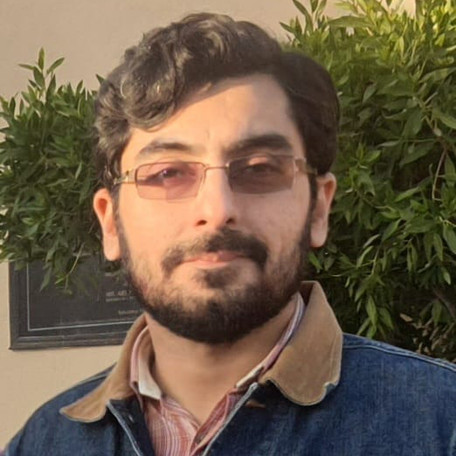
Dr Muhammad Ali
- Senior Tutor
- Textiles MA
Ali is a textile engineer interested in making everyday textiles electrically and thermally functional through printing and finishing processes that can realistically scale.
Ali received bachelor's and master's degrees in Textile Engineering from NED University of Engineering and Technology, Karachi, and his PhD from the University of Leeds in 2013 with the thesis 'Preparation, Characterisation and Application of Printed Electronic Textile Assemblies', supervised by Professor Long Lin.
His doctoral work established an integrated approach to electronic textiles, treating ink preparation, characterisation and textile application as a single problem, that has shaped his research ever since.
Key areas of expertise
- Electronic textiles (e-textiles) and printed electronics
- Conductive inks, dispersions and coatings
- Functional and high-throughput printing ink formulation
- Textile dyeing, printing and finishing
- Sustainable and cleaner textile processing
- Materials and process characterisation
Key details
School, Centre or Area
More information
Research interests
Ali's recent research focuses on electrically heated and electronically functional textiles, from the formulation of conductive carbon-black inks and the printing and stitching of heating elements, to characterising how these textiles behave in use. A central thread of his work has shown that conventional pigmented inks, re-engineered through processes such as the bead milling of binder-free dispersions, can deliver electrical conductivity sufficient for practical printed circuits and heaters, without the costly and less sustainable solvent systems they would otherwise require.
Alongside this, Ali maintains a broad interest in the wider textile field, including the statistical optimisation and bulk-scale validation of dyeing and printing processes, natural dyeing and denim processing, antibacterial finishing, and textile composites. His practice sits at the intersection of materials chemistry, printing technology and textile engineering, moving from the chemistry of the ink through to the behaviour of the finished, worn textile.
He is currently developing this work toward human health applications, exploring how textile-delivered warmth interacts with the body and how heating textiles might be designed to be safe, comfortable and genuinely useful. Ali holds three granted patents in textile machinery and process design, with further patents pending, including one on conductive carbon-black dispersions and inks, and has collaborated with industry partners on research and consultancy. He currently supervises doctoral researchers working on sustainable denim manufacturing and on microplastic pollution from textiles, and reviews for journals including the Journal of Industrial Textiles, The Design Journal, Textile Research Journal and Progress in Organic Coatings. He has presented his research at national and international conferences and has served on the organising and technical committees of successive international textile conferences.
Awards
- Best Researcher Award 2022 awarded by NED University of Engineering & Technology, Karachi
- Best Publication Award 2019 awarded by NED Alumni Association of Southern California (NEDAASC)
- Best Teacher Award 2018 awarded by NED Alumni Association of Southern California (NEDAASC)
- Grand prize in ‘Teaching Skills Competition’, Textile & Fashion Campus of Korea Polytechnic, 2017
Publications, exhibitions & other outcomes
Akhtar, Z., Imran Ali, S., Abbass, N., Ali, M., Khan, M.Y., Hasan, S.A., Ahmed, S., Manzoor, S., Lutfi, Z., 2020. Evaluation of Antibacterial Potential of New Acid Dyes Based on Substituted Aryl Amines and Amino Hydroxy Sulfonic Acid. Journal of the Chemical Society of Pakistan 42, 783–788.
Ali, M., Bysouth, S., 2014. High throughput process of optimisation of pigment concentrates. NED University Journal of Research 11, 15.
Ali, M., Faisal, S., Naqvi, S., Abdul Wahab, K., Afreen, R., Lin, L., 2022a. Electrically heated wearable textiles produced by conventional pigmented inks containing carbon black. Pigment & Resin Technology 51, 390–396.
Ali, M., Hina, S., Siddique, S.H., Lodhi, R.T., 2024. Prediction of yarn sales price using data mining techniques–a case of yarn manufacturing industry. Industria Textilia 75, 150–156.
Ali, M., Lin, L., 2018. Optimisation and analysis of bead milling process for preparation of highly viscous, binder-free dispersions of carbon black pigment. Progress in Organic Coatings 119, 1–7.
Ali, M., Lin, L., Cartridge, D., 2019a. High electrical conductivity waterborne dispersions of carbon black pigment. Progress in Organic Coatings 129, 199–208.
Ali, M., Lin, L., Cartridge, D., 2019b. High electrical conductivity waterborne inks for textile printing. Journal of Coatings Technology and Research 16, 1337–1349.
Ali, M., Lin, L., Faisal, S., Ali, S.R., Ali, S.I., 2019c. Let-down stability and screen printability of inks prepared using non-printing ink grades of carbon black pigment. Pigment & Resin Technology 48, 523–532.
Ali, M., Lin, L., Faisal, S., Sahito, I.A., Ali, S.I., 2019d. Optimisation of screen printing process for functional printing. Pigment & Resin Technology 48, 456–463.
Ali, M., Mahmood, A.H., Hussain, S., Ahmed, F., 2021. An investigation into the antibacterial properties of bamboo/cotton blended fabric and potential limitations of the test method AATCC 147. Journal of Natural Fibers 18, 51–58.
Ali, M., Siddiqui, M.O.R., Yenigun, E.O., Khan, A.S., 2025. Evaluation of conductive threads and stitch configurations for heated e-textile applications. Journal of Industrial Textiles 55. https://doi.org/10.1177/15280837251359799
Ali, M., Zubair, M., Siddiqui, M.O.R., Lin, L., 2022b. A study of the functionality of conventional pigmented inks in furnishing electrical conductivity to textiles. Industria Textilia 73, 602–606.
Beg, T., Jaweed, S., Ali, M., 2025. Study on the effects of cellulosic fiber reinforcements on tensile and flexural properties of fiber-reinforced mortar. Journal of Textile and Apparel, Technology and Management 13.
Faisal, S., Ali, M., Naqvi, S., Lin, L., 2022a. Statistical Optimization and Bulk Scale Validation of the Effects of Cationic Pre-treatment of Cotton Fabric for Digital Printing with Reactive Dyes. Journal of Natural Fibers 19, 6737–6747.
Faisal, S., Ali, M., Siddique, S.H., Lin, L., 2021. Inkjet printing of silk: Factors influencing ink penetration and ink spreading. Pigment & Resin Technology 50, 285–292.
Faisal, S., Naqvi, S., Ali, M., Lin, L., 2022b. Comparative study of multifunctional properties of synthesised ZnO and MgO NPs for textiles applications. Pigment & Resin Technology 51, 301–308.
Faisal, S., Tronci, A., Ali, M., Bashir, E., Lin, L., 2019. Right-first-time dyeing: a design of experiments approach for the optimisation of dyeing-processes using hard water. Pigment & Resin Technology 48, 449–455.
Faisal, S., Tronci, A., Ali, M., Lin, L., Mao, N., 2020. Pretreatment of silk for digital printing: identifying influential factors using fractional factorial experiments. Pigment & Resin Technology 49, 145–153.
Hina, S., Ali, M., Asif, R., Noor Ali, K., 2019. A framework for creation of designs of varying complexity for use in weaving/printing of textiles. International Journal of Computer Science and Network Security 19, 218–222.
Siddique, S.H., Faisal, S., Ali, M., Gong, H., 2020. Optimization of tensile properties of bagasse fiber-reinforced composite using response surface methodology. Polymers and Polymer Composites.
Siddique, S.H., Faisal, S., Ali, M., Gong, R.H., 2021a. Optimization of process variables for tensile properties of bagasse fiber-reinforced composites using response surface methodology. Polymers and Polymer Composites 29, 1304–1312.
Siddique, S.H., Faisal, S., Mohtashim, Q.-A., Ali, M., Gong, R.H., 2021b. Investigation of fibre orientation and void content in bagasse fibre composites using an image analysis technique. Fibres & Textiles in Eastern Europe 29.
Siddique, S.H., Siddiqui, M.O.R., Ali, M., Sun, D., 2022. Hybrid composites based on textile hard waste: use as sunshades. Industria Textilia 73, 680–686.
Siddiqui, M., Ali, M., Zubair, M., 2018. Prediction of air permeability of knitted fabric by using computational method. Texstil ve Konfeksiyon 28, 273–279.
Zahid, B., Ali, M., Zubair, M., Karim, M., 2020. Effect of caustic treatment on cotton/modal blended fabric. Industria Textila 71, 427–431.