Key details
Date
- 28 April 2026
Author
- Alexandra Genova
Read time
- 6 minutes
Prints preserved in the RCA's Special Collections are revealing the remarkable early career of Sudanese artist, TS Ahmed.
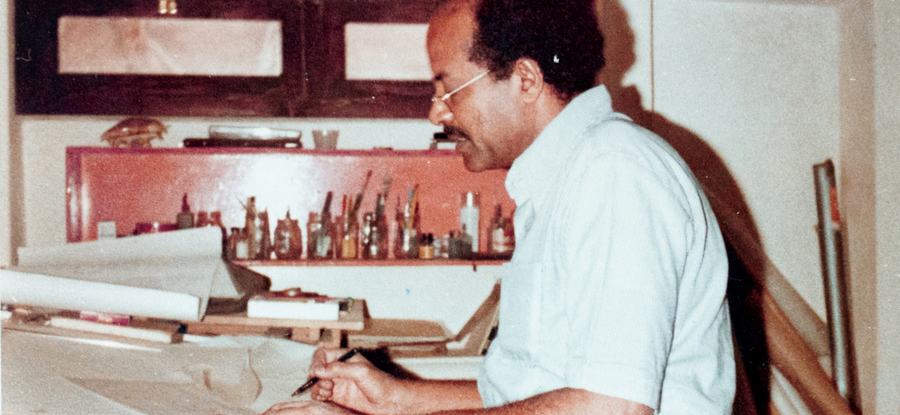
Painter, printmaker, illustrator, graphic designer, architect, interior designer and teacher – the Sudanese artist TS Ahmed led a career that spanned more than six decades and crossed continents. Yet despite an early period of acclaim in 1960s London, his work slipped into relative obscurity after he returned to his home country and later spent much of his life teaching across East Africa and the Middle East.
Now, a new exhibition at Almas Art Foundation in London is helping to restore his place in modern art history. Led by researcher Dr Fathi Osman, the project brings together archival material, artworks and newly uncovered documents to re-examine Ahmed’s life and practice.
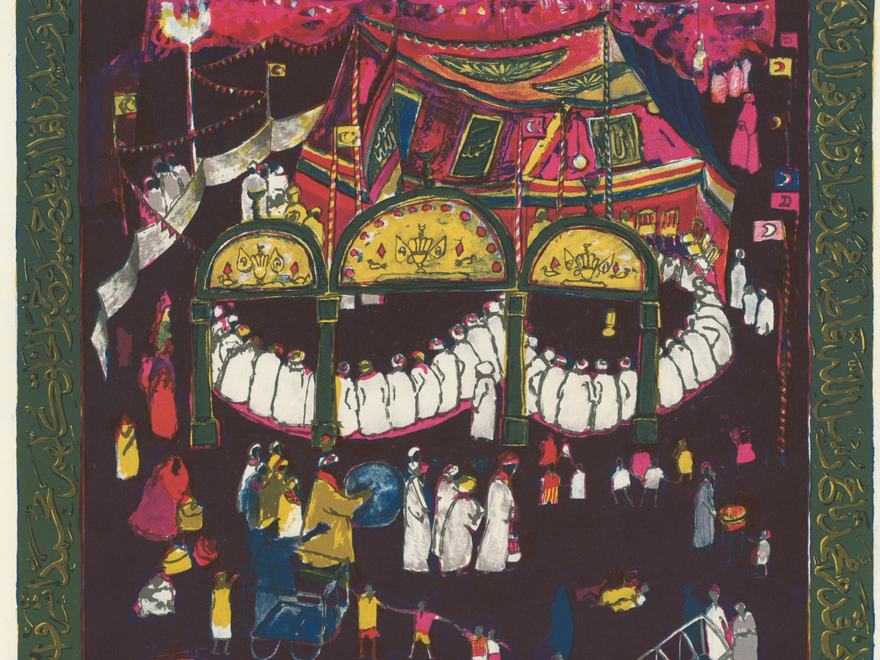
TS Ahmed Al Mu’lid 1960, Lithograph on wove paper.
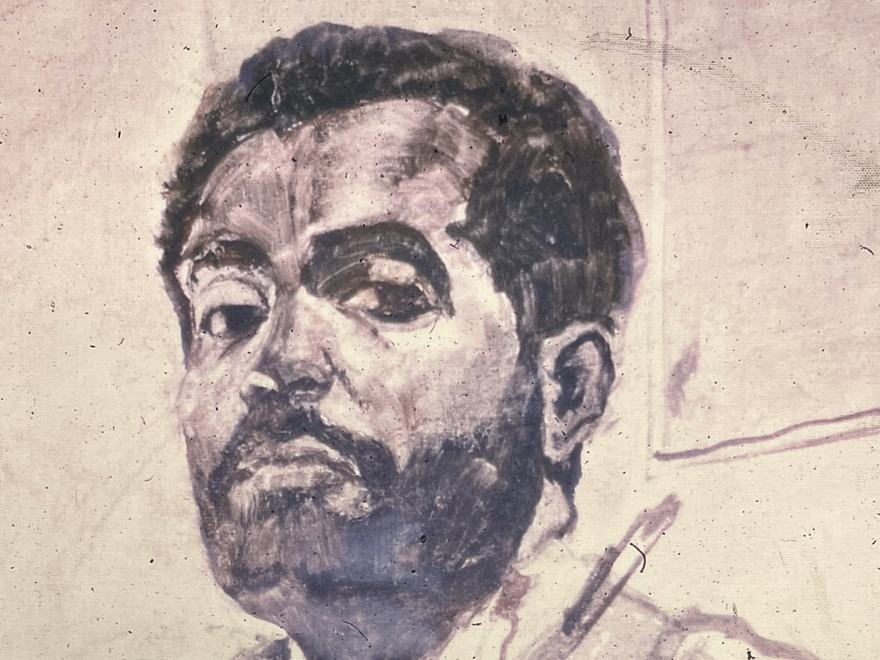
Tagelsir Ahmed, Self Portrait, 1960–1961, courtesy of Dr Fathi Osman.
Osman’s journey of discovery took him from Chicago, where Ahmed’s daughter now lives, to Jordan, where the artist spent the final two decades of his career teaching, and to France, where a Sudanese artist friend had preserved a cache of letters revealing new insights into Ahmed’s thinking and artistic philosophy. Osman's search finally led him to the Royal College of Art, where Ahmed studied between 1959 and 1962, and where the RCA’s Special Collections proved instrumental in reconstructing the artist’s early career. “What they're doing is really great,” says Osman. “Keeping samples of his work for more than sixty years is something really special, because even in Sudan, when I tried to find some of his old work from the ’70s and ’80s, it was in vain. I couldn’t find anything.”
Ahmed arrived in London at a pivotal moment in the city’s cultural life. The late 1950s and early 1960s were the years when British Pop Art was beginning to take shape and Ahmed studied at the College alongside figures such as David Hockney and Frank Bowling. Initially enrolled in graphic design, Ahmed soon transferred to printmaking, a shift encouraged by the department’s head, Richard Guyatt. According to the RCA archives, the move proved transformative: by the end of his course Ahmed had become, in Guyatt’s words, “the star of the department”.
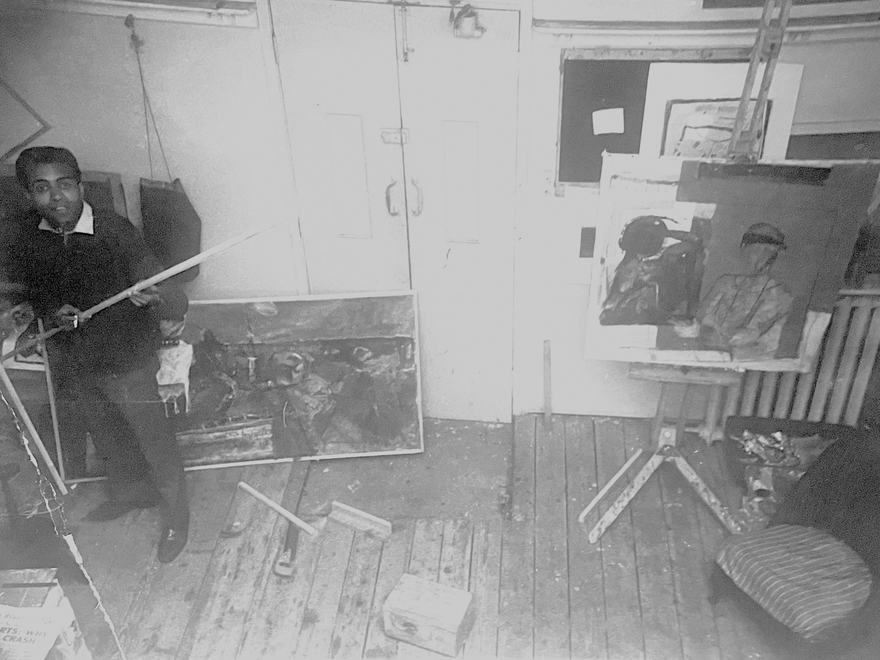
TS Ahmed in his studio
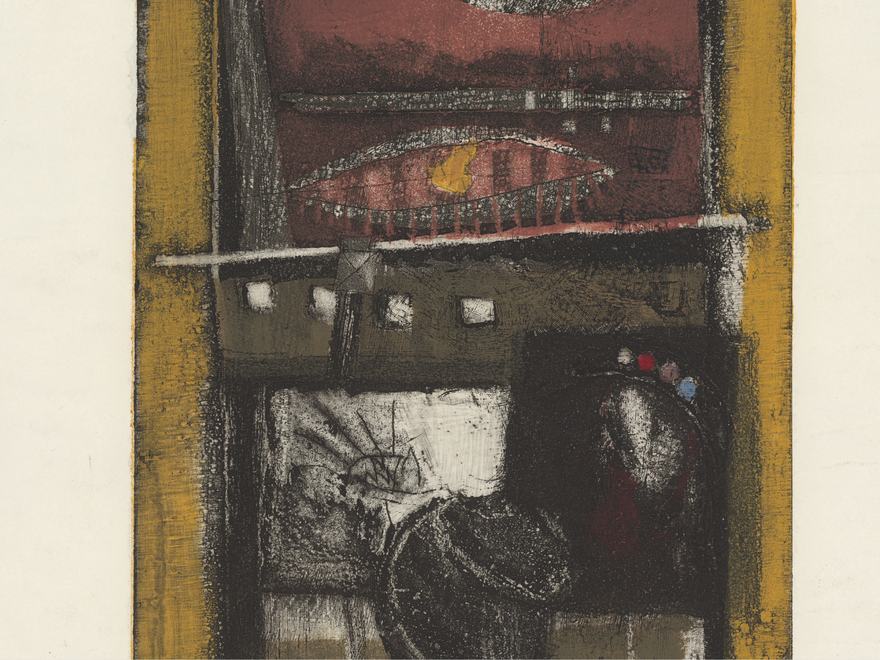
Tagelsir Ahmed, Interior at Earl's Court.
During his student years Ahmed exhibited widely in London, winning first and second prizes at Young Contemporaries (1961–62) and the Graven Image exhibition (1962). In 1963 he held a solo exhibition at the Thames Gallery in Windsor, and was praised by critics in both The Guardian and the Chelsea Post. The works he produced at the RCA already revealed the deeply personal nature of his artistic approach.
Ahmed’s practice was unusually introspective. Many of the prints and drawings he created in London depict the spaces he inhabited: the studio at the RCA, the apartment where he lived in Earl’s Court and intimate interior scenes from daily life. This inward-looking perspective would remain central to his work. “He preferred to work from memory because this is an intimate act,” Osman explains. “He depends on his own stories and his own life and his own experiences.”
Memory – particularly memories of Khartoum, where Ahmed grew up – also became a recurring source of inspiration throughout his career. While living abroad, he frequently depicted the landscapes and environments of Sudan. “He was very much attached to his country and to his city, Khartoum,” Osman says. “Memory was central in his work.”
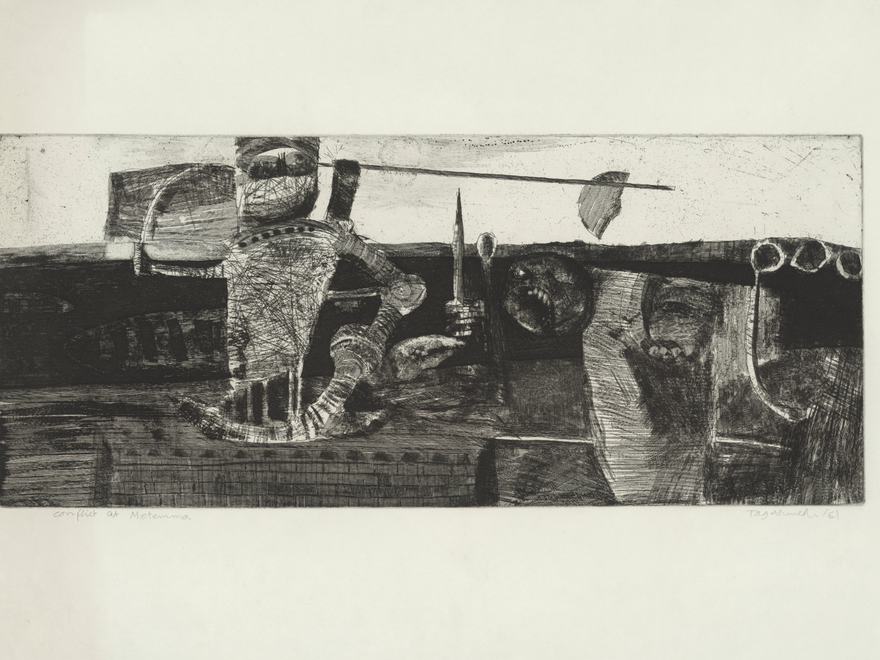
T S Ahmed Conflict at Metemma 1961 Lithograph on wove paper
This deeply personal focus distinguished Ahmed from many of his Sudanese contemporaries. The first generation of modern Sudanese artists – referred to as the country’s “artistic pioneers” – returned home after studying abroad with a desire to develop a national visual identity following Sudan’s independence in 1956. Their work often incorporated African, Islamic and Arabic motifs to reflect a shared cultural heritage.
Ahmed took a different path. “Tagelsir was against all that,” Osman says. “He thought that an artist should not look outside for inspiration but instead look within. The artist should not be a tool for expressing other things but someone who expresses his own ideas.” In one of his letters, Ahmed wrote that an artist could be placed anywhere in the world and still remain an artist; a belief that reflected his sense of creative independence.
Today, the RCA’s Special Collections holds one of the most significant groups of Ahmed’s early works. In total the archive contains 29 prints created during his time as a student, an unusually large number of works by a single alumnus. For the Almas Art Foundation exhibition, 15 of these prints were loaned, forming a central part of the show.
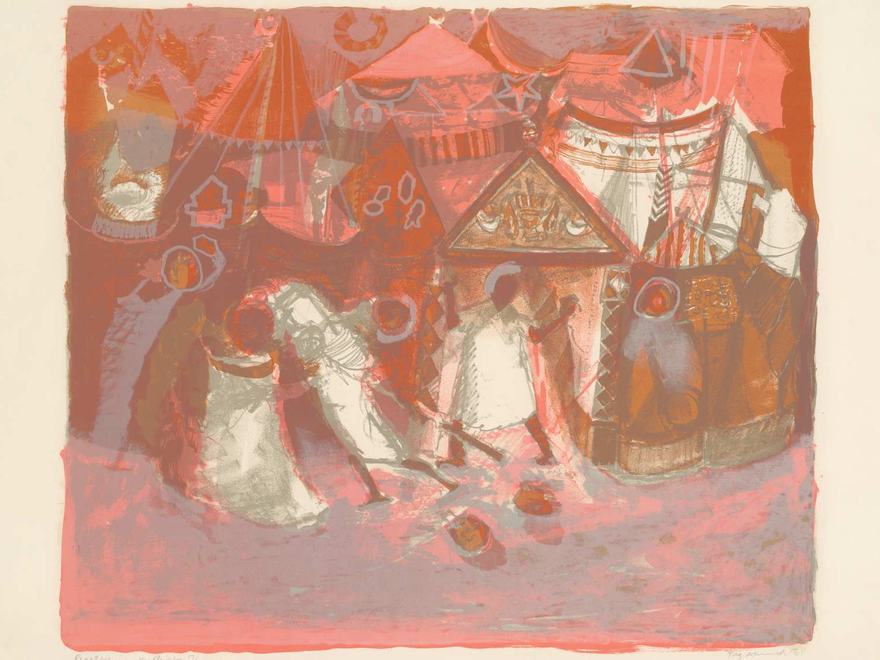
Tagelsir Ahmed, Revellers in conflict, Lithograph on wove paper.
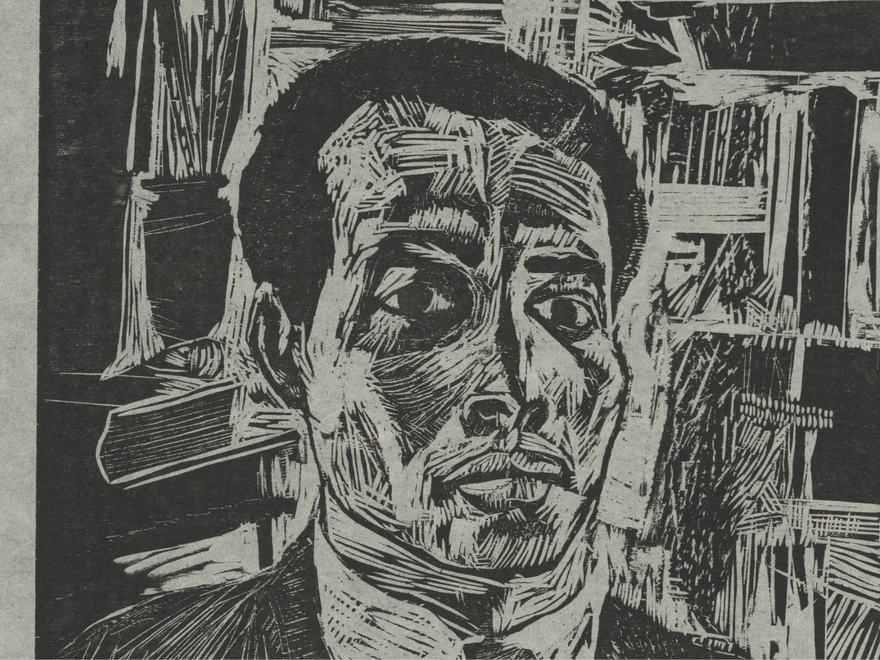
TS Ahmed Untitled 1962 Woodcut on laid paper 45 x 33 cm
“Our prints are much better appreciated on gallery walls than in drawers. So it’s a delight to see the works form such a crucial part of the current exhibition,” says Neil Parkinson, Head of Special Collections, who worked closely with Osman. “But it’s precisely because we kept them in drawers all these years and recorded them so carefully, that we were able to make them available for this research.”
The prints reveal the remarkable range of Ahmed’s early experimentation. “The prints he left behind are not only numerous but incredibly diverse in size, colour and subject,” Parkinson says. “We have interiors, abstracts and portraits, lithographs and etchings. What this reveals is Ahmed’s desire to try everything, to keep pushing his practice and to look ever deeper… You can feel the transition from illustration to self-expression taking hold during his RCA years.”
Despite his early promise in London, Ahmed’s international recognition faded after he chose to return to Sudan. He spent many years teaching in his home country, as well as Uganda, Kenya, Saudi Arabia and Jordan, continuing to paint and draw throughout his life while supporting himself through education. “Simply because he went away – first to Sudan and then to East Africa – nobody recognised his contribution,” Osman says. “Nobody noticed his importance as a modern artist in Africa or in the Arab world or globally.”
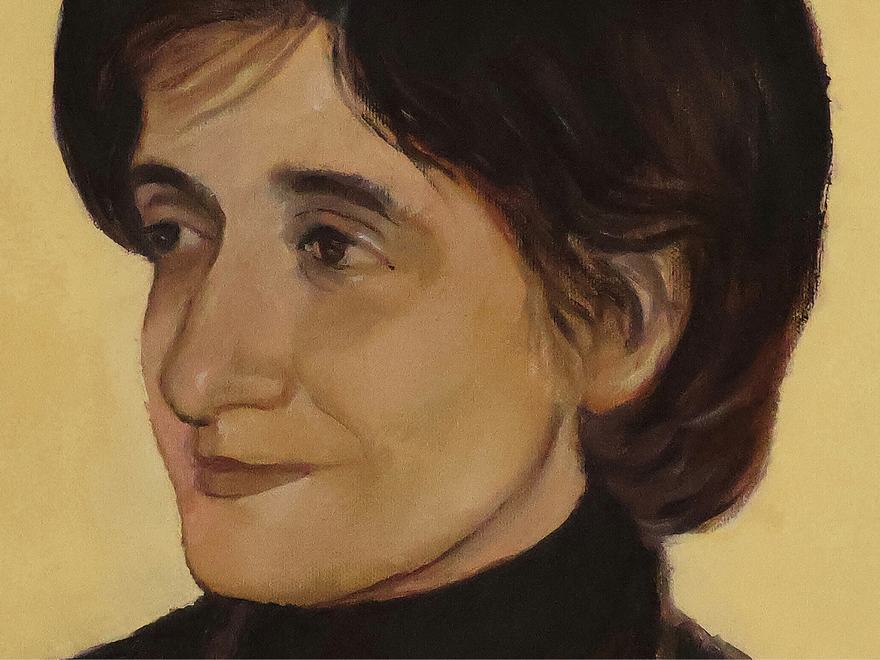
TS Ahmed, Portrait of Maha Kawar, 2010. Acrylic on canvas.
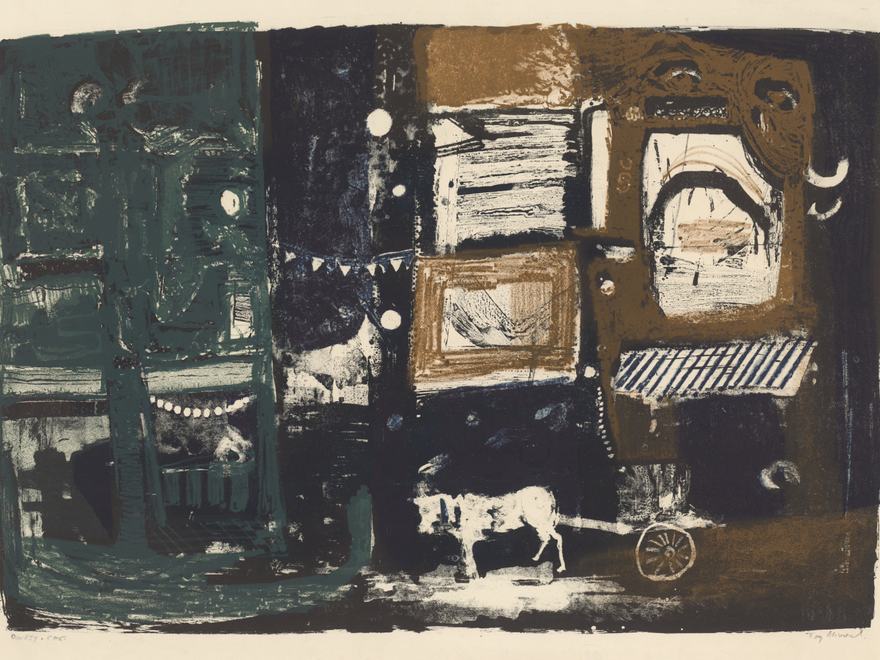
Lithograph on wove paper, T S Ahmed Coptic Fantasy, 1961.
For Osman, the rediscovery of Ahmed’s work is long overdue. “I think his work will always remain relevant,” he says. “He’s a genuine artist who expresses his own thoughts and feelings.” That sincerity, Osman believes, resonates particularly strongly with younger generations of Sudanese artists and members of the diaspora. “Many Sudanese today live abroad and feel detached from their country,” he explains. “Ahmed chose to live away as well, but he never left Sudan in his memory. The country was always with him and he created many works from that memory.”
Osman hopes the project will inspire further research into the overlooked histories of Sudanese artists who studied at the RCA during the 1960s and 1970s. “Working with Special Collections has been really inspiring,” he says. “It makes me think: why not explore the other Sudanese students who were at the Royal College during that period? It would be something of great importance for Sudan – and for the College as well.”
More than sixty years after Ahmed left the RCA, the works he created as a student are helping bring his story back into the light, revealing an artist whose nomadic life and deeply personal vision place him among the important voices of twentieth-century art.
KHARTOUM from MEMORY: The Life and Art of TS AHMED (1933–2015) is on display at Almas Art Foundation, London SE1, until 16 May 2026