Key details
Date
- 17 March 2026
Read time
- 12 minutes
Professor Stephen Boyd Davis reflects on supervision at the RCA and what helps doctoral researchers navigate complex research journeys.
As part of a new series exploring research supervision at the Royal College of Art, we speak with leading supervisors about the relationships, methods and ideas that shape doctoral research at the College. The series, Inside Supervision at the RCA: Conversations on research, risk and collaboration, offers insight into the often unseen work of supervision and the role it plays in guiding PhD students through complex, practice-led research journeys.
"Doctoral supervision at the Royal College of Art (RCA) plays a central role in supporting advanced research in art, design, architecture and creative practice. Supervisors work closely with doctoral candidates to guide the development of rigorous, original research while fostering independence, critical reflection, and interdisciplinary exploration," says Professor Hala Mansour, Head of Doctoral Programmes at the RCA. "Reflecting the strength of this approach, more than 90% of RCA doctoral students report that their supervisors have the skills and expertise needed to support their research, highlighting the importance of experienced doctoral supervision within RCA's research environment.
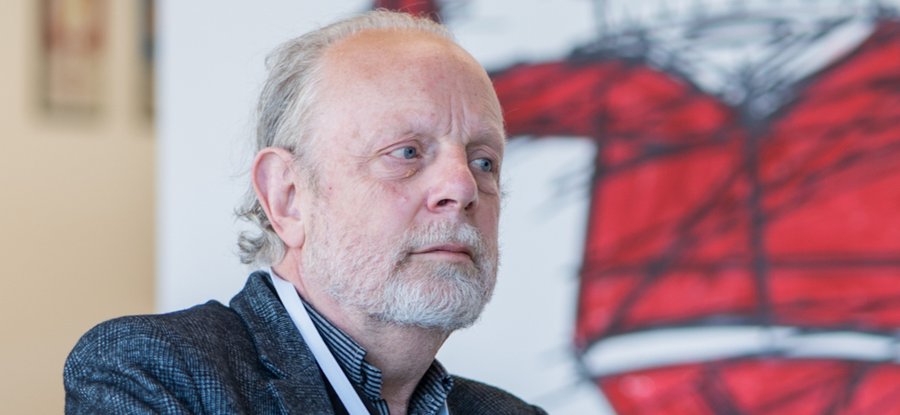
For the first conversation in the series, we speak with Professor Stephen Boyd Davis, Professor of Design Research in the School of Design. Having supervised doctoral researchers across several decades and contributed to the development of design research as a field, Boyd Davis reflects on the craft of supervision; from helping students refine ambitious research proposals to supporting them through the inevitable uncertainties of a PhD.
In this conversation, he discusses what distinguishes fruitful supervision from the merely functional, how doctoral research in art and design has evolved, and what future researchers may need most from their supervisors.

Work by Henrique Paris at the Research Biennale
Can you describe your role as a research supervisor, and what it involves practically day to day?
It’s very varied in two ways. One is that my role varies a lot from student to student. I currently have six PhD students, but I’m not the lead supervisor for all of them, only for some. The role of my expertise is very different in different cases. In some cases – either in the past or with current students – I know a lot about what they’re studying, you’ll be relieved to know. But in other cases I don’t, and it’s the other supervisor, whether or not they are the lead, or perhaps a less experienced supervisor who needs support and help, who will be the subject expert. My role there is simply to know more about PhD supervision and what a PhD should look like – and hopefully how to get one.
It also varies in terms of day-to-day work. Sometimes it’s the most obvious form of engagement: supervision, where I meet a student for perhaps an hour, preferably in person but sometimes over Zoom. I always try to do that with the other supervisor because otherwise students can easily get confused if they receive conflicting advice from two supervisors in separate sessions. So it’s really important that all three people meet together and thrash things out.
I also spend a lot of time reading the text students submit for their progress reviews and the final thesis. I probably devote more time to that than some other supervisors do – that’s the impression I’ve had from things students have said. Generally they’re grateful, although sometimes they feel they’re getting too much advice. But on balance it works out well, because you want the student to do the best possible job of representing the research they’ve done, and you don’t want them to let themselves down by making a bad job of writing about it.
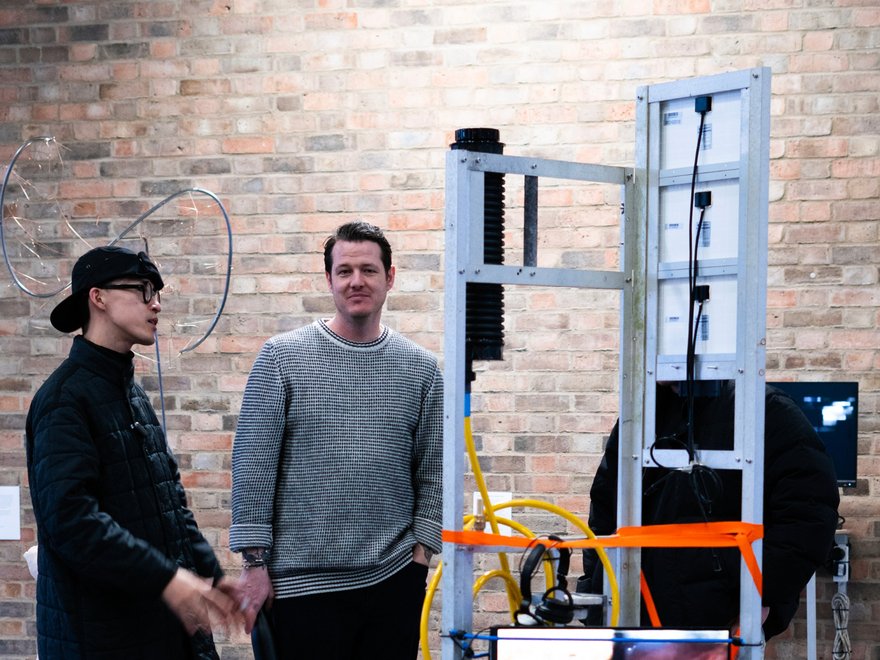
Daniel Durnin Research Biennale
That leads on to the next point around what distinguishes fruitful supervision, and supervision that's merely functional?
It’s really a passion to see the student grow and succeed. The Germans have an interesting way of thinking about PhD supervisors as being almost like the “parent” of the candidate, which sounds a bit odd, but it does capture something of the way you become very invested in wanting them to succeed. It’s a very close relationship. I’ve taught master’s students and even 17-year-olds, but with a PhD you naturally become more invested because it’s a one-to-one relationship rather than one-to-many.
Something that can be quite contentious is whether supervisors should take any interest in a candidate’s future employability. Some people think very emphatically that it’s not their concern. I must say I do care. I try to help students do the kind of PhD that will be useful for their future – that might be useful in a purely intellectual way, but it might also be useful in a practical way. One of the conversations I always have with a student at the beginning, even at the interview stage, is understanding why they want to do a PhD but also how it fits into their life. I don’t mind at all what the answer is – it might be intellectual curiosity, or it might be because they need one for a particular kind of job they want to get – but I feel I need to know, because it should shape the kind of supervision I give them.
Notoriously, you can actually make people less employable by giving them a PhD. They become overqualified and then can’t get a job in the field they aspire to enter, and I don’t want to be part of that provision of overqualified, underemployed PhD graduates.

Work by Varvara Keidan Shavrova at the Research Biennale
I'm sure you do your best to shape their inquiry early on, but can it be the case that things can go off-piste and take a wrong turn?
Yes, absolutely. I’ve had my fair share of failures. I once had three PhD students in succession who all chose to study something I’m a specialist in and specifically wanted to study with me. Two of them did extremely well, but one of them really crashed and burned. He had simply made the wrong choice in deciding to do a PhD. His partner at the time was also doing one – she completed hers while he was increasingly struggling with his – and they eventually split up.
It became quite serious. He started making excuses in supervision, saying things like his laptop had run out of battery and he’d forgotten the charger, which was why he couldn’t show me what he’d done. Eventually the truth came out. In the end he did get a job based on the year or so he had spent with us, and he’s fine now.
This shows how things can go in a very different direction from the one everyone intends, but that isn’t always negative; sometimes a student might begin thinking they’re doing a PhD for purely intellectual reasons and then discover there’s a very practical purpose they could put it to, or vice versa.
That must be a best-case scenario for a corner turn, I imagine.
I think a lot of PhD candidates go through a difficult period somewhere around the middle. Someone once described it to me as like swimming across a sea – you’ve lost sight of the coast you left, and you can’t yet see the coast you’re heading for. That’s an uncomfortable place to be. But as things start to fall into place, it usually gets dramatically better.
Sorry to continue the metaphor, but I presume that's where the supervisor comes in with that lifeboat and tries to give some anchoring or some structure…
Yes, exactly.
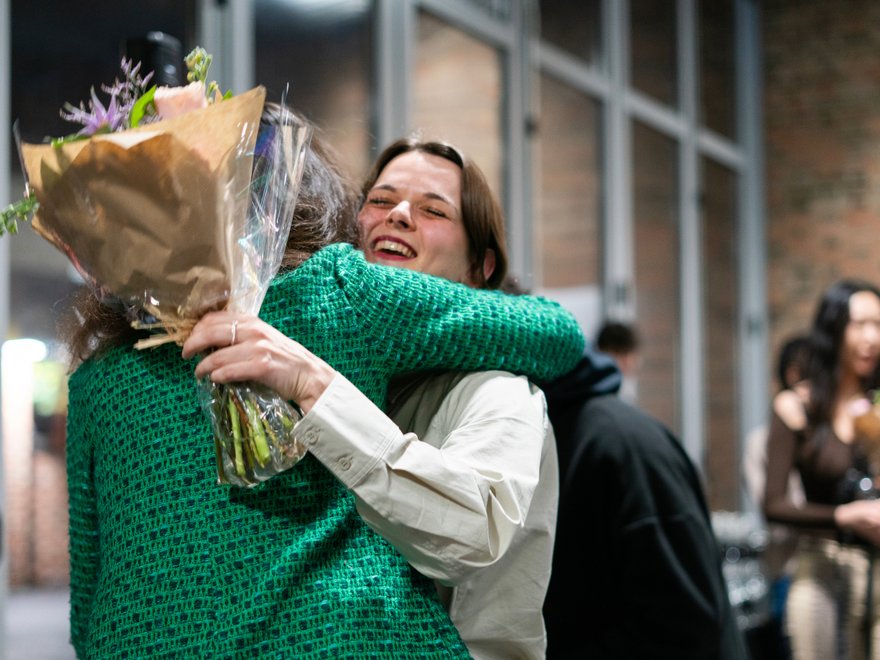
Celebrating at the Research Biennale
And what do you look for when deciding if you are the right fit for a research project, or indeed a researcher?
One of the first things I look for is whether the applicant has a clear rationale for why they want to do a PhD. Some people move from undergraduate to master’s and then think, ‘Obviously the next step is a PhD,’ without really asking themselves why. For me, it’s important that they know the reason, because that has a big influence on my willingness to supervise them.
Another important feature in a proposal is narrowness. Most PhD proposals are too wide and would realistically take six or ten PhD studentships to complete. That’s a very common problem and not necessarily a reason to reject someone. But if a candidate seems very offended by the suggestion that their proposal might need to be narrowed or reshaped, then I start to worry. A big part of my job is to help them focus it.
A metaphor I often use is to think of a PhD as T-shaped. The crossbar of the T represents surveying the field – understanding the subject area and the terrain you’re working in. But the vital part of the PhD, the thing that makes it a PhD rather than just a survey, is the downstroke of the T, where you probe one part of that terrain in real depth. Without that depth, it probably isn’t going to be a PhD.
You’ve held the supervisor role for a number of years, have you noticed any shifts or changes in the way that you do things, or indeed, what you're expected to do by the institutions you work for?
When I look back, it’s quite shocking how little training I had when I first started supervising PhDs – I should say not at the RCA, but at a previous university. That has improved dramatically since then. At the RCA, supervisors are encouraged to undertake refresher training as well as initial training, which is definitely a good thing because the field does change.
One of the areas that has become much more important is research methods. Art and design haven’t been research subjects for very long – in some respects the very idea of design research was developed at the RCA in the 1960s and 70s – so it’s not like the sciences, or even most humanities disciplines, which have long-established research traditions.
In the past there were supervisors, and even examiners, who didn’t fully understand research methods. That has changed a great deal. Now candidates are likely to encounter examiners who are very interested in the methods they’ve used – why they chose them, what alternatives they considered, and what political, cultural or intellectual assumptions those methods might carry. There’s much more emphasis on methods than there used to be.
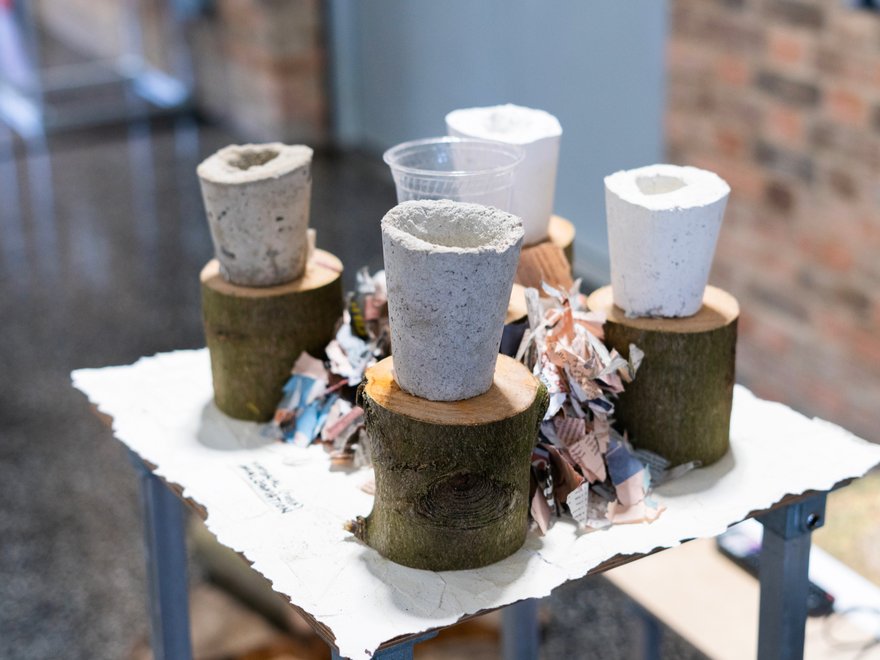
Work by Folashade Elizabeth Olukoya at the Research Biennale
That's really interesting. And with that in mind, what would you say makes studying a PhD at the RCA different to studying at another Art and Design College?
We have a long history at the RCA of encouraging and supervising PhDs that combine practice and theory. Having said that, I’ve actually been a little unusual in that some of my students have submitted by thesis only. But in many ways that’s a technicality – it doesn’t mean they haven’t done a lot of practice. They have. It’s just that the weight of the presented work has been on explaining the research through the thesis rather than presenting the practice itself.
The RCA has a huge amount of expertise in supporting that kind of hybrid work, and of course we have extraordinary technical resources for people who want to physically make things. There’s a remarkable range of knowledge and facilities that students can draw on.
And then there are the RCA’s networks. Students are able to meet and interact with an extraordinary range of people who can be valuable during the PhD and often very useful afterwards as well.
What have been some of your proudest moments as a supervisor, and what does a successful supervision relationship look like for you?
I think there are two different ways of answering that question. I once had three students in succession who wanted to work on a topic I was deeply involved in at the time. One of them, as I mentioned earlier, struggled and eventually dropped out, but the other two did incredibly well. They were very strong applicants – I remember one colleague on the admissions panel referring to one of them as having ‘two brains.’ They were exceptionally bright, working on something I was passionate about myself, and we even co-authored work together, which was a real pleasure. Both of them passed their vivas with no corrections at all.
But at the other extreme there’s what you might call the distance travelled. I’ve supervised students who began the PhD quite naïve and uncertain but grew into mature researchers and went on to satisfying careers. Seeing that development can be just as rewarding.
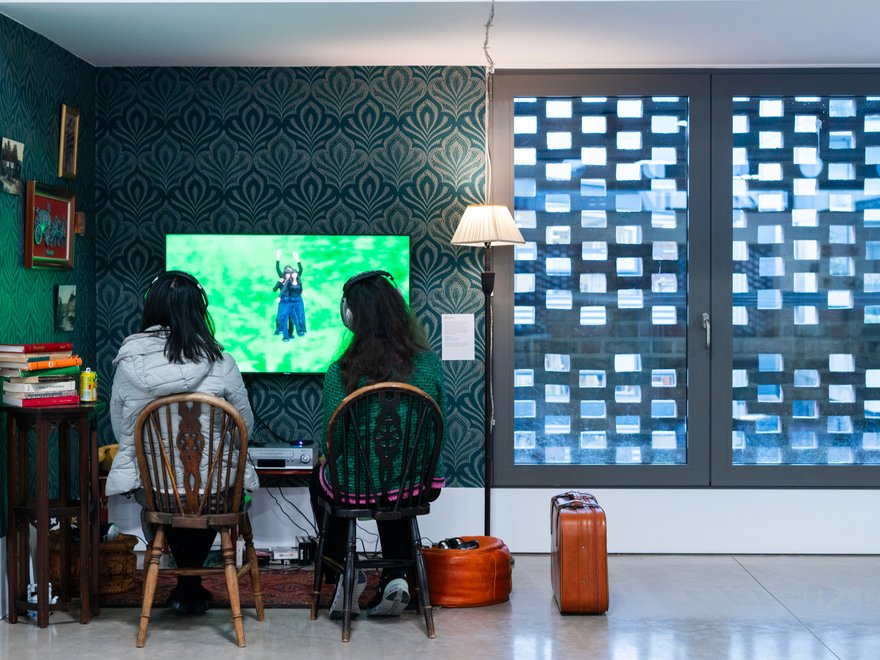
Work by Sohaila Baluch at Research Biennale
What was your relationship like with your supervisor during your PhD?
I was trying to do my PhD while working full-time, and I kept having to interrupt the work because I was being given other tasks that made it impossible to continue. In the end, I’m afraid it took me the maximum – from start date to finish it took ten years.
During that time my lead supervisor, who wasn’t young and wasn’t well, sadly died. But the most important thing he did for me was simply to be encouraging. Looking back, I don’t think he gave me as much practical advice as he might have – but that was partly because, at that time, there simply wasn’t the same level of experience in art and design research that there is now.
He was the person who first suggested that I should do a PhD, and he consistently offered moral support. Over time we became good friends, even though he was technically my boss as well as my supervisor.
I wanted to then look ahead: What do you think in the future doctoral researchers will need from their supervisors, especially an art and design institution like the RCA?
I think understanding and articulating research methods will only become more important in the future – both for staff and for the students they supervise. It’s important that students become genuinely literate in the range of methods available to them.
One of the problems we have – and this shows up in other contexts as well – is that many academics in art and design are still not very confident when it comes to articulating their research methods. People have been thinking and writing about research methods in art and design for decades now, so there is a great deal of expertise available, but many colleagues are still unaware of it.
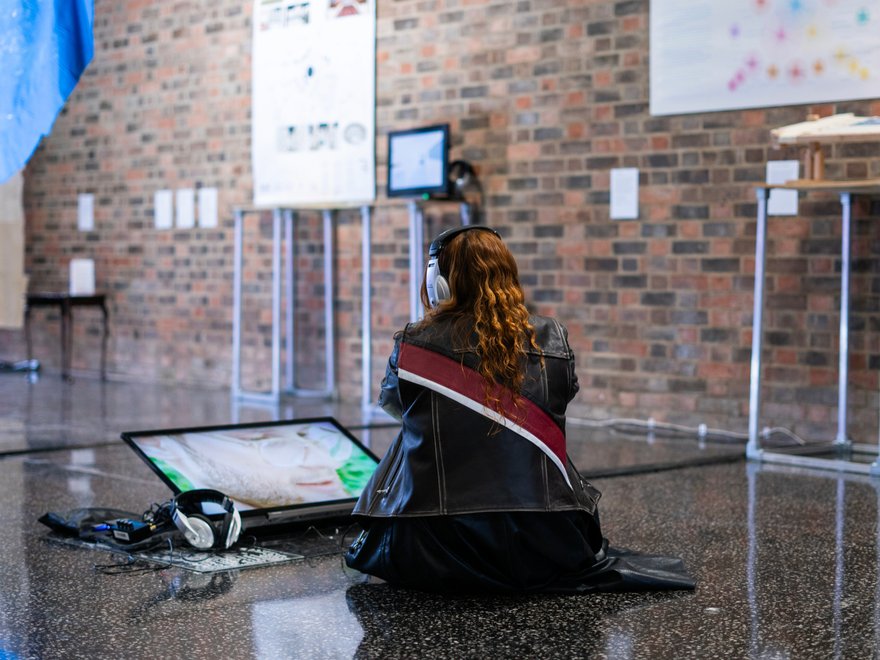
Work by Anju Kasturiraj at the Research Biennale
And how can that knowledge or understanding be improved?
In addition to the training and supervision offered centrally at the RCA, there are also ways within each school of sharing knowledge – research forums for staff, for example, and other mechanisms through which those who are less experienced can learn from colleagues with more expertise.
Something quite fundamental has changed at the RCA, and probably across art and design education in the UK more broadly. It used to be that practitioners would spend some of their time at the college passing on their knowledge to the next generation, with only a small number of full-time academic staff.
But art and design education has become much more professionalised; many of our newer staff – a significant proportion in the School of Design, for instance – are early career researchers, and most of them have PhDs. They spend the majority of their time researching and teaching, rather than practising in the traditional sense of designing and making things. In some ways that’s perhaps slightly regrettable, because it could lead to a detachment from materials and hands-on processes.
At the same time, the opposite argument can be made. The last thing we want is for each generation of staff simply to train students to produce more and more objects. That risks encouraging unnecessary consumption of the world’s resources. Increasingly, many of my colleagues are not designing products at all – they’re designing systems, experiences and ecologies, or leading research projects focused on issues like sustainability and climate. In that respect, it’s a very welcome shift.
But you suggested that can be a detachment from the industry that they hail from?
This is actually a debate that has been going on at the RCA since it began. I’ve done a little research into the College’s history, and when it was founded as the Government School of Design in the mid-19th century it was very much intended as a training school for what we would now call industrial designers. It emerged alongside institutions like the Royal Albert Hall and the Natural History Museum, as part of a broader moment of national investment in design and industry.
But over time it became the Royal College of Art, and with that came a shift. A significant number of people at the College became less interested in industry and more concerned with what they saw as the higher pursuits of the fine arts.
That tension between engagement with industry and a more autonomous artistic or intellectual approach has continued ever since. Government strategies, expectations about what universities are for, and the needs of industry have all pushed the balance back and forth over the years.
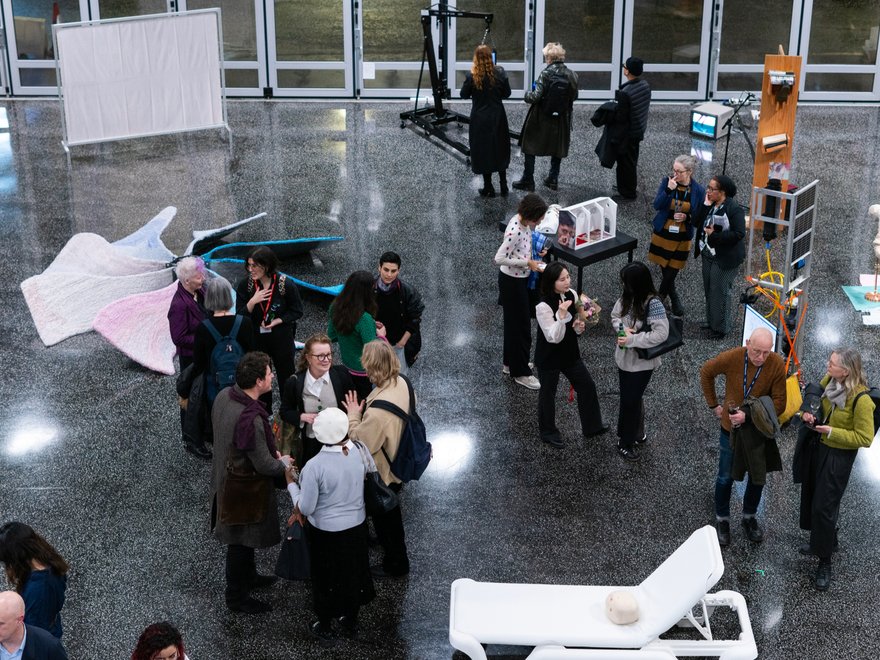
People gather at the Research Biennale
And I suppose this begs the question: why are students coming to study at the RCA? Is it primarily to go straight into a great job afterwards, or is it more about doing it for its own merit?
The question of how far we should listen to what industry says it wants – and shape students to fit those roles – is a highly contentious one. And I think the fact that there isn’t agreement about it is actually very healthy.
In some ways the RCA is quite an arrogant institution – it proudly accepts being called the world’s leading school of art and design each year. But that arrogance can have a positive side. It means we don’t see our role as simply listening to industry and producing exactly what it says it needs, because what industry asks for isn’t always what it should have.
I’ve worked quite a lot with the Intelligent Mobility Design Centre, and it’s a good example of this. If you listen closely to the automotive industry, its priorities are often very short-term and narrowly defined. But the work happening at the RCA is about the future of mobility – thinking five, ten or even fifty years ahead.
The last thing we want is simply to train people for the jobs that exist today, because those jobs might not even exist by the time our students graduate.