Key details
Date
- 1 July 2026
Author
- Lisa Pierre
Read time
- 19 minutes
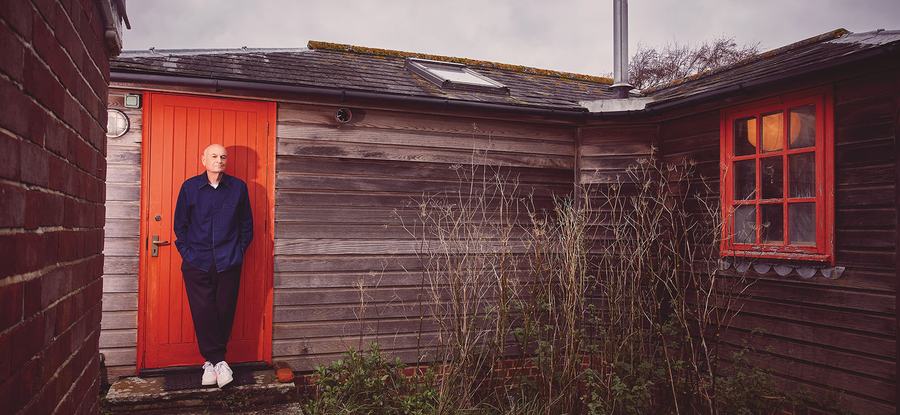
Ben Kelly (MA Architecture: Environmental Design, 1974) is one of the UK’s most influential designers and a Royal Designer for Industry (RDI). He has directed successful and innovative projects across the UK, Europe and Asia. He is best known for his interior design of the legendary nightclub, The Haçienda in Manchester.
His practice has produced influential work for 180 The Strand, Virgil Abloh, The Sex Pistols, The V&A, Vivienne Westwood and Malcolm McLaren, Factory Records, 4AD, The Science Museum, The Design Council, The Natural History Museum, Gymbox and BIMM.
Ben’s installation work has been commissioned by the Southbank Centre and the British Council and his work is held in the permanent collections of the V&A and the British Council. He has been extensively awarded for exhibition design, record cover design and interiors.
“I referred to The Haçienda as being the monkey on my back. It wouldn't go away, because that's what people thought that's all I ever did, which is certainly not the case. But I realised, eventually, that it actually was the biggest gift imaginable, and has led on to many, many things, and it did change my life, because of what it became, and because of the people involved.”
Interior Designer
Magazines had a huge influence on you when you were growing up, in them you saw a life you wanted to create. Do you think that led you to interior design? To create a world you wanted to be in?
That's true, because I grew up in a tiny village in North Yorkshire called Appletreewick. I always say twenty-seven houses, two pubs, and a church. We didn't have a TV. There were lots of ladies that lived in the village who were not from that part of the world. They were a bit more sophisticated and my mother was friendly with all of them and I would go around to their houses. I would see glossy magazines, like Vogue and Harpers & Queen. When I would look through them, I could see in a sense, this other world, this kind of glamorous world, whether these were adverts or features.
I saw interiors and I hadn’t seen anything like that at all and I think they resonated with me in some way. There was a lot of colour involved as well, I suppose they were a kind of a gateway, indirectly, as time went on. This was in the late 1950s, early 60s and Pop art was at its birth and you looked towards America and there was another world going on there and it was glamorous and exciting.
All I knew about were fields and trees and dry stone walls, sheep and cows, which was fine, but those two worlds kind of collided via those magazines. It was a positive thing for me. I have often wondered how or why it was that I ended up doing what I call interior design. I think that seeing those magazines at an early stage certainly had an influence. I knew that there was something going on in other places, and there was something to be discovered. As time goes on things unravel. One thing leads to another, and that's really all I need to say.
One of the ladies, one in particular, sort of became my mentor. She arrived in the village, looking like she's from another planet and she was sophisticated. I gravitated towards her. She played jazz, and she drank gin and tonic and wine. She had books on things that I'd never seen. As the years rolled on, she encouraged me and helped me, and she was a big influence. The outside world kind of crept into this insular village. They all had connections with a different world. The locals were mostly farmers and it was quite an insular world, but it was also amazing, becauseI I could run free, you know. It's like a kingdom. I thought it felt like a kingdom. I would go out in the morning, not come back until it got dark. Then this other outside world kind of crept in, and it was a layering of two communities. I suppose it's the relationship between an inner world and an outer world and the mixing and the blending of those two things.
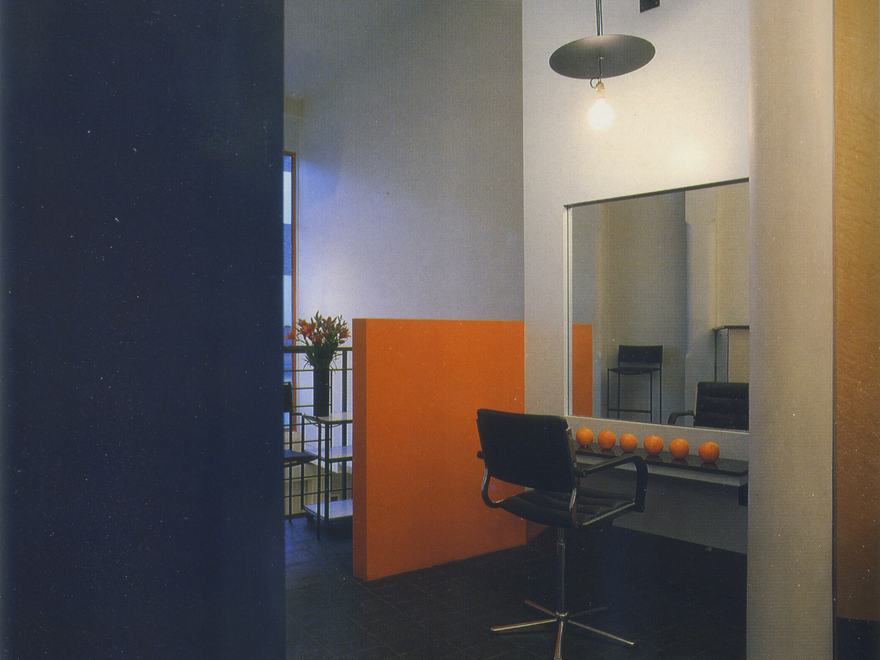
"Smile" hair salon by Ben Kelly
You have said that your life changed dramatically, and radically, when you came to the Royal College of Art. How so?
I was hopeless at school. I hated exams and didn't pass many, but I was interested in art. A friend of mine left school before me and he went off to somewhere called art school, and he came back and he said, it's absolutely fantastic. I was a teenager by this time. He said it's amazing, there's loads of girls, you can grow your hair long, you can wear anything you want and pretty much do anything you want. I thought, oh, this sounds pretty good. I had pressure from my mother, like, what the hell are you gonna do? I thought I could join the forestry commission. The teacher in the art department at school was pretty good, and I think he saw something in me. So I applied to go to art school, to Bradford Art School, because I'd heard of somebody called David Hockney, but I failed to get in there.
I wanted to be an artist, I wanted to do sculpture. But the thing called interior design kept appearing on the horizon, and my mother discovered there was a course at a college in Lancaster that did an interior design course. So I applied, and I was accepted provisionally that I got some more O-levels. I couldn't get a grant, so I had to go to night school and get some more O-levels, which I did. I got onto this interior design course having done a Foundation course, which is an amazing thing. That's the most amazing thing that could happen to anybody, and I think a Foundation course should be compulsory. It opens your horizons, you see all these extraordinary things, and covers a full range of disciplines. I started on this interior design course, I enjoyed it, and I was enthusiastic. The outside world was changing all the time. Another friend of mine who was at the art school, had gone off to somewhere called the Royal College of Art in London. There was a kind of glamorous thing to that, and a kind of magnetic draw. And I thought it would give me the opportunity to spend more time at college. I wanted to get to London, and this was almost like a stepping stone to be in London.
I was married very, very young and early, and we had a child, and I looked after the child for a year after I left Lancaster, because my wife then was at Teacher Training College. During that year, I worked to get my portfolio together to apply to the Royal College of Art. I was accepted to go for an interview. I had an interview for the course in the interior design department, with the head of that school, Sir Hugh Casson. I can remember sitting in this room, at the interview, and eventually he asked me this question: “Why do you want three more years of further education in the subject of interior design?” I said “because I want to see if it's possible to combine the disciplines of art, art practice and interior design. To see if you could produce what I called art interiors.” After I thought, oh god, did I say that? How embarrassing. Was it horrifically pretentious? I got accepted and we came to London, which is a big deal, you know, it really was a big deal. Having grown up in that village, having spent four years at Lancaster Art School. I think it was just at the right time, you know, 1971. It was very exciting at the time. The world was changing, things were happening very, very quickly. It was just an environment that I thrived in, I loved it, and it was truly amazing.
“The Royal College of Art is in London and it should be a hotbed of activity. I think as students, you can bring about change. You can have attitude, you need to have attitude, you need to break the rules and the commercialisation of everything, the branding of everything. Be awkward, be difficult, be independent, be annoying. Be strong, be bold, and be brave. And don't comply with the kind of regime of what you're told. You need to reinvent things. Make your own. Create your own. It's not just about the internet.”
Interior Designer
You took advantage of the fantastic opportunity of cross collaborative working at the College and used many of the other departments’ facilities. How did the use of these facilities enhance your learning and thought process?
When we came to London we got a student hostel. There was a crèche at the Royal College in Jay Mews, so I took the baby there everyday. It was like a hippie commune, it was fantastic and quite anarchic. In my first week, I wandered down the King's Road and found a shop called Let It Rock. It was run by two people called Malcolm McLaren and Vivienne Westwood. I became very interested in that place, and that led onto a relationship, and led on to all sorts of other things. My strap line at the moment is “one thing leads to another”, and it keeps happening. One thing did lead to another.
The Royal College felt like the Foundation course at Lancaster, where I was encouraged to investigate all the different disciplines, whether it was ceramics, photography or print. And learn. To get a sense of those skills. I very quickly made a friend in the department, and we went on this kind of mission to see if we could work in almost every department that the Royal College had to offer. We did a series of silkscreen prints based on an interior design project. I did a photography course. We got involved with the ceramics department. We did sets for the fashion students' end-of-year fashion shows. It was like a kind of big toy box in a sense. We took full advantage of it, and it was possible to do that. It was open and there were no boundaries and barriers. It seemed the obvious thing to do. I knew the tutors in other departments, there were many, many interesting people, for example, Eduardo Paolozzi was teaching in the ceramics department.
The Students' Union was quite strong at the time. Every Friday night there was a disco. People came from the outside, or from other colleges. You could form friendships and relationships with other people, and share things. We were excited together about what was going on in the outside world. David Bowie appeared on the scene, and doing what he did, Roxy Music appeared on the scene, and in fact, Roxy Music played a gig at the Royal College, which I was at. Eventually I developed this kind of other persona, kind of an alter ego, which became known as the Photo Kid, and that kind of grew out of the fact that I started going to Malcolm and Vivienne’s shop a lot when it was still Let It Rock, and getting clothing and things from that shop. Taking a step backwards and back to David Hockney, I knew he'd gone on to the Royal College, and I knew that he had peroxide-dyed blonde hair, and I knew that at his graduation, he wore a gold lamé suit. I built up this idea that all the students had peroxide blonde hair, and all wore gold lamé suits. I was really looking forward to that, and I walked into the canteen, and saw the most boring bunch of looking students I've ever seen in my life. I had quite long hair at the time, because that was the thing to do. I went home that night and got a pair of scissors out, and I kind of scalped myself and chopped my hair off, all of it.
So I was anxious and keen to become as much of an individual as possible, and stand out from the crowd and wanting to make a statement. Not for ego reasons, but, you know, this was the Royal College of Art, this was the kind of mecca, this was the kind of the beating heart of everything. Eventually, one day, I was sitting in the canteen and a whole crowd walked in through a pair of double doors. I thought, thank Christ for that. It was the fashion students, and they just looked amazing. Absolutely incredible. There were girls, they'd shaved their eyebrows off and they looked weird. It was exciting, challenging, and stimulating. So I thought, okay, it's not bad. I found my people.
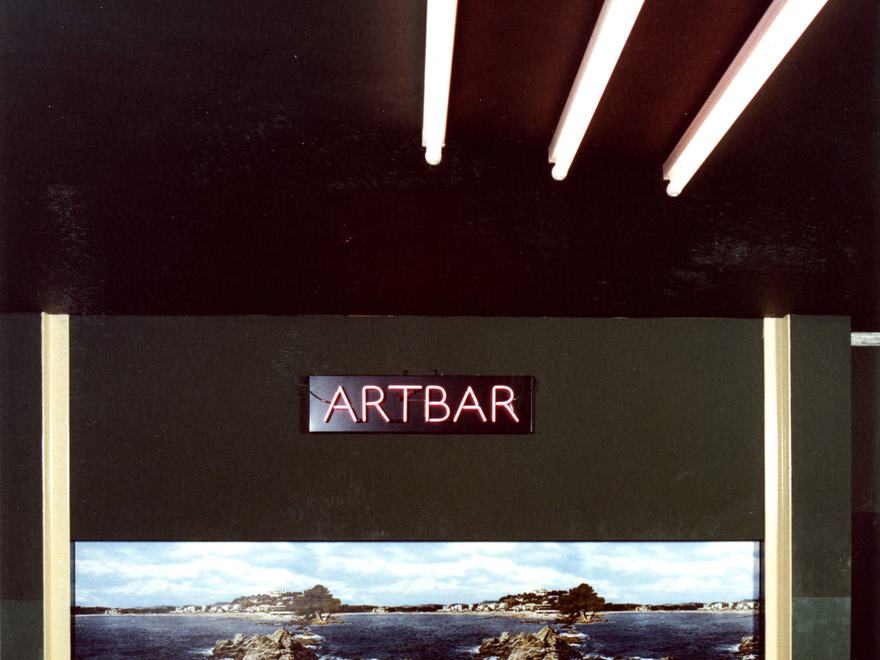
The ArtBar designed by Ben Kelly & Geoff Hollington
The art bar opened in 1973 with an inaugural design by you and Geoff Hollington. You named and created the distinctive neon sign. What did you envisage the space as, and why did you feel the college needed such a space?
I knew historically about the student bar before I got there, I think the students had been in earlier years, encouraged to design the look of the place themselves. I'd seen a book by Hugh Casson called Inscape: The Design of Interiors. I think there's an image in there of the bar. I honestly can't remember what the bar was like when I arrived there. But the Students' Union was quite a strong organisation at that time. And it had an independence about it, it made its own rules up and put on its own events, ran its own magazine. And it was really strong, and it had a kind of power as an organisation. The Students’ Union president became a friend of ours. And I honestly can't remember how it came about, but it was decided, or we decided, that we would redesign the interior of the bar.
And as a student doing interior design, it's kind of frustrating because it never gets off the paper. You can't build an interior as a student, you can't create one, but here was an opportunity to actually create an interior for real, that people were going to use and spend time in. We wanted a kind of holistic environment. So, a friend of ours designed the ashtrays, which were like ceramic still lifes. Quite beautiful things. My girlfriend at the time designed the outfits for the people working behind the bar. Somebody from a graphic design department did some graphics for it. So, you know, it became almost like a real project, a real job that you might be working on out there in the real world, with all the other disciplines involved. It had everything and an image, and was quite strong and bold. I suppose at the time we got interested in sort of industrial things, a bit of what became known as high tech. I would say that, you know, because of what was going on in the music world, and Roxy Music in particular, as a band, were incredibly influential, and they had such a strong look and a strong image. I think we wanted to create a kind of an interior that was sort of akin to Roxy Music's image. We painted the radiators pink, aluminium lampshades that look like something you might see in a photographer's studio, so we wanted a bit of glamour. It predated glam rock, in fact. It was a combination of a kind of a working men's club and a kind of glamorous disco. So, it was a hybrid.
I thought, it needs a bloody name, it has to have a name, and I thought, it's the ArtBar. So, we needed a neon sign, so we had a neon sign made. Whether it was pink or red, I can't remember, but that was actually placed above the bar. So, it had strength, it had an image, it was strong, it was bold and it stood out. We wanted to make a statement, and it did become a statement, and I've said this before many times, but it's true, it is one of my proudest moments that I named it the ArtBar and it's still called that today and that's just an amazing legacy. Students should be able to be free and loose and create things within the environment of the art school. It became a gathering place and every Friday night it was just amazing. Students came from all over London. It was just a great time. It was very stimulating, and people met people and kind of formed relationships, and probably went off and formed businesses, all different disciplines gathered together. So it was a place for sharing. The music at the time was important. The bands were important. What was going on in the scene was important.
“I have often wondered how or why it was that I ended up doing what I call interior design. I think that seeing those magazines at an early stage certainly had an influence. I knew that there was something going on in other places, and there was something to be discovered.”
Interior Designer
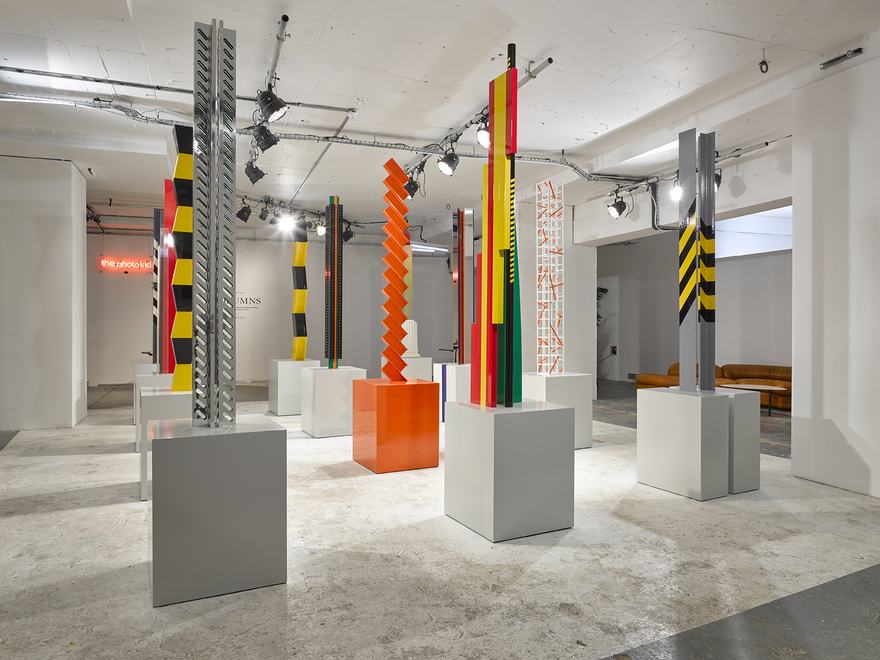
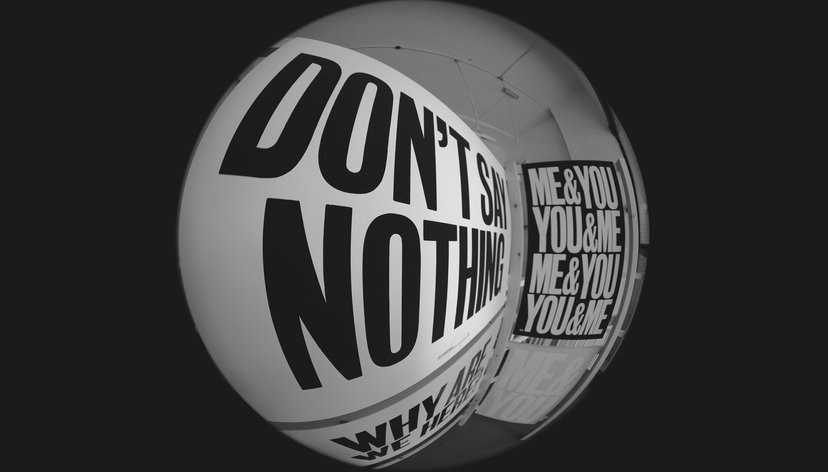
“COLUMNS” Exhibition by Ben Kelly at The Store X
What challenges do you think students face now trying to establish their practice?
Well, that is the hardest and most difficult question imaginable. It's not a very optimistic outlook. I think back to when I was graduating, anything was possible. You could rent premises cheaply, you could get a flat cheaply, you could afford to do things on little or no money. That is totally and utterly impossible now. I just wish them good luck. My message would be to be independent. But I know that is very, very difficult. Try everything, be creative. Be difficult. Be loud. Be bold.
My other mantra is related to what I call peripheral vision. I'm concerned that everything is screen-based, and our world is ruled by the digital world and that means that everybody is looking at their phones, always right what's in front of you. I think you need to know what's going on. Either side, to the left of you, to the right of you, or even what's going on behind you. You need to have a broad view on what is happening and what isn't happening, and not just focusing on what's in front of you, because you need to know what's going on all around you.
You have produced influential work for The Sex Pistols, Vivienne Westwood and Malcolm McLaren. You and your work are part of such a moment in history. Do you think we could see such a creative and influential epoch again?
I mean, the thing about Malcolm and Vivienne, it sort of happened by chance because I discovered the shop Let It Rock. It was an ever-changing scene and they were just amazing people. I ended up designing the Sex Pistols rehearsal rooms on Denmark Street. I ended up being on the riverboat when they played God Save the Queen. I ended up spending the night in Bow Street police station for knocking a policeman's helmet off. But that led on to all sorts of other things, and I think god, that word being independent comes back again. Everybody could be independent then, in lots of little ways.
Shops sprung up everywhere. The King's Road was an amazing street. Endless independent things going on. Punk happened. It shook the nation. But it also created a new community, angry and disaffected young people, but out of that, new bands came, and a whole new type of music appeared.
Punk was the spark that changed people's outlook on things and I think it was really important, it was necessary, it was creative. It appeared to have a kind of negativity about it, but I only see it in a positive way. The Royal College of Art is in London and it should be a hotbed of activity. I think as students, you can bring about change. You can have attitude, you need to have attitude, you need to break the rules and the commercialisation of everything, the branding of everything. Be awkward, be difficult, be independent, be annoying. Be strong, be bold, and be brave. And don't comply with the kind of regime of what you're told. You need to reinvent things. Make your own. Create your own. It's not just about the internet.
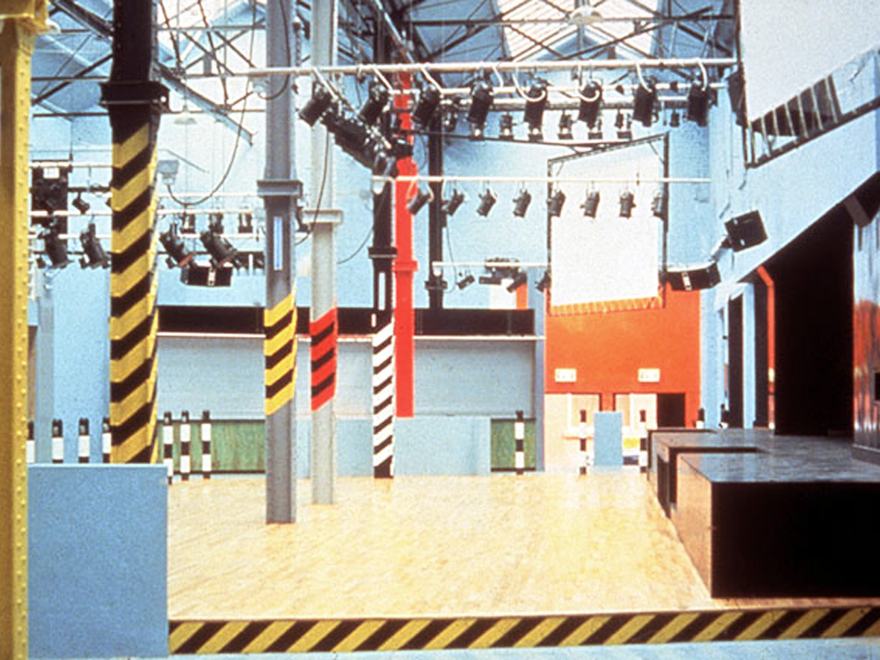
The Haçienda Nightclub in Manchester designed by Ben Kelly
Historic England has listed The Haçienda nightclub in Manchester as one of the 100 places that tell the story of England and its impact on the world. Do you feel that was a turning point for you in your career?
Well today, being the 21st of May, happens to be 44 years ago today of the opening night of The Haçienda Nightclub in Manchester on Whitworth Street West. So it's amazing, it is extraordinary that we are having this conversation on this very day. I remember it well and I may have to talk about it every day of my bloody life, one way or another, because I'm constantly bombarded by emails and questions and things from students, from journalists, from people all over the world.
My trajectory, started having met Malcolm and Vivienne, led on to being involved with Factory Records and Tony Wilson in Manchester. I was kind of a bit of a conduit between those two people. And was lucky enough and fortunate enough to engage with both of them. I felt they kind of helped to shape and change the world. You know, from little independent outlets, and we need more of that. I had this relationship with Peter Saville who designed all of the album covers for all of the bands on Factory Records. He and I collaborated on the records for a band called Orchestral Manoeuvres in the Dark, and Peter had told me that he had this idea, this concept, but didn't know what to do with his idea to make a record sleeve.
It was an album cover using the least amount of cardboard possible. A pretty random kind of thing and I suddenly thought, I know exactly what it should be, and I said, Peter, it should be a perforated sleeve. I told him to go down to Long Acre and look at the first client project I'd ever done, in 1976, a shop called Howie, a clothes shop in Covent Garden. I’d put some perforated steel panels behind the glass panels of the door into the shop and I said it should be a perforated panel. It won all sorts of awards. This led on to a relationship with Factory doing record sleeves.
But before that, as a student at the Royal College, I had to write a thesis in my final year. Which I did. And it was called Metal Lined Cubicles. The cover of that was a piece of mild steel, A4 with the letters etched out of the steel, saying, “Metal Lined Cubicles”, which was a line I borrowed from a William Burroughs book, I think, The Naked Lunch. Peter Saville saw that and asked if he could borrow it. Joy Division, the band (still existed before Ian Curtis tragically died by suicide) [their] single, Love Will Tear Us Apart, which is one of the most amazing pieces of music imaginable, and ended up with a record cover that was exactly the same as my Royal College cover for my thesis. When that single came out, tragically, Ian Curtis had died, and people thought it looked like a headstone, but it wasn't, it was the record sleeve.
These have all been stepping stones, from Malcolm and Vivienne, Peter Saville, Factory Records and Tony Wilson, New Order, Joy Division, The Haçienda. They all happened by chance and seizing the moment. Some of these things have kind of gone down in popular culture history and I was part of that. For several years, afterwards, I referred to The Haçienda as being the monkey on my back. It wouldn't go away, because that's what people thought that's all I ever did, which is certainly not the case. But I realised, eventually, that it actually was the biggest gift imaginable, and has led on to many, many things, and it did change my life, because of what it became, and because of the people involved.
“I've said this before many times, but it's true, it is one of my proudest moments that I named it the ArtBar and it's still called that today and that's just an amazing legacy.”
Interior Designer
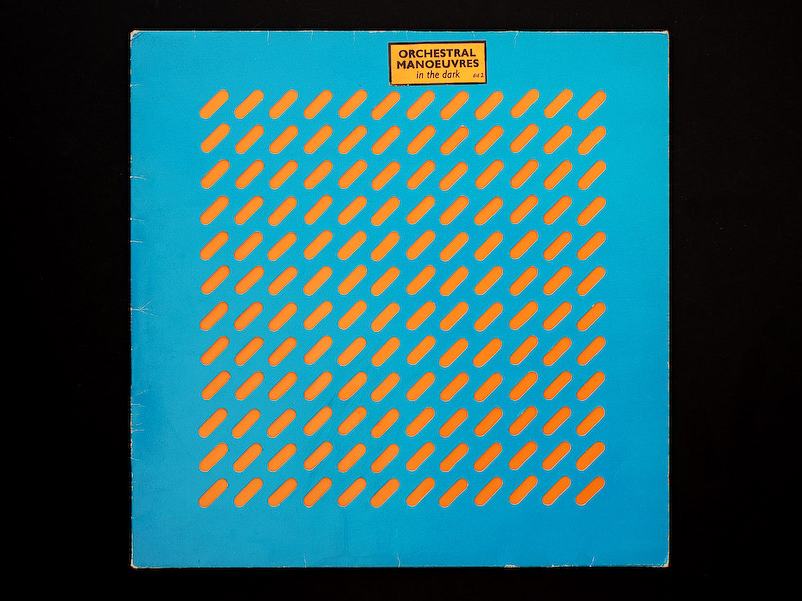
Orchestral Manoeuvres in the Dark album cover
The industrial aesthetic and striped lines of The Haçienda became a trademark for you. Did you see that as a positive thing?
Yes, of course! I'm still doing things using that, kind of, motif, whatever you want to call it. The stripes have been appropriated, and they've gone around the world. It's now within the design language. It's extraordinary, because I saw stepping onto the dance floor of the Haçienda as a hazard, so I put black and yellow stripes on it and that's the truth on how that came about.
My friend Anthony Burrill, who I know you know, introduced me to an amazing charity organisation called War Child. They have invited around 100 people to design a record sleeve for a 7-inch single. They give you a list of seven music tracks and you choose one of them. You do your own design for that particular track. They put them out together, there's an online auction and people can buy the artworks. They're going to exhibit them at 180 The Strand at the end of the auction, and coincidentally, I have a very strong relationship with 180 The Strand, because I've done lots of installations there. So on my single sleeve, you will see black and yellow stripes. But you’ve got to wait to know the single!
What differs in your practice when designing a physical space like a nightclub or a gym, to designing a physical object like an album cover?
In a sense, to me, it's all the same. I'm interested in the design process. It's all a creative process, and the language is across each other for a three-dimensional space or a two-dimensional thing.
A journalist wrote “Ben Kelly rescued the colour orange from the scrap heap of style” and you said you wanted it on your gravestone. How important is the use of colour to you? And how important is it in interior design?
Well, it's incredibly important. I think, you know, in the world of interior design, for example, or architecture, people are scared of colour in a way, and different colours that have stigmas attached to them, which is why, with the colour orange, which has kind of become a trademark for me, I designed a hairdressing salon around about the time of The Haçienda called Smile. It was a groovy, hip place at the time and I used the colour orange in there, and that's where that quote came from. “Ben Kelly rescued the colour orange from the scrap heap of style” and I just love it. I couldn't have dreamt a better thing for myself. There's a lot of psychology around colour, the things that go in and out of fashion. And I think, for me, with orange at that time, people are scared of it as a colour. It had been kind of fashionable in the 50s, I think, and a bit in the 60s, but it was untouchable, in the early 70s, and in the sort of work that I do, anyway. I think it's a very positive, optimistic colour. It's bold, it's strong, it's unafraid.
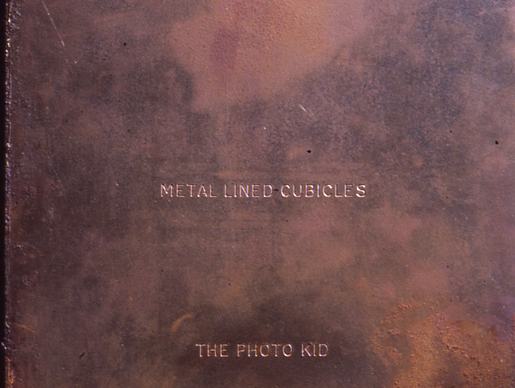
Metal Lined Cubicles - Final year thesis at the RCA by Ben Kelly
From stripes on walls to stripes on garments. Tell us about your collaboration with Virgil Abloh. Almost 35 years after the design of The Haçienda, the show Ruin included immersive artwork pulling together fragments of abandoned nightclubs, iconic discos and cut-ups of dance music history. Did it feel like a full circle moment for you?
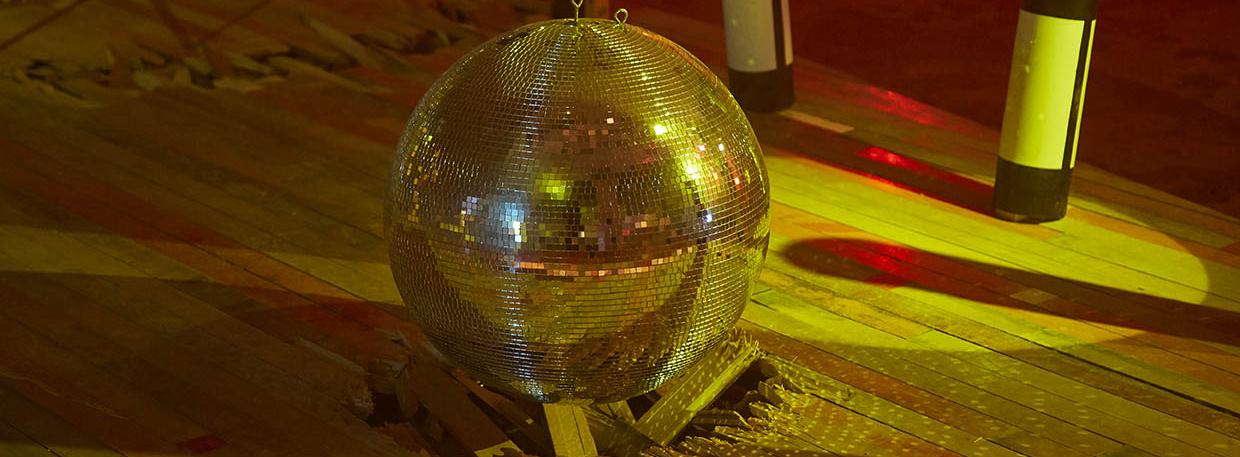
Years and years and years later The Haçienda nightclub led to a relationship with a man called Virgil Abloh. And the reason for that was because I'd painted stripes on the steel columns that supported the roof of The Haçienda that ended up being on the dance floor, and I saw them as hazards, so I thought, there's a health and safety risk here, so I painted coloured stripes on the columns, and there were hazard stripes on the step, up onto the dance floor, and this man called Virgil Abloh, was a student of architecture in Chicago, who was Kanye West's creative director, had seen images or pictures of The Haçienda, and had started a fashion label Off-White. And he sort of borrowed, or as Peter Saville uses the word, appropriated the stripes into this label called Off-White. Eventually that led on to a phone call with Virgil, because a fashion label was launching the Off-White label in London, and they put an event on, and Virgil asked if they could contact me, maybe I could design something, or build something for them for that opening night to launch the Off-White label, which I did. And that led onto endless things. We did a big installation at 180 The Strand. It was kind of a collaborative thing with Virgil and we called it ‘Ruin’. It was a big installation of a ruined nightclub. It was a huge thing, cost a lot of money, and it was as if a flood, or a fire, something awful had happened in a nightclub, and it was kind of a wreck. Things were still working and flickering, and it was cold, and there was mist in there. There were videos showing it was full of atmosphere, and it was kind of like a Roman ruin, you know, the mirrorball had fallen down and smashed through the dance floor and it was a kind of statement, I suppose.
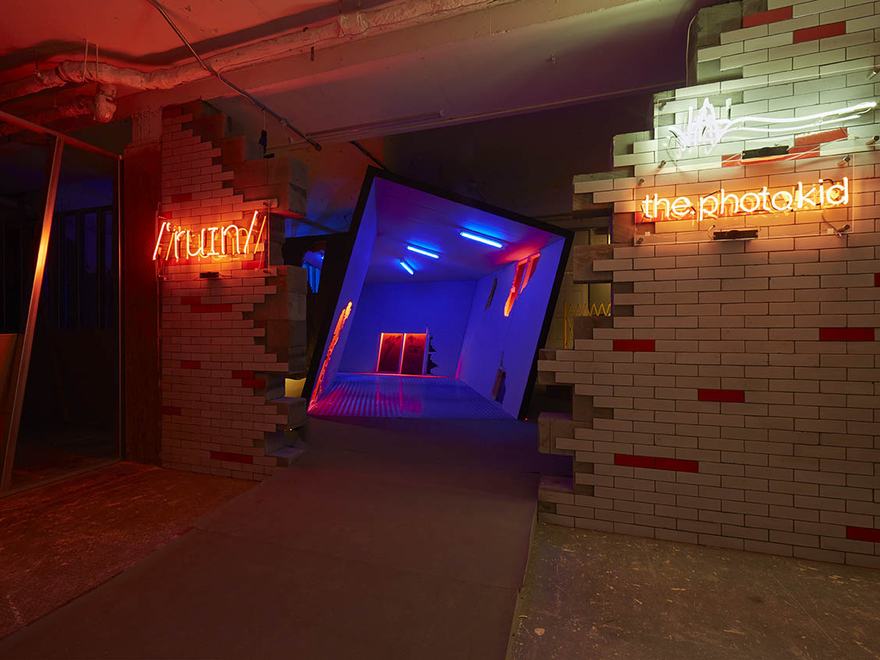
Ruin - Ben Kelly & Virgil Abloh