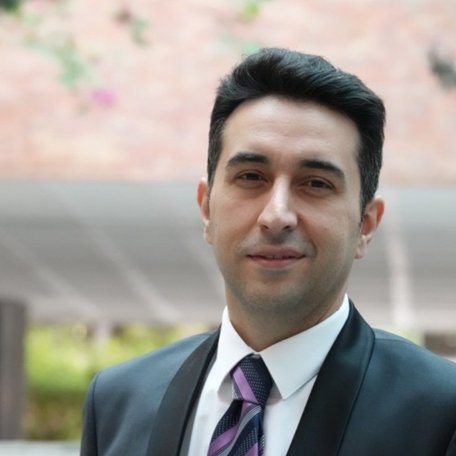
Dr Mohammad Kargar
- Postdoctoral Research Associate
Mohammad is an AI researcher and educator with +10 years experience in machine learning, optimisation, and applied control, developing intelligent systems for sustainability and human-centred design.
Dr Mohammad Kargar is a Postdoctoral Research Associate at the Computer Science Research Centre, Royal College of Art. His research bridges artificial intelligence and human-centred design, focusing on applied control and optimisation. Before joining the RCA, he served for over ten years as an Assistant Professor in Electrical and Electronic Engineering at IAUN University, where he taught and supervised research in control systems and intelligent automation. He has extensive experience in academia and industry, leading projects on energy optimisation, smart buildings, and human–robot interaction. Mohammad is a Fellow of the Higher Education Academy (FHEA) and has published widely in high-impact journals on control, robotics, and energy systems.
Key details
School, Centre or Area
More information
Research interests
Mohammad’s research lies at the intersection of artificial intelligence, optimisation, and sustainable design. He investigates how intelligent and interpretable AI systems can enhance decision-making, efficiency, and sustainability across both engineered and designed environments.
His recent work within the Circular AI project focuses on integrating Large Language Models (LLMs) to support sustainable product and material decisions. By developing a user-friendly platform, he aims to make environmental data, standards, and sustainability guidance more accessible to designers and creative practitioners.
Earlier, during his postdoctoral research at the Computer Science Research Centre (RCA), Mohammad contributed to the development of the Spatial AI Modelling Environment (SAIME), a VR-based platform that combines LLMs and Multi-Agent Reinforcement Learning (MARL) for spatial and robotic optimisation. This earlier work established the methodological foundation for his current research, which applies similar AI principles to sustainability and circular design challenges.
His broader goal is to bridge engineering precision and creative design thinking, enabling adaptive, data-driven, and human-centred AI systems that respond intelligently to environmental and social needs.
Research funding
- Future Leaders Fellowship (FLF) Proposal – UKRI/EPSRC (in development)
- Health Innovation Centre, Isfahan University of Medical Sciences – Principal Investigator (Assistive Robot for Parkinson’s Patients, 2019–2021)
- Niroo Trans Sepahan Company – Principal Investigator (Transformer Modelling for Loss Reduction, 2018)
- Isfahan Power Plant – Principal Investigator (Fuzzy Control for Boiler Combustion, 2017–2019)
- Isfahan Science and Technology Town (ISTT) – Principal Investigator (Smart Home System, 2015)
Current and recent projects
Circular AI (2025 – present)
An interdisciplinary project at the Royal College of Art that explores how AI can support sustainable product and material design. Mohammad’s work focuses on developing a conversational AI platform that makes data, environmental standards, and sustainability guidance more accessible to designers and creative practitioners.
Spatial AI Modelling Environment (SAIME) (2023–25)
– A VR-based platform developed at the Computer Science Research Centre (RCA) that integrates LLMs and Multi-Agent Reinforcement Learning (MARL) to transform textual descriptions into 3D spatial environments and optimise space utilisation and robotic movement. This research established the methodological foundation for Mohammad’s ongoing exploration of AI-assisted design and environmental optimisation.
Publications, exhibitions, other outcomes
Kargar, S.M., Yordanov, B., Harvey, C., & Asadipour, A. (2024). Emerging Trends in Realistic Robotic Simulations: A Comprehensive Systematic Literature Review. IEEE Access, 12, 12345 – 12358.
Kargar, S.M., Bahamin, M. (2025). Advanced Model Predictive Control Strategy for Thermal Management in Multi-Zone Buildings. Energy Exploration & Exploitation.
Talaei, F., & Kargar, S.M. (2023). Design and fabrication of a device for reducing hand tremor in Parkinson patients during eating. Journal of Medical Signals and Sensors, 13(1), 21–28.
Hosseini, B., Kargar, S.M., & Shojaei, K. (2025). Integrated Fault Identification and Fault-Tolerant Control for Network-Based Multi-Agent Systems. International Journal of Control, Automation, and Systems. Springer.
Babosalam, S., Kargar, S.M., Moazzami, M., & Zanjani, S.M. (2025). Occupancy-Aware Energy Optimisation in Building-to-Grid Systems Using Deep Neural Networks and MPC: Journal of Building Engineering.
External collaborations and activities
(2024) Collaborator, Hong Kong University of Science and Technology (HKUST)
(2025 – present) Hourly Paid Lecturer, University of West London (UWL) – Teaching undergraduate and postgraduate modules in artificial intelligence, programming, and computing mathematics
(2024) Reviewer, IEEE Transactions on Industrial Electronics; Neural Networks and Learning Systems
(2023 – present) Mentor, “Eats and Algorithms” RCA x SODEXO Studio Project
(2022) Secretary, National Electrical Engineering Conference (NEEC), Iran